Author Archives: Alex

A Look Back: My First Twitter 10

Friend and colleague Jeffrey Levy, in conversation the other day, said he went back to the beginning….of his days on Twitter that is, to see who he first started following. So, I did the same. It caused me to reflect on my own Twitter activity. Therefore, without further ado, my first Twitter 10: (take-aways listed afterwards)
1.    @misslacey123: Lacey is the one who got me on Twitter. We are both Mizzou J-School alums who have re-located to the great DC. She mentioned it one day as her and her colleagues at PBS were starting to explore it. At first, I was a little skeptical. But obviously, Twitter’s functionality grew on me!

2.    @bbravo: I’ve been a long-time fan of Britt’s Have Fun * Do Good blog and last fall joined in with her on the Changebloggers movement. So, I wasn’t too surprised to see that I started following Britt on Twitter from the get-go.

3.    @NetSquared: NetSquared is a great resource for all socially-inclined organizations as they are “remixing the Web for social change through social tools.”

4.    @osocio: This blog was the very first blog that I became a fan of and would read just about every day. Mark and his team do an excellent, excellent job at showcasing social advertising from around the world. Upon discovery of this blog, I talked about it all the time, showed it to my graduate classes, recruited others to check it out. And, this is back when Osocio went by Houtlust!

5.    @TechSoup: TechSoup is a leader when it comes to non-profits and Technology. They and its members are a wealth of resources. When I first joined Twitter, I wanted to connect with the non-profit community. Since then, its expanded into the social change community, which also umbrellas the non-profit community.

6.    @mikekujawski: I saw very early on that Mike was leading the way for social marketing amongst public sector organizations up in Canada and immediately admired his work and became inspired. This is because I could relate. He is a member of the “new wave” of social marketeers who are willing to go the distance for social good. Mike is one of the first, out of many, that I would continue to identify, encourage and admire.

7.    @elliotthoffman–Elliot is an acquaintance from way back in high school. We were both in one of my good friends weddings and we both happen to enjoy technology. Reminded me of take-away #4, to follow-up and reconnect with those you haven’t checked in with lately.

8.    @_FakeSteveJobs–Not quite sure what made me start following FakeSteveJobs, maybe I was hoping, along with others, that maybe, just maybe, it really was the RealSteveJobs. Having been outed and no updates since August 2007, I have now “unfollowed” this account.

9.    @cnnbrk–One of my best friends I made in grad school was a CNN fanatic. She knew any breaking story before the rest of us and in the midst of class would update us with important information. Then, she showed me her secret: CNN email alerts. Becoming quite the fan-atic myself, I found them on Twitter. Given its friendly banter with @aplusk earlier this year, @cnnbrk is continues to stay relevant.

10.  @penguinasana–Megan is the online community manager for TechSoup, so it was a natural decision to follow her given my interest in NetSquared and TechSoup. Admitedly though, I haven’t engaged in as much conversation as I’d like. So, Megan, if you’re listening, I look forward to connecting with you and the TechSoup team more. =)

*********

This exercise provided me with 4 key take-aways:

1.  Remind yourself. Make sure you go through who you are following and who is following you to remind  you of your friends, potential friends and fellow people who you might have things in common with. Notice I did not say, “Remind yourself of your audience.” Your followers should not be your audience, but more of an active hive that you leave and return to with information, resources, questions, and more.

2.  Double check your stream for active participants. Since some people sign up for Twitter and then never use it or use it just to “push out” information, your list might need a slight refresh.

3.  Evaluate your own use of Twitter. When you first started, you might have been more in an “experimental” phase or started for a different reason than why you currently use Twitter. Looking back at your intial follows/followers can provide some good reflective insight for thought.

4.  Follow-up with people and connect in conversation. At one point you connected. It could be a former colleague, friend or co-worker. If you haven’t chatted it up in a while, get those DM’s and @ replies to work. You never know what new projects they may be working on, new interests you may have in common or opportunities for collaboration that might develop. Plus, life is too short and time is too precious, especially in the social media space.

*********

What about you? Who were your first First Twitter 10? Did they surprise you? And better yet–do we happen to have any of the same ten in common?

flickr credit: holeymoon
Twitter Bios: Experts Versus Beer

What you say in your Twitter bio makes a difference. You get 160 characters to describe yourself, share an outlook on life or to define your work. If you’re curious what others say, you are not alone.

Through some fancy Google search queries, the folks at Twitter Truth were able to discover that the following words were mentioned in Twitter bios:

“Twitter” =14,300x 

SEO’ = 4,980x

Beer’ = 20,300x

‘Expert’ = 4,060x

‘Democrat’ = 311x

‘Republican’ = 872x

‘Liberal’ = 1,130x

‘Conservative’ = 2,280x

‘News’ = 49,100x

‘PR’ = 8,420x

‘New Media’ = 8,190x

Now, if you are a job seeker, over 1,000 people were identified as having the word “recruiter” in their bio. Now that might make ya go hmm…and in case you’re wondering who they are, I was hoping you’d ask: 1,000+ Recruiters on Twitter.

Expert Versus Beer

What I found interesting, was that over 4,000 tweeps use the word “expert” in their bio while over 20,000 tweeps use the word beer. So, the question I ask you is, would you rather hang with the expert or with the beer? 😉 That’s what I thought.

Some Twitter Bio Tips:

1. Be real.

2. Be you.

3. Tell us what you do, or

4. Tell us what you love.

5. Be funny, but not obnoxious.

More Resources:

5 Tips to Optimize Your Twitter Profile

Joel Heffner Offers 6 More Great Tips I’d Agree With

Why Your Twitter Bio is Important

Chad Norman’s Personal (Compelling) Case Study of Optimizing Bios

What others Twitter bio tips might you suggest?

Social Marketing Bulletin–List of Change, Local Public Health and More

It’s been awhile since the last Social Marketing Bulletin, but all the more reason to get on with the show. The Bulletin includes items that encompass social change, social marketing and social media:

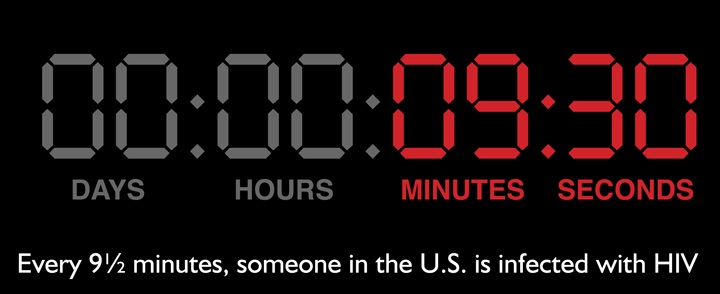
1. FEATURED: “I Know. I Took the Test.” I chose this initiative because it encompasses social change, social marketing and social media, as well as public health, non-profits, and government 2.0. What is it? The cross-collorative effort to recognize National HIV Testing Day on June 27th from AIDS.gov, the CDC, the White House’s Act Against AIDS campaign and other work by sister agencies including healthfinder.gov and womenshealth.gov. I’m excited to participate and observe this effort evolve as it is agencies walking the walk and reaching across agency lines to serve the people. (disclosure: I work with healthfinder.gov and am doing work to support this effort. However, I’d still feature it as I believe AIDS.gov is doing amazing work and blazing trails for fellow HHS agencies and public health!)

2.  SOCIAL CHANGE: Beth Kanter, Geoff Livingston and Shannon Whitley announced the launch of the “List of Change.” The list is a compilation of social change blogs and currently is over 75+. If yours isn’t added yet, feel free to join the rest of us changebloggers and help spread the word!

3.  PUBLIC HEALTH: Friend and colleague Andre Blackman recently posted an excellent interview/case study on how folks in Salt Lake City are utilizing social media for public health. Highlights include discussion on the YouTube video they created in-house with a flip camera, iMovie and a $0 budget, as well as their integrated approach.

4. GOVERNMENT 2.0: Related, I am part of the Program Committee for Tim O’Reilly’s Gov’t 2.0 Expo and Showcase in September. (This is a volunteer role.) At this event, anyone can submit a proposal to present. I am rallying anyone (especially public health agencies) at all levels of government to submit entries. I also know that the committee is looking forward to hearing from a more diverse collection of proposals from near and far, as well as more local and state agencies.

5.  GOVERNMENT 2.0: Sunlight Labs recently put together an in-depth evaluation and suggested re-design for the U.S. Supreme Court. Reading through the blog and studying the before-and-after designs, there are many take-aways in communicating online. Some themes I noticed were one: 1) Simplify. 2) Provide graphics and images to paint your story, and 3) Design, think and write from the consumer’s perspective, not the organization’s.

6.  SOCIAL MEDIA: A new Twitter study was announced from Pace University and Participatory Media Network. One conclusion from this study was that “Only 22% of 18-24 yr. olds are on Twitter.” Interestingly, another Twitter study from the Harvard Business Review came out which found that the Top 10% of Twitter users produce 90% of Twitter activity. Makes ya go hmmm…Still not sure what Twitter is? Just out Mashable’s Top 7 Twitter Tutorials on YouTube.

7.  EVENTS: Next week will be the “Games for Health” Conference on June 11 and 12 in Boston. I can’t attend, but will be sure to be following along on Twitter as my latest blog crush is the blog healthGAMERS. Other events coming up this summer include the Social Marketing in Public Health Conference later in June and CDC Health Marketing Conference in August. For more events, check out SB’s eventst page.

8. SOCIAL MARKETING: The number of “social marketeers” on Twitter continues to expand. Social marketing and behavior change folks and thought leaders I’ve identified include: @nedra (Nedra Weinreich), @chiefmaven (Craig Lefebvre), @sm1guru (Mike Newton-Ward), @stephendann (Stephen Dann), @ssuggs (Suzanne Suggs), @socMKT (Dr. Stephan Dahl), @socialmktgNW (McCann Erickson’s Social Marketing Shop), @jimgrizzell (Jim Grizzel), @mikekujawski (Mike Kujawski), and @JimMintz (Jim Mintz). Great to have more people joining us here!

9.  SOCIAL MARKETING: Worldways, a social marketing agency based in Colordo, is revving up with its new blog We Take Sides. Don’t you love that title? I think it’s great positioning because it places them as a leader, who isn’t scared about saying and doing what they believe in.

What did you catch this week in the world of social change, social marketing and social media that you think deserves a shout out?

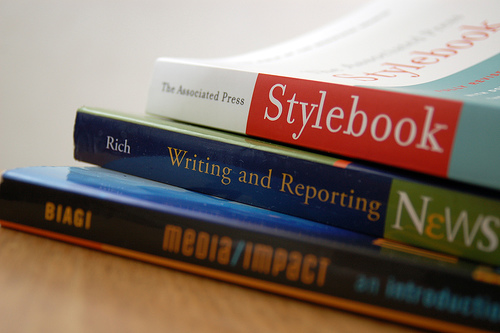
Dear May 2009 Graduate, Here’s 40 Reasons to Still Study Journalism

I am completely biased in this post because of my own studies in journalism. That said:

Newspapers are downsizing. Jobs are being cut. The journalism field is in the midst of a re-invention. Despite the landscape and view people may hold when they think of today’s journalism, enrollment in journalism school has INCREASED!

Recently on the Mizzou Mafia’s list serv (we do exist), an alum wrote about her frustration when a prospective freshman asked her about a career in journalism. She just felt like she couldn’t encourage the girl to go into a field that she felt was losing hope.

However, when my High School Senior, Class of 2009 cousin asked me about it the other weekend, I was thrilled. I still encourage perspective students and recent grads to continue in the field of journalism. To provide evidence as to why and to help spread hope in the journalism field, I write this letter:

********************

Dear May 2009 Graduate,

Here are 40 reasons to still study journalism:

  1. We need journalism. As a society, we need journalism to help us be the watchdog, to speak for the people, to highlight issues and areas that need addressed, to highlight people’s voices and to protect our freedoms.
  2. As a society, we need good journalism. We need journalism that knows its purpose and role in society. We need journalism to remember its roots, and as Walter William said in the Journalist’s Creed, we need journalism to act as a public service.
  3. We need good journalists. We need journalists who can be jugglers. Journalists who are multi-faceted, sharp, quick, curious, creative, inventive, profound and moving.
  4. We need journalism’s spirit. Imagine if more of this moved in our words, writing and work: Also from the Journalists Creed: Journalism…“seeks to give every man a chance and, as far as law and honest wage and recognition of human brotherhood can make it so, an equal chance; is profoundly patriotic while sincerely promoting international good will and cementing world-comradeship; is a journalism of humanity, of and for today’s world.”
  5. We need the next generation’s talent. You grew up with technology. You care about your friends and your communities. You aren’t afraid. We need you, your ideas, your voices, your tech-saavy minds, your perspective, and your willingness to adapt, change and evolve.
  6. Journalism teaches you to be a writer, and a good one. In just about any profession, you will be a writer at some point. Journalism teaches you how to write. And when you know how to write, people will value this talent and gift no matter what your title, job or industry.
  7. Journalism teaches you to be a talker, and a good one. Again, in any profession, you will be called upon to speak at some point. Journalism provides you a firm foundation to know what to say, how to say it and why you are saying it.
  8. Journalism teaches you to defend your stance, your writing and your character. When you write or talk, no matter if it’s in work, in relationships or through your passions, you will need to know why you do what you do and write what you write. You will also need to identify your limits and your “no-fly” zones/issues.
  9. Journalism teaches you ethics. You might be scoffing. But, in j-school, they really do teach ethics, and it’s fascinating. You are reporting and telling people’s stories. These are real people and real issues that your words and actions will affect. It is not something to take lightly.
  10. Journalism teaches you to learn on the fly. You will learn something new everyday. Some events you can’t prepare for and sometimes you must be an expert on a situation you just learned about 20 minutes ago. Get ready. (Thanks @brenda_haines for that one!)
  11. Journalism teaches you how to ask questions, including the tough ones. The field is right there with you, and it’s got your back because people want and need to know. You ask the question not just for yourself or your editor, but because you represent “the people.” This will come in handy because in life, sometimes, it’s easy not to ask the tough ones or to think someone else will do it. But, as a j-schooler, you will learn how to take the initiative and be confident in your curiosity.
  12. Journalism makes you look at situations, problems and issues from multiple perspectives. It gets you out of your comfort zone. Again, great lessons for life.
  13. Journalism teaches you to be a good networker. You have to build relationships with your sources and with those gateways to your sources. You also learn how to identify resources, another important aspect of networking.
  14. Journalism teaches you to be a good researcher. You must fact check, and fact check again. You are given an assignment and you must find out all the answers to all the questions your audience may have about your assignment so you can write the best write-up possible or capture the best video.
  15. Journalism teaches you confidence. To succeed, especially in broadcast journalism, you have to be confident in your research, words, and actions. It also helps you identify confidence in others, which is a good talent when fact checking sources, seeking talent, choosing a mentor, finding a love interest or when making a friend.
  16. The world becomes a smaller place. Journalism gives you the platform to meet a diverse amount of people, study diverse issues and if you want, even travel to diverse countries.
  17. Journalism clues you into newsworthiness. You learn how to be interesting, how to make conversation, how to potentially position a business or what to cover for a blog. Newsworthiness is a subject that I think all should take a class in. For example, can you define all the elements of newsworthiness? Here’s three to get you started: proximity, timeliness and prominence.
  18. There are cutting-edge and exciting projects developing. The New York Times just hired a Social Media Editor. People are curious if newspapers will become non-profits. Organizations are adopting journalistic principles into their work. It’s an exciting time to get started.
  19. You can explore your creativity. Writing, photography, art direction, videography, graphic design, Web production, etc. all utilize skills learned in journalism school.
  20. There are plenty of stories still needing to be told. @Boones6433 helped me with this one, and it’s true. So many rocks still left to uncover, in your community, state, nation and around the globe.
  21. It’s historic. You can say you were there. You get involved in history by helping to create and influence it.
  22. People in journalism are diverse, eclectic and interesting. Maybe I’m biased by the program I went to, but you meet people from all walks of life, varied experiences and a long span of passions. It’s inspiring and motivating.
  23. Gives you an excuse to talk to someone in the know. Doing an interesting piece on dairy recall in stores across the nation? This gives you a perfect reason to try and get in touch with someone at Baskin Robbins or the U.S. Department of Health and Human Services. Better yet, do graduate research on any topic you find interesting and find a way to interview people “in the know.”
  24. You grow broad shoulders. People will critique your work. If not an editor, then your readers. You learn to brave the wind, and it makes you a better person for it, even beyond the world of journalism.
  25. Make the right decision the first time. Enrollment of older adults in journalism is increasing. Some reasons are because of its appeal, the breadth of skills it teaches and the variety of doors it opens. Don’t not go to j-school because you are afraid nothing will come of it. Have a better reason for an alternative than fear.
  26. You can reach more people than ever. With the help of evolving technology, today’s stories have the capability to be heard around the world instantaneously.
  27. You can be you. According to Mark Glaser at PBS, Web technologies and blogs offer reporters the ability to “explain their conflicts of interest in greater detail, leading to more transparency. Plus, online writing tends to be more personal, giving reporters, editors and news anchors the chance to be more human and connect with their audience in deeper ways.”
  28. It’s easier to freelance. With blogging and others sites like Craigslist, E-Lance, iFreelance and others, jobs are literally right at your fingertips.
  29. There are internships galore that you can start doing now. Because of the economic crunch many journalism organizations are facing, the amount of internships have increased….everywhere. With some creativity and some luck, you can even make your own internship opportunity anywhere you want. Journalism can truly be an entrepreneurial field that you define and mold.
  30. There are top-notch universities with amazing learning labs. For some of the top ones, check out Missouri’s School of Journalism (my alma mater), Columbia, NYU, and Northwestern.
  31. Inside information is easier to attain. According to the Online Journalism Blog, “wikileaks and the like” have make it easier for people with sensitive information to bypass censorship, making information more available.
  32. It’s less costly to do. The Online Journalism Blog also notes how today’s journalists can conduct interviews over Skype or through email for free.
  33. You mom will be proud. You can have a moment of nano-fame when you first get “published” and the byline says your name. Keep it, frame it, dance around and call your mom. I admit I did exactly that.
  34. You will know how to mediate a conversation. The journalism profession teaches you how to keep conversation going person to person or within groups both small and large. This is helpful for work meetings, making small talk or even arguments amongst friends.
  35. You will learn how to multi-task. Your phone is ringing with a hot new lead. You have a deadline in a two hours. You still need to fact check. You need to follow-up to some emails and you have a meeting in ten minutes. Yay, like, I said earlier, jugglers.
  36. You can make a difference. Cliche? Maybe. But you can. Depending on your interests and passions, you can make a difference. I used to report for Adelante on Mid-Missouri’s Latino population. We made a difference as we were the only print voice for Latinos in all of Mid-Missouri by bringing attention to worker conditions, immigration issues and health conditions just to name a few.
  37. You will learn tangible skills. Studying journalism, you will be able to develop tangible skills. Not just writing, interviewing and researching, but also Web literacy, photoshop techniques, Flash, Studio 8, Videography, video editing, and many more.
  38. You can pursue graduate education. There are many top-notch graduate programs that can be leveraged to open new doors and opportunities. As I like to say, in journalism, you can own your education. Love the art of journalism, but interested in public health but also like to travel? Then, do a graduate fellowship or research project abroad covering community health. Like studying how technology affects communication? Then, create your own research study to measure an organization’s Diffusion of Innovation.
  39. It changes everyday. This is more true nowadays than ever before. The field is constantly evolving. Sure, stories may last longer, but being a journalists means different assignments, different interviews and different situations. You won’t be bored.
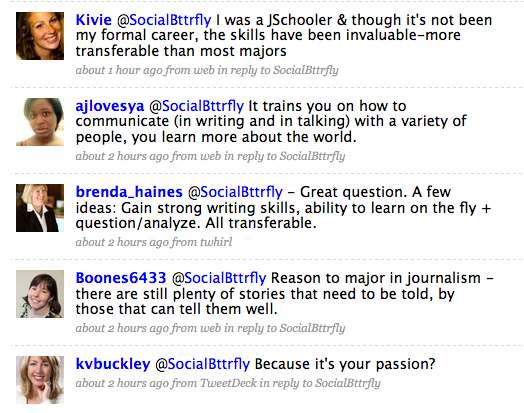
  40. Twitter tweeps agree that studying journalism is invaluable. Don’t believe me? Then ask these tweeps:

The goal is to get to 50. I’ve done the first 40. Going with the whole co-creation concept and knowing SB readers are smart and savvy, I figure you’ll have some reasons of your own to expand the list! =)

flickr credit: Jonathan Pobre

************ (from the comments):

#41: Headline writing is great practice in a social world. With only 140 characters on Twitter and the increasing need to be short, simple and to the point. @brenda_haines reminds us that headline writing is great practice for Twitter posting.

#42: MerAnda added–Being a reporter means your job will be cooler, or at least perceived as more interesting, than 95 percent of the kids you went to high school with. When someone asks what you do, they can’t help but want to know more when you say you’re a journalist.

#43: MerAnda added–Even if you don’t get rich (and you probably won’t), you will at least have some great stories to tell. What’s the craziest crash, destruction or natural disaster you’ve ever seen? What was the best performance or speech you’ve attended? Who’s the biggest celeb you’ve met? Most people have responses to these. You will be able to not only top most of them, but because you’ve been trained to notice and remember details, your story will be more vivid and interesting.

#44: MerAnda added–You’ll learn to find interest in subjects you’re not naturally interested in. That will make you a more well rounded person, not only in journalism but also in life.

#45: MerAnda added–Journalism can take you anywhere. There is no geographical limit to stories waiting to be told. And with the Internet and freelance opportunities, there are few limits on the outlets and methods in which those stories can be shared.

#46: MerAnda added–You don’t have to wonder if people read what you write. The proof is there in black and white. There are people responding to your stories, in letters to the editor or story chats or through blog posts or calls to you.

#47: MerAnda added–You don’t have to work 9 to 5. In fact, you probably won’t. (SB: I would also add that you won’t work 9 to 5. You will probably be on call around the clock and find yourself working at odd hours, especially the more technology evolves. This, at times, can create more flexibility, but also teaches you some mean time management skills.)

#48 MerAnda added–Strangers will recognize you, if not by sight, then by name. Your byline may be small and easy to skip over skimming the publication, but the people who care about the topic you cover, know who you are and are familiar with your work.

Social Change: Art or Science?

When explaining social media, I find myself, at times, explaining how it is half art and half science. Last week, marketing guru Seth Godin brought up the age-old question again in terms of the marketing field, stating that marketing is both. He explains:

“Some marketers are scientists. They test and measure. They do the math. They understand the impact of that spend in that market at that time with that message. They can understand the analytics and find the truth.”

“The other marketers are artists. They inspire and challenge and connect. These marketers are starting from scratch, creating movements, telling jokes and surprising people. Scientists aren’t good at that.”

A solution Godin gives is that we must wear hats, and be willing to switch hats. A mental image of my boss immediately flashed in my mind as he loves Harvard’s creativity tool “6 Thinking Hats.” There is a heap of value from this exercise that I too have become quite a fan, but that is a blog post for another day.

On the social marketing list serv, Godin’s post inspired a discussion on how this debate applies to social marketing. Though social marketing, is in many ways, the “science behind social change,” my favorite perspective came from thought leader and the mother of social marketing herself, Nancy Lee:

“Personally, I think we need the scientific approach for the situation analysis, determining desired behaviors, selecting priority audiences, and identifying the competition, barriers and motivators. Then, the artists uses this input to inspire the strategy. Then, the science comes back to measure outcomes and impact and what to do better the next time.”

Applying this to Godin’s “hat” analogy, Lee offers us insight, as social marketers, when to wear which hat. Brilliant.

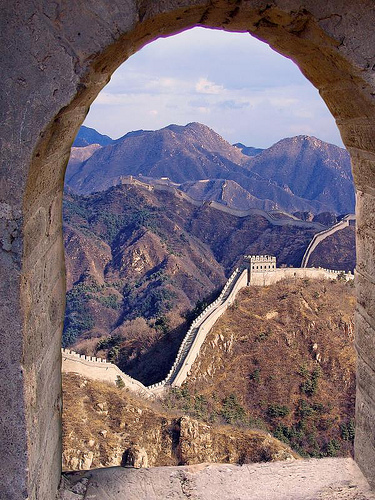
Applying this debate to social change, I believe it is both part art and part science, along with some sweat mixed in, buckets of perseverance, one strong vision, a diverse set of hands and a dash of luck. And, this is a good thing. Take architecture for example. There is no denying that there is a science to building strong foundation that support people, systems, and communities. But on the same note, there is no denying that certain places–the Sear Tower, Sydney’s Opera House, the Great Wall, the Eiffel Tower–emulate an artistic vision and ring a certain bell of inspiration upon viewing. It takes many, many types of hats at different times. The key, is knowing which hat and for what purpose.

Thus, to me, it’s not a question to debate, but a question that expands your closet (and your horizons!)

flickr credit: doc.holiday41

Do you consider yourself an activist?

There are certain people you get really excited about meeting. One of those people for me was Geoff Livingston. A couple of weeks ago, I finally got the chance to meet him in person. During our conversation, he referenced me as an activist.

This was another first for me. I know Geoff said it with love, but no one has ever called me that, and I found myself pondering: Do I consider myself an activist? So, I let it marinate. And I came to three conclusions:

1. I do consider myself an activist. But then comes the question, what am I advocating for? I feel the answer to this question will continue to morph, evolve, and develop with time. For the longest time and presently, I am an advocate for a cure to multiple sclerosis. I’m also an advocate for my family, for human rights, for literacy and for social good. It may be cliche, but the quote, “Stand for something, otherwise you stand for nothing.”

Well, when my name is called, I want to feel confident about where I’m standing and why. This blog helps document my approach to activism as it’s deeply rooted in the belief I have in the process of social marketing and behavior change.

2. Being considered an activist is a good thing. I consider it a badge of honor. I know the word “activist” itself carries with it many ideas and immediate connotations from a variety of people, which is all great and dandy. However, what I realized was more important, was what it meant to me. I started thinking of others that I would deem “activists.” Maybe I’m just a little too on the optimistic side, but I first thought of those like Susan B. Anthony, Martin Lurther King Jr., Nelson Mandella, and my family.

You see, I feel like I come from a lineage of activists so to speak. One, my grandfather of about five generations ago was a Cherokee Indian Chief. Another super great uncle was an abolitionist with John Brown and was actually hung with him as documented in the book Man on Fire. Though I know that one is a bit extreme, there was my great-grandpa Russel who was a teacher…A teacher who lost his job because he didn’t believe in the segregation of his classroom. To carry on the torch and encourage others to join,  well, to me, that’s a good thing.

3. This, inherently, implies action. The word itself carries the word “act” in it. Are there “activists” that you don’t agree with? Yes. Are there activists with bad intentions? Yes. Are there activites who use approaches you don’t agree with? Yes. But, then, if that’s the case, act on it. =) Being an activist is what you make of it.

Find your voice. Channel your purpose….and I think you’ll find that you will want to ACT on whatever you feel called or led to do more than ever. Are you with me?

(*I hesitated writing this post, because I thought the word “activist” might lend itself to be controversial. But then I thought, hey, SB readers are pretty smart folks. They’ll have some good insights to stretch me even further on this. I’m counting on it. In the meantime, thanks Geoff for the compliment!)

flickr credit: RockChalk Jayhawk, John Rover

Looking for a Job in Social Change? Look No Further

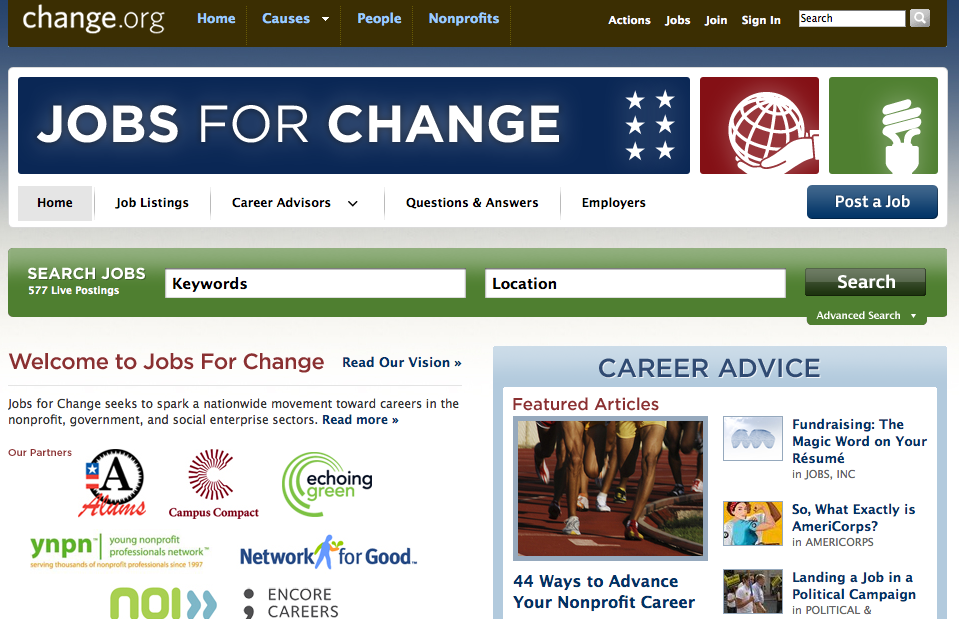
Change.org made a major announcement Thursday in response to Obama’s call for public service: Jobs for Change.  This is to be a hub and marketplace for social change jobs that they’ve created in partnership with dozens of nonprofits including: Young Nonprofit Professionals Network, AmeriCorps Alums, Echoing Green, Network for Good, and Encore Careers.


The goal: Spark a nationwide movement toward careers in the common good – including nonprofit, government, and social enterprise jobs. (Cross-Fertilization–> This makes me especially happy!)

Status: Currently, Change.org is building a huge database of social change jobs with their partners and have just hired a team of career advisors who will be blogging every day to provide guidance on finding and developing a career in social change, including Rosetta Thurman! (Mentors, resources and role-models….even better!)

Now What? Besides just checking it out and getting some good food for action, Change.org is also reaching out to like-minded bloggers and non-profit leaders to spread the word–specifically by signing a statement to endorse the vision. If you think this sounds pretty sweet….then join me (and @mikekujawski @engagejoe @mindofandre @bbravo and many others in signing.

Some Highlights of the Vision:

  • People are the most important factor in advancing social change.
  • To attract leaders, we need to enhance the social sector’s ability to recruit, develop, and retain talent.
  • Innovative businesses should join as partners with nonprofits and government in the pursuit of social good.

Thanks Change.org for providing an avenue for people to cultivate their passion with their purpose for effective, long-lasting and positive change.

(For the record, I currently have no relationship with Change.org other than being a member of their community…I jam ust that impressed with 1) their blogger outreach strategy anf 2) the actual product/vision behind this initiative.) =)

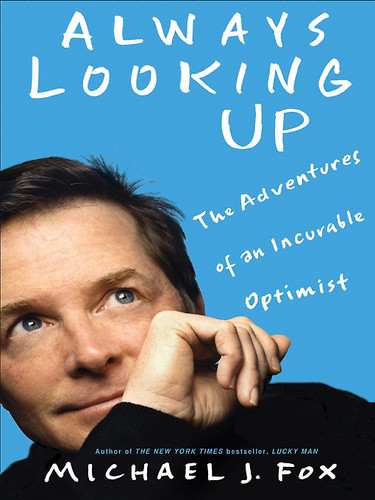
Lessons from the Incurable Optimist

I write this post purely out of inspiration gained from one Incurable Optimist–Michael J. Fox. I knew I chose him as my favorite actor when I was 8 years old for a reason.

During Michael J. Fox’s “Adventures of an Incurable Optimist,” I found myself live-tweeting inspirational quotes, thoughts and ideas from the show. As a gift for a job well done this week, I encourage you to check out the points below and remember 1) that hope is alive and 2) it is attainable.

**********

“As hard as things are right now, there is something happening with people…people reaching out and helping each other.”

“Maybe that’s where hope comes from. If I could do everything, I would have no reason to be thankful for hope.”

“I’ve discovered it’s not always about winning…it’s about accepting yourself” -MJFOX (Do we do this enough? Remember to celebrate.)

Did you know that the Bhutanese officially measure GNH: Gross National Happiness. It just makes sense when you think about it. They base this on the belief that a commonality of the human experience is to be happy.

“Optimism is contagious…Happiness is contagious. You can give it out in handing out newspapers.” -Michael J. Fox

Is there a link between optimism and creativity and the arts?

“For everything this disease has taken, something of greater value has been given…After everything with Parkinson’s, I’ve learned that what’s important is always making that one step count.”

**********

httpv://www.youtube.com/watch?v=sKk8Wyap7sE

“Optimists are open to alternatives in the face of adversity.”

So I ask you: Do you consider yourself to be an optimist? I think if we can attain just an ounce of the optimism, joy and connected-ness that I witness in Michael J. Fox, my mom, my friends, the dear elderly man in my building who smiles and loves the moment in a simple hello….then I think we’ll all be okay.

flickr:  Shanissinha

BloggersUnite.org Drives Earth Day Buzz

Can you swallow this math?

According to Copywrite, Ink, there were 88,000 blog posts on Earth Day (April 22) that were added to the already existing 2 million written earlier in the week. What’s even more amazing? …About 10% of all those blog posts, came from bloggers on BloggersUnite.org.

In all transparency, I’m a participating members in both the BloggersUnite and BlogCatalog communities, and we worked on a project together in the past, but dang—they deserve a big pat on the back for accomplishing their exact mission, harnessing the power of the blogosphere.

As mentioned on the BloggersUnite Earth Day event page, Earth Day 2009 was held April 22nd and also marked the beginning The Green Generation Campaign, a two-year campaign that will culminate with the 40th Anniversary of Earth Day in 2010.

More Green Goodness

  • In honor of Earth Day, Colleague Mike Newton-Ward and fellow social marketer wrote a post on applying a social marketing approach to the environment and other green goodies that I highly recommend checking out. Bonus: He provides a slideshare presentation that outlines this even more! (But like a good blogging friend, I’m going to make you go to his post to access it. It’s worth it.)
  • Looking for ways to take action? Check out EPA’s “Pick 5” campaign to identify five ways you can start today to make a difference for our earth. Twitter tag: #p5e

One More Thought

So I say again, great job Tony, Rich and the whole BloggersUnite team–and count this posting just one more for the record book! And I ask you, the SB reader, how have you seen blogging communities drive awareness, change and/or action? I have some of my own ideas, but I’m more into hearing yours. =)