Making Behavior Fun, Popular and Easy

If you know social marketing extraordinaire Nancy Lee, then you have heard this saying. Recently, on the social marketing listserv, some dialogue has been shared in response to Nancy Lee and Philip Kotler’s article in Stanford’s Innovation Review titled “Best of Breed,” which looks at corporate social marketing. This could be its own post, but alas, I want to focus on the message of being fun, popular and easy.

Why? Because whether it’s social marketing or corporate social marketing, you are still working to effectively change or influence behavior for good–and an effective way to do so is making your desired behavior fun, popular and easy–which is exactly what started bubbling through on the social marketing list serv as others started sharing some of their favorite fun, popular and easy social marketing initiatives. Enjoy–and when you find yourself running around ragged, ask yourself: Is anyone having fun? Is this easy for people? and go from there.

The Piano Staircase

To encourage passerbyers to take the stairs rather then the escalator (and thus promote physical activity), this group turned the stairs into a piano–whenever you stepped on a stair a different sound would echo–in effect, making taking stairs more exciting than an everyday escalator. I can’t find the source, but it apparently had a 60% success rate. Who’s behind it? Volkswagon. Apparently, Volkswagon has been trying out some experimental marketing based around “The Fun Theory” to see if they could create desired behaviors if the action was made fun. You can read more about the piano staircase and other initiatives such as the recycling arcade and more at TheFunTheory.com.

httpv://www.youtube.com/watch?v=2lXh2n0aPyw

The Pink Glove Dance

You may have seen this one already, as it’s been circling the blogosphere for a while. But, it’s an example of everyday people–hospital employees–finding a way to make their job fun while communicating a message–that you aren’t alone when taking steps to prevent breast cancer, like getting a mammogram.

httpv://www.youtube.com/watch?v=OEdVfyt-mLw

Musical Hand Sanitizer

Aas part of Volkswagon’s initiative, they are hosting an awards program on the best “fun” applications for healthy and good behaviors. One entry was a University who had installed hand sanitizers to prevent the spread of germs during the flu season. They found few students using them. Thus, they adopted the fun theory and installed some sounds. Each time someone went for hand sanitizer, a funny noise was created. Results? With the sounds included, students were seven times more likely to use the germ-reducing resource.

httpv://www.youtube.com/watch?v=p9nCRJo73oI&feature=player_embedded
Pedestrian TV Traffic Light

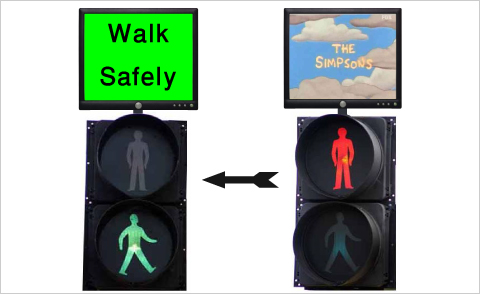
In this example, you get some free entertainment while waiting to cross the street. Instead of staring at a red outline of a person wishing it to change with your desired mind control, this traffic light shows TV clips–vidoes from YouTube, funny clips from TV shows, etc. This way, the hope is that you’ll actually wait until it’s safe to cross the street.

Make Your Watermark
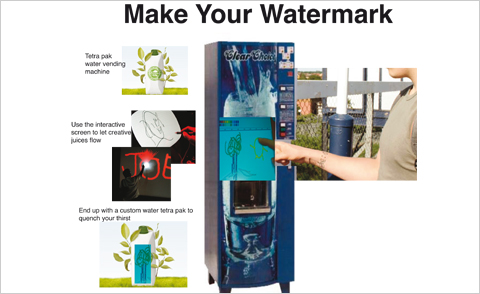
Design you own bottle at the vending machine. Granted, I know bottles and paint on bottles isn’t good for the environment. But if you can’t quite get that change initiated, then check out what this group did. To encourage people to buy water over sugary pop or juices form the vending machine, they enabled it so people can design their own water bottle from the vending machine at the point-of-purchase. Now that’s easy, and fun!

Fun, Popular and Easy…Online?

More examples are found on the FunTheory.com Web site mentioned earlier, and I have to admit–it’s fun just looking through them. But, my mind started going: How can you make your online and social media communications fun, popular and easy to help you achieve your behavior change mission? Now, that’s a weighty question. Then, I started thinking about what is it in a Web or social media behavior change initiative that makes it fun, popular and easy:

  • FUN: Community-based, drive accountability of others through accountability, collaborative in nature
  • Example: Certain online communities help training for a 5k easier by focusing on accountability or making the desired behavior fun by making it social. Other communities, such as the Sister to Sister Foundation’s online community focusing on healthy behaviors for heart health amongst women. These type of communities make healthy behaviors fun by creating accountabilty and making the behavior social.
  • POPULAR: Driven by influencers and respected peers in the community or content area the desired behavior resides.
  • Example: AIDS.gov video-storytelling. AIDS.gov encouraged state officials to create their video on why its important to get tested for HIV. Another example? HHS’ flu PSA contest. Not only was this driven and announced by the HHS Secretary herself, but it was also supported and promoted by all of HHS’ agencies. And it’s winner–come on, who’s more popular than a rapping doctor?
  • EASY: This may be the most important when it comes to the online arena. Because, for people to use the technology combined with the messages, etc., the technology must first work. It must incorporate usability best practices, be accessible and depending on your audience, address literacy issues, including technology literacy. You technology could be great, but if it’s too complicated and no one uses it, it’s just techology.
  • Example: Most recently, AIDS.gov hosted the “Face AIDS” campaign asking people to join in. The effort involved a few steps, but AIDS.gov made it easy and fun by creating a collective flickr account to display all the images. Here’s a thought: Some social media is easy to adopt. one click and your a fan, one click and you are a follower. One click, and you’ve downloaded a healthy recipe book. One click and you have a mobile app to track your physical fitness. How can your organization leverage these easy tools for behavior change?

What about you? What are some of your favorite fun, popular and easy social marketing efforts? Any of those take place online?
Four Phases of Online Social Change

red heartYou may agree or disagree with me on this, so I encourage your thoughts as I’m transcribing some of my own observations into the online social change field. These observations boil down to four “phases” of online social change that I think reflect our maturity into using social media tools to meet our organization’s aims:

  1. Awareness Building
  2. Fundraising
  3. Contests and Competitions for Change
  4. Advocacy

In the beginning, I feel many tools were leveraged as awareness-building mechanisms. From the initial launch of Causes to recruiting fans, followers and friends, many tools were initially set out to further awareness-building of an organization.

Then, I felt like the tools and our use of them matured as we discovered ways to leverage the tools into dollars–from Twestival to Tweetsgiving to Goodsearch. Even Causes adapted and identified birthdays as a way to increase micro-donations. You could say that online fundraising in and of itself has seen a phased formation and continues to evolve. See Beth’s Kanter’s recent post: 5 Social Media Fundraising Trends for 2009.

Then, enter the behemoths–contests and competitions like “America’s Giving Challenge,” hosted by the Case Foundation entered in the next rendition. You could say this ties into a more advanced type of fundraising, but I felt like it deserved to be on its own. As, I don’t yet think this area has been “tapped out” and neither do organizations according to Andre Blackman who interviewed the Robert Wood Johnson Foundation who uses contests and competitions to further public health innovation.

However, where I feel we are still in our infancy is with online advocacy for social change. It’s starting to creep up–just look at LiveEarth’s 2009 campaign “Love, the Climate” where people were encouraged to write love letters to office holders who worked to prevent climate change or the “Be a Voice for Darfur” movement which utilized activist and blogger toolkits to further realize the campaign’s objectives. Even act.ly provided a way for people to create and spread petitions with a call to action via Twitter.

Like I said, I think advocacy is where we have the most potential to further expand. I could be biased based on my government and citizen engagement day-job type of work–but I think there’s more ways we can get involved, as citizens, in decision making and peace keeping in our local, state and Federal governments–even internationally. What about you? Where do you think we have the most room to grow and what do you predict as being phase 5? Perhaps, partnerships and collaborations might be a phase five as we see how online and social media open up new doors of opportunity across organization firewalls. Or, another phase 5 might be storytelling–as more of these functions become interwoven and organizations get better at telling their story.

What do you think?

flickr credit: flatfield

How a “Place” Strategy Can Change the World: Meet ColaLife

Not too long ago, we talked about the importance of social products as part of the marketing mix. For review, the marketing mix is made up of the four p’s: product, price, promotion, and place. In the world of social marketing and social change initiatives, the “promotion p” has been stealing the spotlight for quite a while. This is why I want to highlight this amazingly wonderful place social marketing strategy–Meet ColaLife.

httpv://www.youtube.com/watch?v=z8gqgZQPS28

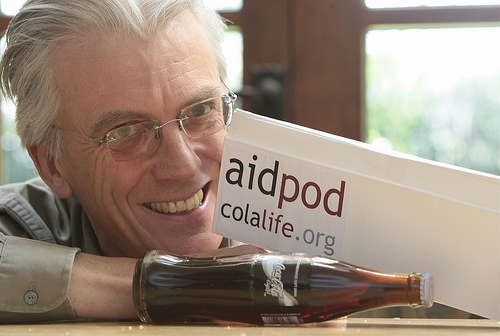
ColaLife, is a non-profit that is lobbying Coca-Cola to leverage its worldwide distribution channels to provide social products that help sustain life and improve public health. How exactly? –With some creative packaging in the form of “Aidpods.” With the help of these aidpods, Cola Life hopes to help achieve the following three goals:

  1. Reduce child mortality in developing countries (= UN Millennium Development Goal #4)
  2. Improve maternal health (= UN Millennium Development Goal #5)
  3. Combat HIV/AIDS, Malaria and other diseases (= UN Millennium Development Goal #6)

You can read more about the organization’s aims and objectives, but overall, I think the idea is brilliant. At just about any public health conference I’ve been to, someone always references Coca-Cola as having the classic place (distribution) marketing strategy. Now, that same strategy can actually be leveraged to make a difference. There’s just one hitch…

Coca-Cola, or a similar corporate organization, has to sign on first. ColaLife has already had a successful trial of the program in Tanzania, and currently it’s focusing on spreading awareness of the project and gaining influence by talking with stakeholders and reviewing the strategy and overall plan. If interested, here’s five ways we can help:

  1. Follow @colalife on Twitter.
  2. Become a fan of the initiative on Facebook.
  3. Create your own aidpod.
  4. Watch the potential of this project by viewing ColaLife’s online videos.
  5. Donate.

Take away: This is one example of using a place strategy to do social marketing and in effect, create social change for the better. Thought: What distribution channels currently exist in your community that can be leveraged for social good?

Some Golden Nuggets of Social Change

In between turkey and tweeting, I caught up on some of my online do-gooders, as well as explored and discovered new (and highly valuable) minds who are doing good. Thus, this post is filled with some true golden nuggets of social change. Enjoy!

  • Find new friends in this list of the top 100 Social Entrepreneurship Tweeple to follow, put together by @socialedge, a program of the Skoll Foundation. What I love most, is that this post also gives you a great listing of hashtags and what their purpose is as well.
  • Speaking of @socialedge, I discovered that they host weekly live discussion around numerous social change topics, including this one: What works in social change? Feel free to give input based on your knowledge and experiences–I did.
  • Can prevention PROSPER? Read up on this prevention program–backed by the CDC, NIDA and the Annie E. Casey Foundation–whose trial shows a $10 payback on every $1 invested. Now, it’s getting ready to go national.
  • Going to be in D.C. on February 12? If so, you may be able to catch the Non-Profit 2.0 Conference organized by Geoff Livingston, Shireen Mitchel, and Allysin Kapin.
  • Even though I did my own research on millennials for a project I did for Special Olympics Missouri, it’s always good to see what others found out as well.  Those at Millennial Marketing put together a FREE e-book titled “Marketing to Millennials.”
  • On someone’s Twitter list and you don’t want to be? Read up on how to opt-out of someone else’s list through this back door trick.
  • Have some doubters in your presence? Share Valerie Maltoni’s free e-book, Twittertales, a collection of Twitter success stories.
  • Seeing the time of giving is upon us, check out this article on Barron’s that lists the Top 25 Philanthropists.
  • Keeping with the giving theme, did you know you could start a fundraiser with wine? Find your favorite charity or rally friends around one–and buy some wine in support of it. I discovered this while doing my own holiday shopping, so I wanted to share the idea with others. Think goodsearch–just with wine.

People Doing It Right (hat tip to Chris Brogan)

  • Health Populi. Written by Jane Sarasohn-Kahn, I find just about every single post of hers helpful, thought-provoking and insightful. Lately, it’s become a blog staple–the kind that you can’t wait to read when you see there’s a new post in your RSS reader.
  • Prevention in Action. With its focus on prevention and research–how can you not be a fan of this organization’s news content? They are writing about topics not everyone writes about, pulling evidence, timely events and research together in a way that gets the mind ticking.
  • 501derful.org. We all already know he’s doing it right seeing as David Neff won AMA’s Non-Profit Marketer of the Year award. But with Neff’s recent announcement that has left the American Cancer Society to pursue his next big adventure, I’ve been staying tuned to his blog ever more closely as I admire his leadership and courage to follow his passion of Lights. Camera. Help.

What about you? What golden nuggets did you discover over the holiday?

flickr photo credit: Curtis Gregory Perry

The Next #read4change Book is…

You voted, and now, Actions Speak Loudest by Robert McKinnon will be our next #read4change book. I feel it’s quite timely considering my post last week about knowledge, attitudes and actions.

Actions Speak Loudest is a compilation of some of today’s greatest doers like Jimmy Carter, Queen Noor, Mia Hamm, Joe Torre and others who are everyday American heroes that make a difference. Together, they look at thirty-two issues, ranging from childhood obesity to climate change, that are critical to the well-being of the next generation–while also providing ideas and ways to take action. All funds raised from sales of the book go back to the causes and organizations featured within its pages.

BONUS: Robert McKinnon will join our #read4change chat. Stay tuned for time and date.

Feeling lost and wondering what the heck #read4change is?

In September 2009, with some inspiration and a desire to create deeper connections with the talented online community, SB launched “read4change,” an online social change book club–where anyone can participate.

Using the Twitter account @read4change and the hashtag #read4change–do gooders, social changers, nonprofiteers and the like gather around each month to discuss that month’s book and how its relates to our do-good work.

Now, curious about how to get involved?

  1. FOLLOW us @read4change on Twitter.
  2. RECOMMEND a book. Email me at socialbutterfly4change@gmail.com.
  3. VOTE each month on which book we should read. The top book will be chosen.
  4. READ the book or browse our bookshelf to see what we’ve recently discussed.
  5. DISCUSS the books with us on Twitter using the #read4change hashtag.

Want to help? Just answering these two simple questions helps:

  1. Do you prefer to have a pre-set reading list–or do you like voting on the book each month?
  2. Given the holidays, should we meet for December’s #read4change or schedule our next one to be early January?

Defining Your Organization’s Story

I believe the importance of storytelling is currently under-utilized in the market–yet it’s becoming ever more needed. As a customer myself, I value companies that take a position, that share their values and back them up with action–companies that are more than a company–but a passionate group of people not afraid to add to the manuscript.

But as an organization–how do you get everyone on the same page? Sure–a communications brief, a missions statement, or a value statement might provide a route to defining one’s table of contents. However, constructing those documents can be an intimidating, formal and painstakingly long process. So, I have another remedy for you.

Jump over to Ogilvy PR’s recent post where Patagonia’s VP of Marketing shares Patagonia’s story. The simple, bullet format provided offers insight into the values Patagonia has, the position it takes and how it translates both into business.When done reading, try the exercise out for your own organization. Try it with a colleague or even try it with a customer–what were your answers? Did you have an answer? And if you did the exercise with someone else–how’d the answers differ?

Now, my next question: What process might you recommend for an organization wanting to define its story?

PS: I want to give props to an organization who is doing this right (examples always help)–> Worldways Social Marketing. The title of their blog is my favorite title of any blog, We Take Sides. It tells me where they stand. It gives me a feel for the type of company they are, and communicates to me that they are a passionate group of people who believe in what they do–without any corporate speak. Your turn: Who do you think is doing it right?

flickr photo credit: JeremyHall

Knowledge + Attitude = Action?

This was the equation at the center of one of Thursday’s New York Times Articles titled: How Understanding the Human Mind Might Save the World from CO2. The article shared insights gained from the Behavior, Energy and Climate Change Conference this past week in Washington D.C., and wouldn’t you know–highlighted social marketing as a potential solution to leading the climate change movement forward.

I believe the main message from the article is best summed up by one of the quotes from researcher Dr. Doug McKenzie-Mohr:

“Social psychologists have now known for four decades that the relationship between people’s attitudes and knowledge and behavior is scant at best,” said McKenzie-Mohr. “Yet campaigns remain heavily focused on brochures, flyers and other means of disseminating information…I could just as easily call this presentation ‘beyond brochures.”

Beyond brochures. Beyond promotion. Beyond. The article elaborated by pointing to research that knowledge and how we feel about something (attitude) do not always line up with action. So what’s the solution? The article, McKenzine-Mohr and the field of social marketing says: look at the barriers to the desired behavior change. Even simpler, look and study behavior. Even better, look at policy.

McKenzie-Mohr is a leader in what is referred to as community-based social marketing. A specific practice of social marketing that works to address sustainable practices such as recycling, waste water reduction, transportation and other green-related challenges.

I’ve been a fan of McKenzie-Mohr’s research since my grad school days as his research is what initially gave me the hope that social marketing can provide a framework to follow and help us discover lasting solutions to some of our world’s greatest problems–beyond those affecting public health. This week I was further inspired that social marketing has wider implications outside of “public health” by Craig Lefebvre’s recent post that applied social marketing to financial literacy and education.

Key Take-Aways:

  1. Social marketing can be applied to world issues beyond just public health such as the environment, financial literacy, poverty and other challenges.
  2. To create “change” or build a movement, look and study behavior change–not your PSA impressions.
  3. Better yet, consider where policy falls into the equation.

flickr photo credit: doozzle

Focus on Some Inspiration

I am so thankful for community–including those at BlogHer. I woke up this morning and found this inspiring post and video emphasizing a word that I’ve been concentrating on: FOCUS. The video starts with this beautiful quote. I encourage you to take a moment and reflect upon it:

“Your real work is to decide what you want and then focus upon it, for it is through focusing upon what you want–that you will get it. That is the process of creating.”

httpv://www.youtube.com/watch?v=th3GMejUm3I&feature=player_embedded

The video closes with another thought-provoking quote by Ghandi:

“Keep your thoughts as positive because your thoughts become your words.

Keep your words positive because your words become your behaviors.

Keep your behaviors positive because your behaviors become your habits.

Keep your habits responsible because your habits become your values.

Keep your values positive because values become your destiny.”

You can apply these words to yourself, to your family, your work, and you can also apply them to your organization. Think: When was the last time you (or your organization) felt inspired?