Author Archives: Alex

Obama Online – More than Social Media

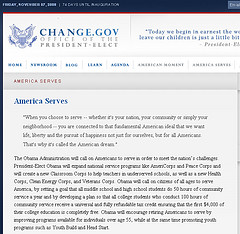
Change.govWith the launch of Change.gov, commentary on Obama’s social media strategy and success have been made here, here and here. Yup, here too. Some are even calling Obama and the government integration of new media tools through Change.gov the Digital New Deal while others wonder about the extension of the Obama brand and community – post election.

*******

Social media is awesome. Grand. Influential. Amazing. In my professional role working with government agencies, I must admit that my first reaction to Change.gov was, “Sweet, I can’t wait for this priority on social media to trickle down among other government agencies. Man, that would make our job so much easier.” Or, would it?

Because now, instead of talking about why to do it, the opportunity to implement may [hopefully] increase, meaning we must show results. And, Obama set the bar high.

Granted, Obama’s campaign is an amazing case study that aided in achieving an important end objective – getting Obama elected. However, Obama’s online success is due to more than social media.

“Overall, the presidential campaign filled 54% of the newshole as measured by PEJ’s News Coverage Index from Oct. 27-Nov. 2. That represents a slight uptick from the previous two weeks when the election was at 52% (Oct. 20-26) and 51% (Oct. 13-19). The race for the White House was the dominant story in all five media sectors, most notably in cable, where it accounted for 84% of the airtime studied, and on the radio airwaves, at 65%.”

  • Obama created the Obama-brand. If you work in government, you may understand some of the government’s sensitivity to the word brand. And from the outside, how the public might react to the government branding or marketing itself. (Hence, the whole debate back when to transition from health communications to health marketing.) However, the Obama-brand has become widely accepted and adapted while maintaining a consistent message to diverse audiences across a range of platforms.
  • The number of resources available. Obama’s fundraising numbers were out of the roof. Not every project is as fortunate. This is why highlighting and emphasizing ROI is important and critical.
  • Obama was the first, and it was sexy. Being the first is always advantageous. In the government 2.0 sector, Obama led the way in showing how to leverage a comprehensive social media plan to create an online presence that connected with the overall program’s mission. Not only did he do it, but he made it sexy by implementing creative elements that encouraged not only online users, but also online ambassadors.
  • Obama and his team understood the essence of social media online and off line. This is the biggest one I think. Obama’s message tapped into the cornerstone of social media – help me, help you, help me, empower America. Did you get lost in that? Web 2.0 is about the conversation and Obama is encouraging conversation with him and among each other. The Change.gov Web site communicates it best:

“Share your vision for what America can be, where President-Elect Obama should lead this country. Where should we start together?”

He took the essence of social media tools and made it his mantra. He is change, but he needs you to help create that change. You want change, but you need him to lead that change. Brilliant.

In your opinion, what other factors outside of social media helped mold Obama’s online success?

Liked what you read? Feel free to share with others: Bookmark and Share

Did You Know? 2 Must-See Videos to FLY Together

My dad sent me this great video today. It makes you think. It motivates you, like @garyvee, to get off your butt and get moving. You may think that doing nothing only affects you. Tuning out is a choice. So, that can be your opinion. But, standing, means not helping others to fly.

httpv://www.youtube.com/watch?v=cL9Wu2kWwSY

No matter your political leanings, you must admit this quote is poetic. On NPR, a man talked about getting ready to vote for a president for the first time was being asked who he was voting for and why. He recalled this text message he received from a friend:

“Rosa sat, so Martin could walk. Martin walked, so Obama could run. And, Obama is running so our children can fly.”

What if that could be you? What if your actions could empower others to succeed. Think about the power that ripple effect could have. Whether it’s for Obama or McCain, Vote. Act. Do. No matter what, after the election, we will all need to keep moving, if not faster. Let’s get busy, and let’s FLY together. Just ask these guys:

httpv://www.youtube.com/watch?v=fX40RsSLwF4

*Don’t quote me on the stats, as I’m still trying to find this video’s source. But, it is powerful.

Liked what you read? Feel free to share with others: Bookmark and Share

Mapping Out Your Strategy: Using Maps as a Means for Marketing

Google Earth recently launched its iPhone app, so what does this mean. I think this means more non-profits and organizations taking notice on how to literally, map out their strategy.

Mapping Fun

Mapping, mainly through Google earth and Google maps, has been increasing in use. I was first introduced to mapping glorious-ness by my fiance. When we went to Rome last year, he created a Google map highlighting all the Gelato hot spots in Rome. What more can I ask for than a man who not only shares my second love of ice cream, but plans it as key stopping point while we tour Italy? Now, In terms of relevant non-profit mapping, I was moved by 1) Wild Apricot’s recent post about Google Earth outreach, and 2) a SB Reader.

As Wild Apricot shares:

Google Earth and Google Maps let anyone create a custom map — and share it by sending a link, or embed on a web page. Personalized and annotated, even enhanced with photographs and videos, online maps can help to engage your supporters in a way that bare text never can. New features now let you collaborate with others and import geographical data to customize a map.

Case Study Highlight

SocialButterfly reader, Dan, at Tutor Mentor Connections recently shared with me how he and his non-profit are utilizing mapping technolgoy. Over the past six months, Tutor Mentor Connections have developed a library of maps that are intended as tools that leaders use to support the growth of volunteer-based tutor/mentor programs in specific geographic areas in Illinois. I conducted an email interview with Dan which I will feature later this week, but here is a sneak preview:

Why mapping?

“Maps are one form of visual communications. Pictures are worth thousands of words in communicating ideas. Generals use maps to distribute troops in time of war. They do this to make sure they have forces everywhere they are needed. A city could have a telephone directory full of youth program listings, and still not have programs in half of the places where they are needed. Maps can help leaders understand where there are programs, and can be used to help build business/non profit collaborations. They can be used as tools in any leadership strategy.”

I look forward to sharing Dan’s work with you as I think Dan is doing a fantastic job of creating a 1, 2 Punch when it comes to tackling giant issues (i.e. poverty and education) through mapping technology. Crafting data, supported by research, and translating that creatively through meaningful, visual representation.

Others Examples of Non-Profits Mapping

  1. Google Earth’s outreach blog highlights 10 example case studies on how non-profits have used Google Earth for their efforts. These groups include: the U.N. Environment Programe, EDGE, The Jane Goodall Institute, U.S. Holocaust Museum, Sierra Club and others. Whether this means providing virtual tours, highlighting the location of endangered species, or elevating the work of researchers and scientists, mapping can provide innovative and creative ways to communicate a message visually.
  2. The New Orleans Food and Farm Network used Google Maps to show how residents in devastated areas where to find food, from grocery stores and restaurants, to farmers’ markets and emergency kitchens. Additional related outreach included the distribution of paper and PDF maps.
  3. Mobilizing Youth – Though an older post from August 2007, the blog lists over 25 examples of non-profits using maps to conserve rainforests to raising awareness for child cruelty.
  4. Factory Farm Map – Food & Water Watch, a nonprofit consumer organization concerned with clean water and safe food issues, had the goal to illustrate the growth of factory farms across the United States, mapping US Census data to show how and where animal production is becoming concentrated in different regions of the country. (Wild Apritcot) Thus, enter mapping technology to bridge the disconnect between dense data and understanding.

Where to Get Mapping

Tools

  • Google Earth, Google Earth Plus, Google Earth Pro
    • According to Wild Apricot’s summise, NP’s can use Google Earth Free, but it is not to be used to provide paid services. Compare Google earth packages to determine the one you need for your project. For the Pro version, organizations. To see what financial assistance may be available, be sure to check out Google Earth’s grant program.
  • Google Maps
  • CommunityWalk.com
  • MapBuilder
    • A mashup development tool that builds custom Google and Yahoo maps without any knowledge of the Google/Yahoo Maps API and JavaScript.
  • PlaniGlobe
    • Create interactive maps using a vector architecture base.
  • Zee Maps
    • Quickly create interactive world maps through a service that allows you to add your own search query, allow for user-admins and is multiple-user friendly.
  • Frappr
    • Frappr collects three pieces of information: an online guest book, a hit log and a map. Using Google Map technology, visitors to Frappr can enter their name, zip code and other information. Their locations are then marked on the map with a clickable flag that pops up their information. (Netsquared)
  • WayFaring
    • Create, view, share and and personalize your own custom made map. The user-interface on this tool looks very user-friendly.
  • DataPlace
  • Dabble DB
    • Helps you create online databases to manage, share and explore data and to build web applications. Some that can be represented in the form of a map to help breakdown and identify trends.
  • MapPoint
    • A product of Microsoft, this tool helps you visualize and translate your data into meaningful information.

Apps

Wrap Up

Mapping is a great visual. However, for the map to be both effective and useful, it must be fueled by great content while also being data-driven. Thought this research document is from 2002, skimming through it shows just how data can be re-constructed to be meaningful and cohesive. However, this is where I believe mashups come into play too.

What are your thoughts on mapping technology?

Photo credit: flickr, dannysullivan

Liked what you read? Feel free to share with others: Bookmark and Share

The Cool Factor About Mobile

Mobile. What do we do with this one word? We CAN do so much. Rather than go on, instead, I want to give some examples and highlight the cool factor of how mobile can add some out-of-the-box type thinking to an overall health and/or social marketing-related initiative.

(Granted, any initiative must go beyond cool, and must not be done solely for the cool factor. But, for creative juices, let’s show off some coolness.)

****************

Organization(s): The U.S. Centers for Disease Control and the University of Georgia’s New Media Institute
Objective: Get the word out about National HIV Testing Day

Cool Factor: Personal PSAs, 24 Hours, and Collaboration.

In one day, more than 20 students from 6 universities and five AIDS organizations hit the streets with only cellphone video cameras to produce 8 short video messages to encourage youth to be tested for HIV. (Personal PSAs are those shared via mobile and social networks, in addition to being user-generated.)

****************

Organization(s): University of Auckland Clinical Trials Research Unit and Healthphone Solutions
Objective: Using Mobile SMS Technology to increase individual smoking cessation success.

Cool Factor: Txt2Quit. 480 Customized Text Messages. 26 Week Program.

This is a tested and research-based product produced to help individuals quit smoking. The program was presented at the Texting for Health Conference this past February, and hopes to provide the tool in multiple languages as well!

****************

Organization(s): The 2007 Live Earth Concerts, The Ethical Reputation Index and LightSpeed Research
Objective: 1) Measure the effectiveness among 18-45 year olds of event sponsorship and advertising in real-time and 2) Measure this audience’s interest in green issues raised by the global concerts and sponsors.

Cool Factor: Mobile as a research tool.

The first example was using mobile to raise awareness and increase a call to action. The second example offered a product to those working to stop smoking. This example expands the uses of mobile by showing how it can be used as a medium to conduct research. In case your curious, the response rate was 20% and most notably, the research was done, fast, with results given that same day.

****************

Organization(s): The Fair & Lovely Foundation and Hindustan Unilever Limited
Objective: Increase the visibilty and utilization of the Fair & Lovely Foundation’s scholarship program among women and girls in low-income groups in rural and urban India.

Cool Factor: Cost Effective. Wide Reaching. Full Approach.

All elements of mobile marketing were utilized in this campaign: an SMS Blast, SMS Shortcode (a code word/number individuals can respond to), interactive voice response, banner advertising, a microsite and the Lead Capturing Zone that induced the call to action for individuals to apply for the scholarship. As a result, over 44,000 student applied in 1.5 months and 2 million page impressions were gained from the banner advertising.

****************

Organization(s): Macmillan Cancer Support
Objective: Provide an alternative route to collect donations for those not wanting to donate online via credit or debit card.

Cool Factor: Mobile as a fundraising channel.

For this organization and through this campaign, SMS donations was the most successful mechanism with 59% of donations being made through text.

****************

Organization(s): Save the Children and Verizon Wireless
Objective: Provide lifesaving assistance during the natural disasters that occurred in China and Myanmar.

Cool Factor: Assists during times of emergency.

Individuals could text 4SAVE with the word ‘quake’ to donate to earthquake relief or the keyword ‘cycloce’ to contribute to the cyclone relief. Upon texting, a reply asking for confirmation will be sent and a $5 donation will be added to the person’s phone bill.

****************

Organization(s): Major universities and colleges across the country.
Objective: Implement an emergency notification system for all the University campus community.

Cool Factor: Campus Alert System. Emergency Preparedness.

Across the country, universities and colleges are implementing emergency alert systems through mobile and email technology to prevent another Virginia Tech tragedy. It’ll be interesting to see how other systems and institutions implement a similar strategy.

****************

Organization(s): mGive & Keep A Child Alive, mGive & the Washington Nationals, The MLB and the Children’s National Medical Center, mGive & The All-Star Game, Stand Up for Cancer, and Make a Wish Foundation
Objective: mGive & Keep A Child Alive: Move people to donate during Alicia Key ‘As I Am’ tour; mGive & the Washington Nationals: When the Nationals play the Houston Astros, fans will be asked to donate to the Children’s National Medical Center to fight pediatric diabetes through a mobile/text campaign; mGive & The All-Star Game, Stand Up for Cancer, and Make a Wish Foundation: fans will be asked to donate to these two non-profits during the All-Star game through a mobile program.

Cool Factor: Mobile Giving. Integrated Marketing.

Mobile giving is now becoming a trend. Through the Alicia Keys mobile campaign, over $40,000 was raised to support Keep a Child Alive. mGive itself is a social giving company that helps non-profits utilize mobile technology to increase their fundraising efforts. To see the latest campaigns (including combining broadcast television commercials with a mobile call to action), check out their blog. The Mobile Giving Foundation currently keeps a list of all 36 ongoing mobile giving campaigns.

****************

Organization(s): The Centers for Disease Control and Prevention
Objective: Provide a home site for of CDC’s mobile information about hurricane preparedness and the flu season.

Cool Factor: Government Goes Mobile.

Due to the increasing amount of dangerous hurricane like Katrina, Gustav and Ike, the CDC recently created a mobile Web site to further assist during times of emergency. I see this site growing as the use of mobile increases, but it’s a great first step and a good role model for other government agencies.

***************

Organization(s): Meir Panim (Network of Soup Kitchens in Israel)
Objective: Increase donations for the soup kitchens, while also communicating an individual’s impact on the cause.

Cool Factor: Shows Impact on the Spot.

Meir Panim ran an interactive campaign with banner advertisements asking individuals to ‘SMS for Lunch‘ a promotional interactive campaign: On their website a boy was featured, facing an empty plate. The site encouraged donations and once the system received the SMS, the banner changed to show a full plate of food with the boy smiling. Talk about realtime impact!

***************

MORE:

From these examples, we’ve seen how mobile technology can be used to:

  • Raise Awareness.
  • Provide a product.
  • Be an instrument for research.
  • Be cost-effective, fast, and provide results.
  • Be a fundraising tool.
  • Be creative.
  • Encourage mobile giving.
  • Extend a current campaign.
  • Be another medium to integrate into a marketing program.

What other mobile campaigns exist that you think have an extra dose of the cool factor?

Liked what you read? Feel free to share with others: Bookmark and Share

Work Hard. There’s No If’s, And’s or But’s About It.

I recently watched Gary Vaynerchuck, of Wine Library TV, deliver at the Web 2.0 Expo…on YouTube. And, when you’re feeling down, feeling like, you’re giving up too much of life, or that breaking into the social media mold is just ‘too hard’ or you’ve gotten lost within this space. Watch this. It’s a good kick in the pants.

httpv://www.youtube.com/watch?v=EhqZ0RU95d4

(Note: There is some foul language, but like I said, it’s’ a good kick in the pants.)

Gary V. presented about “Building Personal Brand Within the Social Media Landscape.” I often get this question through email, speaking with others and students too. I agree with Gary in this video.

There are no shortcuts. —–> (There are smart cuts.)

There are no excuses. —–> (There’s time management.)

There is no one else to do it. —–> (There’s only yourself to motivate.)

And it’s called: HARD WORK. Now get going. =)

(Thank you Mike Kujawski for sharing this item!)
Liked what you read? Feel free to share with others: Bookmark and Share

The Bulletin: Updates in the Social Marketing Field

New Resources and Communities Abound…

1. Two Social Marketing Blogs join the movement! Mike Newton-Ward, a social marketer based in North Carolina launched Social Marketing Panorama earlier this fall. Bob Marshall also launched USSOCIALMARKETINGPLAN to highlight the need of a larger social marketing movement that attaches itself to a body of professionals in the United States.

2. C-Change, a new peer-reviewed and research-based e-newsletter developed by USAID and AED is now available and…is free! According to the web site, “C-Change works with global, regional and local partners to use communication to change behaviors and social norms, supported by evidence-based strategies, state-of-the-art training and capacity building, and cutting-edge research. The ultimate goal is the improved health and well-being of people in the developing world.” The e-newsletters focus on four main areas:

  • Family Planning and Reproductive Health
  • HIV/AIDS
  • Malaria
  • Communication for Behavior and Social Change

3. GovLoop, the “premiere social network for the government community,” including agencies, contractors and consultants has grown to over 1700 members! I invite you to join me and the main other amazing professionals on this robust community created through NING, especially SB readers who are keen to the government 2.0 movement! For those in DC, join the DC Social Media Club this upcoming week Oct. 22 for a seminar panel on all items Government 2.0, moderated by John Bell of Ogilvy PR.

4. As I’ve shared, the full presentations from all the keynotes during the World Social Marketing Conference are available to view and download. I shared my own recap, as well as a picture recap. Good news is that I wasn’t alone as we had a ‘team’ of bloggers covering the event: Stephen Dann, Craig Lefebvre, Andy Jaeger, and Cheryl Brown.

5. Edelman recently launched their Health Engagement Blog to stress the concept of ‘health engagement.’ The blog corresponds to Edelman’s whitepaper, available for free, called Health Engagement Barometer Study.

6. Mike Kujawski, a social marketer based in Canada, created a Government 2.0 Best Practices Wiki for Canadian, U.S. and International Governments. In its first week of launch, the wiki got over 5000 visitors!

7. The CDC is now offering a web-based course called Social Marketing for Nutrition and Physical Activity. This is good. Though, I still echo Nancy Lee’s call for social marketing curricula integrating into formal education. And more courses would be a great start, but a formal graduate degree in social marketing would be even better.

Photo Credit: Flickr, pbrigitte
Liked what you read? Feel free to share with others: Bookmark and Share

********

Have social marketing (or social marketing-related) news you’d like to have featured in the Bulletin? Send job posts, new workshops, events, research resources and tools to socialbutterfly@gmail.com with Bulletin in the subject line. =)

Blog Action Day: What is Public Health? What is Poverty?

In honor of today’s Blog Action Day on poverty, here is a background on poverty and how social marketing can be applied, as I saw broken down by Philip Kotler himself at the World Social Marketing Conference.

Additionally, join over 40 of DC’s influential changemakers at Buffalo Billiards at DC’s 1st Changeblogger meetup. We will recognize and commemorate Blog Action Day, connect with Alex Steed’s social change tour, mingle and share re: living and working for positive change.

What is poverty?

In researching the answer to this question, I couldn’t escape the purpose behind a campaign by the Association of Public Health Schools and the Pfizer Foundation recently created called “What is public health?” This campaign works to better brand ‘public health’ to the public, while also raising awareness, education and encouraging participation in the public health conversation. Participants are asked to put red “This is public health stickers” on items that they feel represent public health. My challenge: What would this look like if the question: “What is poverty?” was asked?

Early Solutions to Poverty

Kotler listed 4 early solutions to poverty: alms programs, workhouses for the poor, deficit financing and economic development. With these solutions, four major strategies reveal themselves to reduce poverty:

  • Economic Growth Strategy
  • Redistribution Strategy
  • Massive Foreign Aid
  • Population Control

As Kotler continued to outline, he stated the “Two Main Thrusts” used to alleviate poverty are population control (from contraceptive campaigns, to abortions, education of women, industrialization to passing laws restricting the number of children) and improving the support of povert-escaping behavior. This umbrellas micro finance and empowerment, education and health programs.

The Goal

As part of the Millennium Goals, the World Bank and the United Nations have 8 goals and 17 targets to alleviate poverty (Kotler). One goal is to eradicate extreme poverty and hunger by:

  • Cutting in half the proportion of people whose income is less than a $1 a day.
  • Halve the proportion of people who suffer from hunger.

Why Care?

Everyone hears we need to solve poverty, but my eyes were widened as to WHY we need to solve hunger. And, this goes beyond the humanity of reasons, but puts some more solid evidence to the issue. Kotler spoke of these 6 reasons:

  1. Sympathy and compassion about wasted lives.
  2. Poverty drives some poor people into crime and terrorism.
  3. Poor are more prone to health problems and spreading of disease.
  4. Poor are more likely to follow demogogues.
  5. Poor nations can collapse into “failed states” that cannot pay their foreign debt.
  6. The poor are an untapped trillion dollar market opportunity.

Why Social Marketing?

Kotler, along with social marketing expert Nancy Lee, both are literally writing the book answering this part of the poverty question. I personally can’t wait for the book to come out because I truly believe that social marketing provides the right tools for us to solve global issues such as poverty. In the presentation, Kotler identified a 6-part framework as to how social marketing can be applied to the poverty issue. However, in the book, a larger and more developed framework is offered, as well as further context of the issue.

So, back to the challenge. How would you answer this question: What is poverty?

Liked what you read? Feel free to share with others: Bookmark and Share

World Social Marketing Conference Recap 2: Picture This

Finally…a picture-based recap on the events from the World Social Marketing Conference, which took place in Brighton, England on September 29-30.

NOTE: PDFs and audio of all keynote presentations are available here.

<– Prof. Stephen Dann was the conference’s Twitter King, providing live coverage of the conference through @WSMC08, and #WSMC08.

Prof. Alan Andreasen gave a closing and optimistic keynote address about the future of social marketing. –>

<– Bill Smith, of AED, discusses the journal Social Marketing Quarterly, calling for more concentration towards social marketing products and services.

This quote was presented by England’s National Social Marketing Centre’s director, Jeff French, who calls all social marketers to unite together and learn from each other in moving the field forward. –>

<– Philip Kotler opened the conference with a keynote about poverty, and how we can apply social marketing to poverty to increase effectiveness and positive change.

Jeff Jordan, M.A., President and Founder of Rescue Social Change, presented his research about Social Branding (which he trademarked), along with 2 case studies about how to use social norming to influence behavior for high-risk adolescents. –>

<– The Purpose Driven Campaign – my master’s thesis that I presented during the poster session! (I also created SocialButterfly, Fly4Change.com pens that were quite popular. =)

Craig Lefebvre, presented an exciting presentation where he “dropped the gauntlet,” and presented the challenge for social marketers to walk the walk, as well as talk the talk when it comes to creating an international social marketing association. Lefebvre announced that he alone has raised a quarter of a million dollars for the project! –>

Other Highlights included:

  • NIOSH presented add some ‘flavoring’ to the conference by presenting their case study on a social marketing program to improve the safety of butter flavoring employees.
  • Ogilvy PR presented their fascinating Pandemic Flu case study.
  • Porter Novelli and CDC presented their case study on HIV testing.
  • Nancy Lee outlined 4 examples of how social marketing can offer products and services.
  • RT Hon. Alan Milbourne, MP, discussed how the world of social marketing and public policy relate.
  • Bob Marshall presented findings from studying the NSMC and from his recent survey about creating a new social marketing association for the States. This is part of an on-going discussion that can be followed here, USSocialMarketingPlan.
  • Ronne Ostby-Malling of AED presented her preliminary research about the behavior of online social network behavior among adolescents versus their behavior in real-life.

The Purpose Driven Campaign: Social Marketing as the Possible Link Between Journalism and Advertising

After reflecting from the World Social Marketing Conference (which I promise updates eventually) and reading Craig Lefebvre’s recent post “Social Marketing: Hard Power and Soft Power in Social Change,” I want to finally share some tidbits from my thesis paper that I presented as a poster session at the conference. As, I think it rounds out and puts a lot of themes together as I studied: the elusive concept of influence.

Abstract: This research project looks at the concept of influence within social marketing as compared to journalism and advertising. This includes examining these professions’ definitions, ethics, standards, and agenda-setting capabilities. Through in-depth interviews, a further understanding of how these three practices relate within the gray matter of the media landscape is pioneered, as well as better defining the role and influence of social marketing.

Excerpt:

The Question of Influence

While the Information Age leaps into the Connected Age, the power of a free press is offered daily to start-up bloggers. Newspapers are downsizing. Amateurism is becoming the new professionalism. Online media producers replace today’s broadcast directors; all making the gray shades of influence between the information and its consumers a thunderstorm waiting to happen. Social marketing is in the business of change, whether it is behavioral change or attitude change, social marketing can also be described as the field for social change. But, how? In today’s world, who holds more influence to create these changes, a journalist, advertiser or a social marketer? How can one tell the difference? Is there a difference? And, do the professions work together? Could they? Should they? This research hopes to add to the discussion on the evolving definition and role of social marketing, using agenda-setting relationships to examine its influence and attempt to determine its position between advertising and journalism in the media landscape.

Literature Review

It is 1961. A time when questions were raised and hope diminishing as borders became gray and a rise of an international community emerged. Two Portuguese students were imprisoned for declaring a public toast towards their dream, rooted in an idea – freedom. Having their freedom stolen from them for displaying a human right of expression, a newspaper article was written, and with it, a movement spurred. This movement would form Amnesty International (www.amnesty.org). Social change is possible, and it begins with an idea. Social marketing is an increasing movement currently being expanded because of its foundation in ideas about positive change for the welfare of the public.

Though specific definitions differ, social marketing achieves social change objectives by applying the marketing mix of product, place, promotion and price. Currently, social marketing is used mostly in public health communications and is expanding in the realms of environmentalism, civil rights, urban renewal, public service and raising awareness of international issues.

Conclusion: The conclusion of course I can’t share here, but it involves what I found consistent between journalism and advertising, but interestingly, the field of public policy was drawn into the mix through the research as well.

Liked what you read? Feel free to share with others: Bookmark and Share