Tag Archives: Social Media

Be Inspired by this Week's Blogger Neighbor: Stacey Monk @ EpicChange

Continuing my weekly “Blogger Neighborhood Series” in honor of the great Mr. Rogers, who called us to “Get to know our neighbor,” I welcome Stacey Monk from Epic Change, who continues to leave me inspired.

Stacey is an amazing writer, showing both her contagious passion and gracious, sincere personality through every word, so I’ll let her tell you about her journey, mission and how she’s gotten to where she is…

***********************

Blog Name:

The Epic Change Blog

Blog Topics:

The Epic Change Blog is a diary of our experiment in social entrepreneurship and an organization I recently founded called Epic Change. We started it just after we received our 501c3 determination last September, and we blog whatever we’ve experienced on the journey since then, including:

We try to give a complete, transparent picture of what we’re working on so that our supporters can feel engaged in what we’re doing, and so other folks can learn from our mistakes and successes. We also try to provide regular opportunities on our blog for folks to get involved. Last week, for instance, to celebrate National Volunteer Week, we provided daily opportunities for our readers to perform 10-minute volunteer activities.

About the Author:

I’m a nerd, a recovering military brat, a perpetual nomad and a total sap. I believe the world is what we make it. I started my career managing a performing arts series, moved into public sector consulting for Deloitte, then worked in IT strategy & change leadership at Genentech and, finally, launched a small change management consulting firm called Funken Consulting. Last year, I left for Africa, came back, stopped working for money & founded Epic Change, a nonprofit that “helps hopeful people in need tell their epic true stories to acquire the resources they need to create change in their communities.” I have a BA in Philosophy and a grad degree in performing arts management from the public policy school at Carnegie Mellon. I like to think that artsy background helps me be more creative in my approach to social change. You can check out my street cred on LinkedIn.

If you could live on any street, what would that street be named and why?

I’d live where Hope, Audacity, Authenticity, & Gratitude intersect because I know I’d like the other people who live there. [This is my favorite quote of the week!]

Who would be your dream real-life neighbor?

Any man who can sing. For today, let’s say John Mayer. His song Say is stuck on my brain. Or maybe Josh Groban. His voice makes me feel like I’m in the presence of an angel.

If you were in charge of the planning the neighborhood’s block party, what entertainment would you plan?

Ditto, previous question. Or I’d plan a performance by a dance troupe that I love like Alvin Ailey or Momix. Or we’d dance ourselves, which might be the most fun. Despite my chubbiness, I love to dance. I’m certified to teach ZUMBA and Shake Your Soul.

If you customized your own license plate, what would it say and why?

FEARNOT, URHOPE or THANKU

What would you gift to a new neighbor as the perfect welcoming gift?

Blueberry Pie. Despite 1950s connotations, pies = love.

What’s your favorite blog post and why?

I’d like to point to something brilliant by someone else, because I’ve taken so much as inspiration. Right now, today, though, I’m really wrapped up in what’s unfolding as a result of my recent, totally random, guest post on the Go Big Always blog of Jive CMO Sam Lawrence. I met him totally randomly on Twitter, and last Wednesday after midnight, when he was tweeting that he didn’t feel like posting to his uber-popular marketing blog, I offered to take his place. He, probably in jest, wrote back “Go for it ;)” and I did. That single post has led to a flurry of others, including one on ZDNet, a tweet by @Scobleizer, and a connection to social media giant Jeremiah Owyang, as well as a drastic increase in the number of people interested in our cause. So for today, the Go Big Always post is surely my fave, despite the fact that it begins with a reference to feces.

What’s one lesson you’ve learned from blogging?

Be authentic.

Past Blogger Neighbors Include:

*************************

This continuous weekly series highlights different blogs and their respective bloggers in the blogosphere neighborhood. Following the great Mr. Rogers, who tells us to ‘Get to know your neighbor,’ this series introduces us to our blogger neighbors, making for a more unified, collaborative voice for the social sector. Like to nominate someone or be featured yourself? Contact me @ socialbutterfly4change@gmail.com.

Web 2.0 Wednesday – Super Tuesday Super Cool: When Google Met Twitter

So, I’ll leave the political analysis to those more qualified, but I will point out a super cool social media event that also took place on Super Tuesday: Google Met Twitter.

Google teamed up with Twitter and Twittervision to show on Google maps, people’s comments through Twitter about the elections and Super Tuesday… and, it was live! Every few seconds the map would change and take you halfway across the world to a person’s comment in Malta, then to Australia, then to Southern California. This continued throughout the day. Then, as the night continued, reported live results too.

Talk about relevance!

This is what social media is all about…and can be about when used and optimized to full potential. Many social marketing clients may get nervous when venturing into new territory, and then again, nowadays, anyone can make a MySpace or a Facebook. But, taking the risks, venturing outside the box, adding to the tools in your belt, and you can come up with fun, interactive, attention-getting technology and marketing.

Wanted to share the tidbit.

Click here to check it out (not sure how long Google and Twitter plan on keeping the application live however).

A Look At Science 2.0, including OpenWetWare Case Study

Last week, I published a post on Health 2.0, based on a couple research studies that were recently released.

Also last week, another report was published by the Scientific American Magazine that looked at the concept of Science 2.0, titled “Is Open-Access Science the future?

About

Before this article was published, the author put the draft version of the article in a wiki, and encouraged readers’ comments and edits…to help formulate the articles final version.

In this article, the author looks at the increasing use of social media within marketing, journalism, and politics – and how it can spread to the field of science, as more researchers increase their use of web 2.0 tools within their research. Some critics think that this new process to scientific discovery curbs the traditional institutional lines and poses danger. Advocates see Science 2.0 as a way to increase openness and collaboration across studies – furthering progress

Science 2.0

Science 2.0 refers to the growing movement of integrating social media into the scientific process and its promotion. Science 2.0 is a component of the broader Open Science movement according to the author of the article, M. Mitchell Waldrop. This Open Science Movement includes other topics such as open-access scientific publishing and open-data practices.

Case Study

The article points to a success project named OpenWetWare at MIT, which:

OpenWetWare is an effort to promote the sharing of information, know-how, and wisdom among researchers and groups who are working in biology & biological engineering. OWW provides a place for labs, individuals, and groups to organize their own information and collaborate with others easily and efficiently.”

OpenWetWare now hosts more than 15 labs, 6100 web pages and is edited by 3000 registered users. To learn more, gain access, or get involved, you can contact the project at admin@openwetware.org or join here.

Concerns

Due to the content of this budding use of technology, in that it is labeled ‘science’ brings many concerns to critics minds. These include:

  • Privacy Concerns
  • Authorship and Copyright
  • Looking ‘unprofessional’
  • Undermining the field of ‘science’
  • Trust-worthiness of information and hackers

Future

Despite concerns, advocates see Science 2.0 as still in its launching point. Future ideas for implementing Science 2.0 include:

  • Collaborate for scientific articles and ideas
  • online lab journals
  • Developing internet-friendly lab equipment
  • Virtual scientific conferences
  • Virtual Labs
  • Updated Lab ‘feeds’
  • Data-Sharing
  • Truth-Based Social Marketing
  • For more information regarding these ideas and more visit here.

More

  • Duncan Hull wrote up an insightful blog post about science 2.0 by interviewing scientist and researcher Dave DeRoure. DeRoure mapped out what he thinks is a widening gap between scientists and the web infrastruture. You can read the post here.
  • For those who like reading how trends relate, the Columbia Journalism Review wrote up a great article about web 2.0 and its evolution to Journalism 2.0 and Science 2.0, and how the two concepts relate. The author demonstrates how concerns towards the two fields are similar and the implications this has for science journalism 2.0.

What are your thoughts on Science 2.0?? A ‘yay’ or a ‘nay’ …share with us your thoughts

Blogger Outreach Series 1: Regulation, in reference to government blogging

hotoblog

On my Twitter feed, I recently asked the question:

What are people’s experience with their clients and organizations about incorporating blogs and/or blogger outreach to their interactive marketing plans?

I ask this because as social media knowledge expands, more organizations are looking at the concept of blogging, including government agencies. Thus, this next series of posts will revolve around questions organizations must ask themselves when wrestling with the ‘blogging dilemma.’ Or, to change the outlook and attitude, the blogging opportunity.

**********************************

Question 1: To blog, or not to blog, that is the question.

The first response I usually receive when discussing blogging is a question relating to regulation. Thus, to start-off this series, this post will focus on regulation. Not all organizations desire to blog. In fact, many fear blogging because of a popular notion that it is an unregulated mode of communications…a public relations disaster waiting to unfold. These fears inspire numerous questions.

1. What if someone leaves a bad comment?
2. What if the blogosphere doesn’t approve or doesn’t view us as transparent?
3. How will we manage this logistical mess?
4. How do we even evaluate if we make any progress?
5. What can a blog even achieve?
6. What is a blog?
7. What will a blog cost us?
8. How do we control a blog?

and the list continues. These questions cover a lot of topics. In my experience, this concept of regulation most often appears with government clients. Here is a common statement:

We can’t do blogging. It’s unregulated and you have no idea what people will say or how they’ll say it. We are a government agency, and we can’t take that sort of risk.”

This fear is understandable. For those not infiltrated in the blog arena, it appears messy – and at times, honestly, it is. However, the blogosphere doesn’t have to be completely viewed as ‘unregulated.’

Here are two examples on how organizations have approached blogging:

1. Regulate Blog Access. One organization I’m working with loves the idea of blogs, so much…(possibly a bit too much in my opinion…but hey, it’s also going to be a trial and error basis)…that their site will have 5-8 blogs. Logistically, this will be interesting. But in theory, the idea is to regulate who has blog access. The site will be set-up as an online community, so only members will see all the topical blogs. Whereas, the public will only see the one main blog. This way we can regulate what non-members have access to.

2. Trial and Error. One consulting client I worked with loved the idea of a blog, but wasn’t sold on having the blog content being created and written by the organization. They wanted to use a blog as an outreach to their non-profit’s community as another tool of engagement. So, they started the blog, regulate it, but let their community members write the content by having the blog’s perspective be: Share Your Story. So, those wrestling with the non-profit’s illness shared their stories, could build online community and support one another.

  • Event blogging
  • Live Blogging
  • Topical Blogging

Now, if you are working with a federal or state agency, the notion of blogging ruffles some feathers. Here is a critical case to make: blogging has been done. and can be done. Here eare some helpful sites to note:

1. Public Officials’ Blogs. Just do a quick environmental scan of the presidential candidates’ websites! This site even offers a full listing of current blogs held by public officials across the United States.

2. Increasing Government Agencies’ Blogs. Now the list may be small, especially when considering just how many agencies exist, but it’s a starting point.

3. Government Blog Resource. A great outline of what blogs are, issues to consider, blog statistics, viewpoints, etc…a great resource!

4. Research Study.The Blogging Revolution: Government in the Age of Web 2.0,” a report by the IBM Center for the Business of Government which lists congressional, state, and local blogs.

(pic from www.masternewmedia.org)

Nominated Neighbor: Len Edgerly shares his love for social media, art and his motto to: TLFC

Please forgive my delay in posting. I had to defend my thesis, travel from DC to KC to Columbia and get all my paperwork together in the past 5 days! However, Len is a great sport and was nominated by our previous neighbor Beth Dunn, over at Small Dots. Read below to learn more about the newest addition to the blogger neighborhood!

Blog Name: LenEdgerly.com

Blog Topics: Arts, technology, politics, travels.

About the Author: Len Edgerly lives in Denver and Cambridge, Mass., and is retired from careers in journalism and the natural gas industry. He podcasts every Wednesday, alternating between the Audio Pod Chronicles and the Video Pod Chronicles, both available at iTunes and from links on his blog. He is a board member of the New England Foundation for the Arts and the Denver Commission on Cultural Affairs. He enjoys giving presentations to arts groups and introduce them in non-technical terms to the wonders of the Internet and why they should be playing around with things like Twitter, podcasting and Qik. He is a Kindle enthusiast, an avid photographer, and an Obama volunteer.

If you could live on any street, what would that street be named and why? Easy Street, and I already live there, it seems. I’m very fortunate since age 45 to have been able to work hard at what I love, without having to worry about finances.Flickr Farm1

Who would be your dream real-life neighbor? The poet W.S. Merwin.

If you customized your own license plate, what would it say and why? In fact, I do have a customized license plate. It reads TLFC. My wife, exasperated with all my spiritual striving in Zen and elsewhere once asked me, “Why don’t you ever just take life as it #$%*& comes?” This struck me as an inspired formulation for a good life, something we could agree on, thus the plate. Please don’t tell the state of Colorado Motor Vehicles Department, though. On the form applying for the plate I said the letters stood for “Take Life as it Fully Comes.” Either way, I like it.

What would you gift to a new neighbor as the perfect welcoming gift? A fresh bag of coffee beans.

What’s your favorite blog post and why? “La Belle Grammaire,” one of the posts I labored long and hard to write in French three years ago when my wife and I spent two months at L’Institut de francais, near Cannes.

What’s one lesson you’ve learned from blogging? Twitter is hell on my blogging habit. [You can follow Len @LenEdgerly.]

**********************************************************

This continuous weekly series highlights different blogs and their respective bloggers in the blogosphere neighborhood. Following the great Mr. Rogers, who tells us to ‘Get to know your neighbor,’ this series introduces us to our blogger neighbors, making for a more unified, collaborative voice for the social sector. Like to nominate someone or be featured yourself? Contact me @ socialbutterfly4change@gmail.com.

NIDA and AIDS.gov Join Together in Blogger Outreach Effort for World AIDS Day 2008

“HIV/AIDS has now become a pandemic that has literally put the world at risk, affecting diverse populations in different ways”. –Dr. Nora Volkow, NIDA Director

Bloggers Unite

HIV/AIDS has been a global epidemic for more than 27 years. Most of today’s youth have never known a world without it. The U.S. Centers for Disease Control and Prevention recently published national HIV incidence (new infections) that showed much higher numbers that previous estimates.

On December 1st, individuals and organizations will recognize World AIDS Day. This year’s theme is leadership – from all sectors, including government, but also leaders among individuals and families, communities, non-profits and other organizations.

Today, on December 1, many of us are joining together through our online activity in the fight against HIV/AIDS. Joining us are two government agencies: the National Institute on Drug Abuse and AIDS.gov.

Together, they both offer numerous free resources for the public that address the HIV/AIDS issue. This is why they are joining together, along with Bloggers Unite, to harness the power of the blogosphere for good and join in community.

**********

Personally, I find this effort important beyond the issue of HIV/AIDS, though I definitely do not want to undermine the issue by my saying that. World AIDS Day 2008 is also important because this (to the best of my knowledge) is the first official blogger outreach activity conducted by not just one government agency, but two. Working together.

Both the National Institute on Drug Abuse and AIDS.gov are joining together with Bloggers Unite to recognize World AIDS Day 2008 through a blogger outreach call to action to raise awareness not only of the issue, but also of the great, free, public resources both agencies offer. The online Webisode below, provided by NIDA, is just one of these many resources. For more information, please visit the Bloggers Unite Participation pa

httpv://www.youtube.com/watch?v=EL8rnEVfU-A&hl=en&fs=

Other resources include:

NIDA’s Learn the Link Campaign
Drug abuse by any route can put a person at risk for getting HIV. This is because drug and alcohol intoxication affect judgment and can lead to unsafe sexual practices, which put people at risk for getting HIV or transmitting it to someone else. NIDA has developed the following resources to help educate, share and increase awareness of the AIDS issue.
AIDS.gov
The Federal government has developed a wealth of HIV/AIDS testing, prevention, treatment and research information. In addition, the following are some of the many resources you can use to help response to HIV/AIDS.

What are your thoughts about the increasing rise of government agencies in the social media playground? Thoughts, concerns or comments. I know you’re not shy. 😉

**********

Liked what you read? Feel free to share with others:Bookmark and Share

Full disclosure: I am leading this effort at IQ Solutions for our client The National Institute on Drug Abuse (NIDA), along with AIDS.gov and Bloggers Unite.

Survey This: Bloggers and Advertising

In hopes to not influence responses, I will withhold my commentary on why I am inquiring about the topic: advertising on blogs. Instead, I will refer SB readers to the quick, 10-question survey I created, and look forward to sharing and discussing results. All responses are anonymous, unless designate your blog’s URL.

Survey Monkey

Click Here to Take Survey

Feel free to share, as the more people that share their experiences, the bigger picture we will receive. Feel free to share with friends and colleagues as I am depending on a snowball sample for this informal survey. Gratzi

Liked what you read? Feel free to share with others: Bookmark and Share

Obama Online – More than Social Media

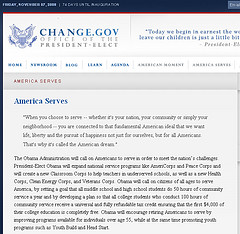
Change.govWith the launch of Change.gov, commentary on Obama’s social media strategy and success have been made here, here and here. Yup, here too. Some are even calling Obama and the government integration of new media tools through Change.gov the Digital New Deal while others wonder about the extension of the Obama brand and community – post election.

*******

Social media is awesome. Grand. Influential. Amazing. In my professional role working with government agencies, I must admit that my first reaction to Change.gov was, “Sweet, I can’t wait for this priority on social media to trickle down among other government agencies. Man, that would make our job so much easier.” Or, would it?

Because now, instead of talking about why to do it, the opportunity to implement may [hopefully] increase, meaning we must show results. And, Obama set the bar high.

Granted, Obama’s campaign is an amazing case study that aided in achieving an important end objective – getting Obama elected. However, Obama’s online success is due to more than social media.

“Overall, the presidential campaign filled 54% of the newshole as measured by PEJ’s News Coverage Index from Oct. 27-Nov. 2. That represents a slight uptick from the previous two weeks when the election was at 52% (Oct. 20-26) and 51% (Oct. 13-19). The race for the White House was the dominant story in all five media sectors, most notably in cable, where it accounted for 84% of the airtime studied, and on the radio airwaves, at 65%.”

  • Obama created the Obama-brand. If you work in government, you may understand some of the government’s sensitivity to the word brand. And from the outside, how the public might react to the government branding or marketing itself. (Hence, the whole debate back when to transition from health communications to health marketing.) However, the Obama-brand has become widely accepted and adapted while maintaining a consistent message to diverse audiences across a range of platforms.
  • The number of resources available. Obama’s fundraising numbers were out of the roof. Not every project is as fortunate. This is why highlighting and emphasizing ROI is important and critical.
  • Obama was the first, and it was sexy. Being the first is always advantageous. In the government 2.0 sector, Obama led the way in showing how to leverage a comprehensive social media plan to create an online presence that connected with the overall program’s mission. Not only did he do it, but he made it sexy by implementing creative elements that encouraged not only online users, but also online ambassadors.
  • Obama and his team understood the essence of social media online and off line. This is the biggest one I think. Obama’s message tapped into the cornerstone of social media – help me, help you, help me, empower America. Did you get lost in that? Web 2.0 is about the conversation and Obama is encouraging conversation with him and among each other. The Change.gov Web site communicates it best:

“Share your vision for what America can be, where President-Elect Obama should lead this country. Where should we start together?”

He took the essence of social media tools and made it his mantra. He is change, but he needs you to help create that change. You want change, but you need him to lead that change. Brilliant.

In your opinion, what other factors outside of social media helped mold Obama’s online success?

Liked what you read? Feel free to share with others: Bookmark and Share

The Cool Factor About Mobile

Mobile. What do we do with this one word? We CAN do so much. Rather than go on, instead, I want to give some examples and highlight the cool factor of how mobile can add some out-of-the-box type thinking to an overall health and/or social marketing-related initiative.

(Granted, any initiative must go beyond cool, and must not be done solely for the cool factor. But, for creative juices, let’s show off some coolness.)

****************

Organization(s): The U.S. Centers for Disease Control and the University of Georgia’s New Media Institute
Objective: Get the word out about National HIV Testing Day

Cool Factor: Personal PSAs, 24 Hours, and Collaboration.

In one day, more than 20 students from 6 universities and five AIDS organizations hit the streets with only cellphone video cameras to produce 8 short video messages to encourage youth to be tested for HIV. (Personal PSAs are those shared via mobile and social networks, in addition to being user-generated.)

****************

Organization(s): University of Auckland Clinical Trials Research Unit and Healthphone Solutions
Objective: Using Mobile SMS Technology to increase individual smoking cessation success.

Cool Factor: Txt2Quit. 480 Customized Text Messages. 26 Week Program.

This is a tested and research-based product produced to help individuals quit smoking. The program was presented at the Texting for Health Conference this past February, and hopes to provide the tool in multiple languages as well!

****************

Organization(s): The 2007 Live Earth Concerts, The Ethical Reputation Index and LightSpeed Research
Objective: 1) Measure the effectiveness among 18-45 year olds of event sponsorship and advertising in real-time and 2) Measure this audience’s interest in green issues raised by the global concerts and sponsors.

Cool Factor: Mobile as a research tool.

The first example was using mobile to raise awareness and increase a call to action. The second example offered a product to those working to stop smoking. This example expands the uses of mobile by showing how it can be used as a medium to conduct research. In case your curious, the response rate was 20% and most notably, the research was done, fast, with results given that same day.

****************

Organization(s): The Fair & Lovely Foundation and Hindustan Unilever Limited
Objective: Increase the visibilty and utilization of the Fair & Lovely Foundation’s scholarship program among women and girls in low-income groups in rural and urban India.

Cool Factor: Cost Effective. Wide Reaching. Full Approach.

All elements of mobile marketing were utilized in this campaign: an SMS Blast, SMS Shortcode (a code word/number individuals can respond to), interactive voice response, banner advertising, a microsite and the Lead Capturing Zone that induced the call to action for individuals to apply for the scholarship. As a result, over 44,000 student applied in 1.5 months and 2 million page impressions were gained from the banner advertising.

****************

Organization(s): Macmillan Cancer Support
Objective: Provide an alternative route to collect donations for those not wanting to donate online via credit or debit card.

Cool Factor: Mobile as a fundraising channel.

For this organization and through this campaign, SMS donations was the most successful mechanism with 59% of donations being made through text.

****************

Organization(s): Save the Children and Verizon Wireless
Objective: Provide lifesaving assistance during the natural disasters that occurred in China and Myanmar.

Cool Factor: Assists during times of emergency.

Individuals could text 4SAVE with the word ‘quake’ to donate to earthquake relief or the keyword ‘cycloce’ to contribute to the cyclone relief. Upon texting, a reply asking for confirmation will be sent and a $5 donation will be added to the person’s phone bill.

****************

Organization(s): Major universities and colleges across the country.
Objective: Implement an emergency notification system for all the University campus community.

Cool Factor: Campus Alert System. Emergency Preparedness.

Across the country, universities and colleges are implementing emergency alert systems through mobile and email technology to prevent another Virginia Tech tragedy. It’ll be interesting to see how other systems and institutions implement a similar strategy.

****************

Organization(s): mGive & Keep A Child Alive, mGive & the Washington Nationals, The MLB and the Children’s National Medical Center, mGive & The All-Star Game, Stand Up for Cancer, and Make a Wish Foundation
Objective: mGive & Keep A Child Alive: Move people to donate during Alicia Key ‘As I Am’ tour; mGive & the Washington Nationals: When the Nationals play the Houston Astros, fans will be asked to donate to the Children’s National Medical Center to fight pediatric diabetes through a mobile/text campaign; mGive & The All-Star Game, Stand Up for Cancer, and Make a Wish Foundation: fans will be asked to donate to these two non-profits during the All-Star game through a mobile program.

Cool Factor: Mobile Giving. Integrated Marketing.

Mobile giving is now becoming a trend. Through the Alicia Keys mobile campaign, over $40,000 was raised to support Keep a Child Alive. mGive itself is a social giving company that helps non-profits utilize mobile technology to increase their fundraising efforts. To see the latest campaigns (including combining broadcast television commercials with a mobile call to action), check out their blog. The Mobile Giving Foundation currently keeps a list of all 36 ongoing mobile giving campaigns.

****************

Organization(s): The Centers for Disease Control and Prevention
Objective: Provide a home site for of CDC’s mobile information about hurricane preparedness and the flu season.

Cool Factor: Government Goes Mobile.

Due to the increasing amount of dangerous hurricane like Katrina, Gustav and Ike, the CDC recently created a mobile Web site to further assist during times of emergency. I see this site growing as the use of mobile increases, but it’s a great first step and a good role model for other government agencies.

***************

Organization(s): Meir Panim (Network of Soup Kitchens in Israel)
Objective: Increase donations for the soup kitchens, while also communicating an individual’s impact on the cause.

Cool Factor: Shows Impact on the Spot.

Meir Panim ran an interactive campaign with banner advertisements asking individuals to ‘SMS for Lunch‘ a promotional interactive campaign: On their website a boy was featured, facing an empty plate. The site encouraged donations and once the system received the SMS, the banner changed to show a full plate of food with the boy smiling. Talk about realtime impact!

***************

MORE:

From these examples, we’ve seen how mobile technology can be used to:

  • Raise Awareness.
  • Provide a product.
  • Be an instrument for research.
  • Be cost-effective, fast, and provide results.
  • Be a fundraising tool.
  • Be creative.
  • Encourage mobile giving.
  • Extend a current campaign.
  • Be another medium to integrate into a marketing program.

What other mobile campaigns exist that you think have an extra dose of the cool factor?

Liked what you read? Feel free to share with others: Bookmark and Share

Forget Personal Branding: What About a Sing-A-Long Resume?

I have lot more to report from the World Social Marketing Conference, however, this news bit is too good not too share. Last week, I connected with Holly Grande on Twitter, and this girl is smart. Not only is she a rising public relations star, but you may not know that she is also rising singing sensation.

So I might have exaggerated a bit (though she has done voice overs for Radio Disney), but Holly took the usual ‘resume’ section on her blog, and instead of posting her actual resume, Holly provided a new range in entertainment. Literally. Check out Holly’s “Sing-A-Long Resume” below. Who wouldn’t hire someone with this innovative creativty (and bravery)?

httpv://www.youtube.com/watch?v=w35SnjFoYco

You can get catch more of Holly on her blog and at BrazenCareerist. What other unique ways have you or your friends done to re-frame and refresh your resume?

Liked what you read? Feel free to share with others: Bookmark and Share