Tag Archives: Social Marketing

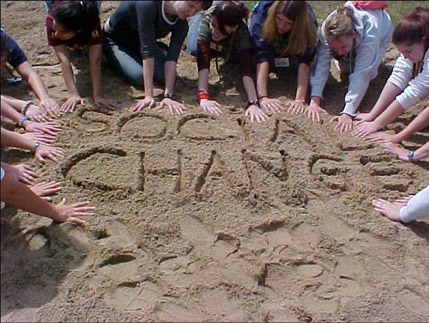
Social Marketing vs. Social Change Marketing

In an earlier post, I clarified how social marketing differentiates itself from social media marketing. Now, I am asking for your thoughts on how the term social marketing relates to the term social change marketing.

social change


Social marketing, as we’ve discussed, has decades of theoretical history and practice. It is a term constantly evolving and defining itself. However, the field also faces a challenge: branding itself…especially since the onset of social media marketing.

Reading through social marketing texts and journals, the terms – social change, marketing for social change, and social change marketing are making increasing appearances, so I am curious on others’ thought about how the two terms relate.

A good summary of the two concepts, including how they relate to commercial marketing, is found in Dr. Stephen Dann’s slideshow titled:

“Social change marketing in the age of direct benefit marketing – where to from here?”

In this presentation, Dann asks the question: Where to from here? which provides information on how social marketing has grown and compares to commercial marketing and what this may mean for the future. Other signs of the concept of social change’s relationship to social marketing dates back to Prof. Alan Andreason’s book: Marketing Social Change. So, there is a history. On the web, Craig Lefebvre’s blog is titled On Social Marketing and Social Change, suggesting the relationship.

Thus, I am curious on your thoughts about the terms/concepts of social marketing versus social change marketing:

  • Can social marketing be renamed social change marketing?
  • Or, is social marketing one component of social change?
  • Or, is social marketing one piece of social change marketing? What’s the difference? Is there a difference?

It may seem like a matter of scrabble to some, but these discussions really engage me, and I hope the enthusiasm sparks interest as I think the relationship between the two terms is continuing to develop and will becoming increasingly important as we work to brand social marketing. =)

Non-Profit Blog Exchange: Virtual Event

For the Non-Profit Blog Exchange’s 8th Virtual Event, top bloggers in social marketing and non-profit communications are writing posts about each other’s blogs and posts. This is SocialButterfly’s inaugural debut in the Non-Profit Blog Exchange, so insightful feedback is always appreciated.

My blog in focus is Nancy E. Schwartz’ blog Getting Attention. Operating since May 2007, the blog acts ‘as a resource of ideas, tactics and tips for nonprofit communicators.’

Ms. Schwartz is founder of Nancy Schwartz & Company, a marketing and communications firm for non-profits and foundation clients. She also manages her blog Getting Attention and Getting Attention’s e-newsletter.

I had come across Ms. Schwartz’ blog previously when she participated in a round of the Carnival for Non Profit Consultants on Dec. 3, 2007. To be transparent, I am a fan of her blog and the information it provides. The site is easy to navigate, is practical, insightful and offers a variety of content on various topics within the social marketing and non-profit communications world.

I’d like to respond to a specific post of Ms. Schwartz titled: Leverage Prez Hopefuls’ Understanding of Women to Increase Your Nonprofit Marketing Impact. Having just come from a seminar at the Sewall-Belmont House & Museum on Women in Politics, this topic is currently on my mind.

In her post, Ms. Schwartz analyzed the current political debate combined with a New York Times article about how gender influences politics to formulate some non-profit marketing insights on the female target.

Her insights are great and helpful. It’s the premises that catch my attention. Take the first premise: Women vote to protect their interests (men vote because they enjoy politics). However, I know lots of men who are concerned with protecting their interests and just as many women (such as those who gathered at the Women in Politics seminar tonight) who are passionate about politics.

Let’s look at another premise: Women network organically so they already have a network or two in place. One of tonight’s speakers, a Virginia state legislator veteran would also attest, that she learned how to fund raise and garner support from observing the ‘good old boys’ network.

Now don’t get me wrong, I agree and find Ms. Schwartz’ marketing insights on women helpful. I also admire how she took a very popular current event and made it relevant to us non-profiteers. I am just reflecting a lot on women, gender, politics and how they relate. My faithful readers will observe that I am big into concepts and terms and how they relate, ;). It’s the academic in me.

So, in closing, let me leave you with this New York Times article from Feb. 10, 2008 titled: When Women Rule. The author of this article poses the question: Can a woman leader be both liked and perceived as qualified and effective? According to this author and others, a woman leader can either be liked or perceived as competent…but not both. You can see how this ties into the article on female target marketing and women politics.

My thoughts on this were phrased well by Missouri Secretary of State Robin Carnahan tonight at the Sewall-Belmont seminar when Carnahan voiced, with enthusiasm and motivation (paraphrased from memory):

“Is running for a political office hard? Yes. Is it hard for anyone? Yes. Is it harder for women and minorities? Yes. Is it unfair? Yes. But let’s get to the ground running.”

Thus, using Ms. Schwartz’ demonstration of creating relevance from an important topic to us marketers and nonprofiteers….let’s hit the ground running with our social marketing and non-profit communication skills and talents all you fellow SocialButterflies!

…to change lives and the quality of life for all!

(Ad Council and IAA) Survey Says: More Social Marketing!

At this past week’s International Advertising Association’s World Congress in Washington D.C, the Ad Council and IAA revealed results from the Ad Council IAA Member Survey on Social Advertising Programs. For all social marketers out there, the results are on our side.

Among the Key Findings, the following figures were given in support of social marketing:

  • 57% of respondents felt their country should implement MORE social marketing campaigns than it currently has.
  • 61% said their country NEEDS HELP developing social marketing campaigns.
  • 90% of respondents expressed interest in sharing and learning MORE about research and creative materials for social marketing campaigns in other countries.

As I was in attendance during this conference, you can imagine how STOKED I was about this. I had to pinch myself. Here I was at the IAA World Congress, and did I hear right:  We are talking about social marketing. The real social marketing. Not social media. I could barely contain myself. Then, it happens again, and then again. And then I realize, the IAA is trying to educate and send a message to the ad community: invest in social marketing!

But where were we social marketers? our experts in the field? our voice? Absent. Here was a chance to share our passion, knowledge, excitement and message with the very industry that we can work with….and we weren’t there. So, here is my message for this post. Social marketing is great and wonderful. But we can’t stay in our bubble. We’ve reached out to the non-profit community, but all advertisers aren’t bad. There are big movers and shakers who want to do good and see the value in doing goog. We need to integrate ourselves with them….not be divisive.

********************************************************

These results were shared with the Advertising industry during the IAA presentation for the 1st Social Responsibility advertising awards. These awards were presented with cooperation between IAA and ACT Responsible. The Grand Prix winner was “Signature” for Amnesty International by TBWA/Paris. To see the rest of the recipients, go here.

(This was a web-based survey through Zoomerang among IAA members from December 13, 2007 to February 11, 2008. 204 completed surveys were received from member respondents in six continents. Respondents included respondents from advertisers, ad agencies, media outlets, research companies, trade associations and universities.)

Philanthropy: Po-ta-toe, pa-ta-toe?

Browsing my facebook groups following my last post on FliP, I found and joined the FLiP facebook group. I noticed one of the discussions posted on the topic: ‘Traditional vs. Social Change Philanthropy.’ For the sake of anonymity, the Poster of the topic wrote as follows:

“On the FLiP homepage there is a great article about how, in many respects, traditional philanthropy is actually reinforcing the status quo. In my comment to that article I quoted Martin Luther King Jr, “Philanthropy is commendable, but it must not cause the philanthropists to overlook the circumstances of economic injustice that make philanthropy necessary.”

What are your thoughts on that? Are too many of us in the nonprofit sector offering programmes that are far too reactive, vs actually examining and addressing the socio-economic issues that require our ‘programmes’?”

This discussion topic is followed by another that asks about philanthropy education programs. And, to my surprise and after some research, there are many, and growing: IUPUI’s Center on Philanthropy, NY University School of Philanthropy, Columbia’s MA in Fundraising, Hebrew University of Israel’s M.A. in Community Leadership and Philanthropy Studies, Bay Path College in Massachusett’s M.S. in Non-Profit Management and Philanthropy, St. Mary’s graduate program in Philanthropy and Development, and MORE!  The programs listed include degrees surrounding fundraising, non-profit management, leadership, governance, development, philanthropy and othe-related terms….yet social marketing termed programs still lack.

Upon this brief internet browsing, I reflected on what the definition of what ‘philanthropy‘ means. Are the terms philanthropy and social marketing interchangeable? What is this term social-change philanthropy? We’ve been talking a lot about the identity crisis in communications, and it appears that there is some overlap. Social marketing does take in the marketing process, but it is also – as the Facebook Poster said – can be applied to looking at socio-economic issues.

Feel free to share as this thought is still developing….how do the two relate to one another and what does this mean for the field of communications or in the non-profit sector?

Who is SocialButterfly? An Interview for BlogHer as the Interview-ee

Beth Kanter, of the Beth’s Blog, who I featured last month as the second member of SocialButterfly’s Blogger Neighborhood, interviewed me for BlogHer. My first official ‘professional’ interview as the interview-ee!

1. Tell me a little about you.

I am a social marketing believer, blogger, researcher, practitioner and enthusiast. Social marketing for good – not to be confused with social media marketing. Currently, my day job is a graduate student at the University of Missouri’s School of Journalism where I will graduate this month. In June, I will start full-time at the social marketing firm I’ve been completing a fellowship at in Washington D.C., working on the client team representing the National Institute on Drug Abuse. As of this moment, I am defending my thesis, graduating and taking a moment to breath, =).

Academics and work aside, my passion is working with and on behalf of nonprofits. My family, myself and a small group of dedicated and committed individuals started a non-profit in Arkansas that benefits multiple sclerosis and works in partnership with the MS Society. In one year, with about eight people, no budget and two main events, we’ve raised over $275k.

2. Tell me about your thesis.

Just the word ‘thesis’ seems to make eyes glaze over, so I’ll try to keep this interesting. What influences you in the actions you take? the opinions or attitudes you hold? What shapes how you feel? Is it CNN broadcasting live, yahoo news feeds, a blog, your next door neighbor, or a guest lecturer? I’m supposing that it’s all the above and more. My research looks at the media landscape and the concept of influence and how this affects the public agenda….and within this mess and shades of gray, how and where the practice of social marketing fits in. I suggest social marketing offers us an opportunity to work collaboratively, erase divisions and provides a platform for those with similar motivations – doing good – to unite across industry fields, and thus, be more effective and successful.
I’m looking forward to hearing feedback and insights when I present the paper at the World Social Marketing Conference in Brighton, England this upcoming September 2008.
3. You’re a digital native (I am guessing ..:-) Millennial or whatever .. so, from your perspective in seeing various campaigns launched by nonprofits that use social media strategies, what are they doing right? What do they need to improve to appeal to folks like you?

Understandably, there are many questions about branching into social media and concerns about it being unregulated. But, I suggest, to just jump in. If not your organization, then you as the marketing/communications/outreach person. You, yourself, need to be familiar with new communication channels. I appreciate the digital native label….but I am constantly finding new applications and new strategies that online technology offers. So new or accustomed, there’s always more to learn.

When you’re open to learning, you’re open to opportunity.

4. Why do you think it is important for nonprofits to embrace social media?

For the same reasons why it is important for you to get to know your neighbors. Or, to teach your child how to change a tire. It just makes sense to know what’s out there and how it can be used.
5. What practical advice would you offer a nonprofit just dipping their toes in the social media waters?

Best practical tip, create a relatively simple, but not hackable password and keep it the same for all the accounts you are going to create. This stays true for the ID/name you create for your accounts. You’re identity still needs to be consistent, and practically, it helps you keep track and manage your online relationships.

Next, do a social media scan of your non-profit and/or cause using Technorati or a Google blog search. There are also social media apps that help you track keywords in the blogosphere. How can you know how to help further a cause, meet needs, etc., if you do not know what people are saying or how people currently perceive your organization/message?

6. Your 5 favorite social media or nonprofit blogs are:

There’s so many good ones out there, that it’s hard to choose. Narrowing it down to best blogs by women helps though…some I love include:
  1. Spare Change by Nedra Weinreich (social marketing)
  2. Have Fun * Do Good by Britt Bravo (nonprofit)
  3. Trendspotting by Dr. Taly Weiss (social media/marketing trends/research)
  4. NonProfit Communications/Carnival for Nonprofit Consultants by Kivi Leroux Miller (nonprofit)
  5. Lorelle on WordPress by Lorelle VanFossen (social media/wordpress help) She gets back to you very quickly with questions/comments too!
…and this one isn’t necessarily nonprofit or social media, but it’s a great break from the routine, work and provides good insight and entertainment: My Cool Job, by Carrie Lowery, where she interviews someone with a cool job multiple times a week and posts the interviews.

Thanks for the interview Beth!

Superbowl PSA Advertisement: Parents, The Anti-Drug

Was anyone else surprised to see this PSA advertisement in the middle of the $2.5 million dollar 30 second ad slots?

[youtube=http://www.youtube.com/watch?v=zY5Css5U82E&rel=1]

At work, rumor has it that the time was really donated for the PSA. How cool is this? Perhaps with other big events and future Superbowls we will start seeing this more and more. My question is though….how did they get this gem of an ad placement? Out of all the non-profits and PSA messages, how did Parents: The Anti-Drug sneak in there? Next year, let’s give them a ton of PSAs to choose from, maybe this will get them to do more of it!

Also, with all the Superbowl advertising water cooler talk, here’s another great tidbit and interactive resource provided by the New York Times: The Super Ad Bowl: Two Decades of Players.

It allows you to view a break down of which types of ads ran each year, what type of genre they used, who advertised, and an one-line synopsis of the advertisement.

Update: The First PSA in-game advertisement was supposedly a 15 second slot by CBS Cares, the NFL and United Way in 2007’s superbowl. Read more here.

Already, for 2008, we saw an increase. the 30-second Parents: The Anti-Drug ad, and Tom Brady’s United Way PSA advertisement as well. Keep the PSA times coming!

The Blogger Neighborhood: Meet the DigiActive Team

candle lightGet out of your comfort zone. This includes myself, often I am use to comfortably perusing my usual blogs in my RSS reader, however, when I first found DigiActive over the summer, I immediately knew I needed to get out more. DigiActive brings together a team of international bloggers from SIX continents and offers great content from diverse perspectives. The change movement knows no boundaries.

I must also give Amine, from DigiActive the award for patience. Amine and I conversed at the end of August, and I am just now getting up their interview. Thank you Amine and the DigiActive team for your world-class patience. Without further adieu, enjoy!

******************

Blog Name: DigiActive.org

Blog Topics: Being the Intersection of Technology and Grassroots Activismfacebook-guide-cover300px

Blog Explained: The group blog at DigiActive.org is part of DigiActive’s overall mission to help grassroots activists around the world use technology to increase their impact. DigiActive also publishes guides, such as “A DigiActive Introduction to Facebook Activism” and maintains a digital activism map. DigiActive is also in the process of launching a research program (R@D), which will provide actionable analysis for the benefit of digital activists around the world.

About the Author(s): The site features an international group of bloggers from six continents from countries including Iran, Morocco, China, Cameroon, the US and Germany. We come from a wide range of backgrounds and professions. Some of us work for NGOs while others are students or journalists. All our bloggers are volunteers and write for the site because of a passion for digital activism.

Why do you blog? A few answers from some of the DigiActive team members include:

“I love to write about things I love” –Kate Brodock

“I write for DigiActive because it gives me an excuse to keep up to date on the cutting edge of digital activism. Activists “hacking” online applications, creating new uses for platforms like Facebook or Google Earth and turning them into tools for change, that’s what gets me up in the morning.” – Mary Jocye

“I’m blogging for DigiActive because I have a crush on digital activism. Blogging let’s me share the product of this splendid connection with a global community, which is another thing I will never really understand, but always be amazed of.” – Simon Columbus

“It is a fantastic opportunity to investigate and learn about this increasingly important movement. I work in a part of the world where these tools are underutilized but needed with urgency, and I use my work to educate and involve the people around me.” – Tamara Palamakumbara

What first prompted you to blog? DigiActive was started by Mary and Amine, who met on Facebook and built DigiActive together before ever meeting in person. Our ambition was “to create a center for the global digital activism movement.” With an ever-increasing number of partners, we are still working to achieve that goal.

Why digital activism? What is it, and how do you know when it’s successful?

Digital Activism is defined as digital actions taken by grassroots organizations or individuals to achieve a social or political change. It means taking the power of the new global reach of user-generated content and turning it towards the purposes of social justice.

It’s hard to know when digital activism has succeeded. Clear-cut cases of digital success, like the Help Fouad campaign in Morocco are rare. Even when a goal is achieved, it is often the result of multiple campaigns, not only digital ones, and often it takes years to achieve these goals. I don’t think there’s a clear formula for success. Digital activism is not about quantity of people you can reach, but it’s about the quality by which you reach them.

What’s the impact digital activism has, or could have, on our community?

One of the greatest strengths of digital activism is that it allows people to collaborate closely regardless of physical location. As mentioned previously, Mary and Amine developed the idea for DigiActive and built the site without ever meeting. In fact, they still live on different continents. Talia edits for the DigiActive blog from Boston, even though our correspondents are dispersed across the globe. I think the two biggest technical advantages that digital activism has are 1) the speed at which technology is being introduced, improved upon, and made widely available and 2) the number of tools that are available, which enables users to use the one that best suits their situation. It’s not a one-sie-fit-all. It’s a custom-tailored approach. The biggest qualitative advantage of digital activism is, as mentioned, the ability to connect to so many people and get yourself in front of large number of eyes and ears!

If you could live on any street, what would that street be named and why?

“Hope Street” – Simon

“The Beginning” – Kate

“TechCanHelpUChangeTheWorld Blvd.” – Mary

Who would be your dream real-life neighbor?

Some of the answers from the DigiActive team include: An international group of passionate grassroots activists, committed to the goal of realizing the human dignity of all the world’s citizens. Dalaid Lama and Dave Barry. Maybe Jon Stewart too.

What was the last URL you added to your RSS feed?

What’s your favorite blog post and why?

Successful digital activism campaign are always fun to write about. Whether it be about young Egyptian activists using Facebook to organize a country-wide strike, about Jamaican gay rights activists who use blogs and the internet to fight to get into a UN AIDS meeting or about activists in Morocco who used the web to coordinate a successful international campaign to free the “Facebook Prisonner”. However it is also important to consider the limitations of digital activism and provide useful information and guides on how to best harness its potential.

What’s one lesson you’ve learned from blogging?

  • Don’t be afraid to express yourself – everyones experience and opinions count.
  • That it takes a global village to write a blog.
  • It’s a great way to meet and to get to know incredible people from around the world.

Liked what you read? Feel free to share with others: Bookmark and Share

**************

Past Blogger Neighbors Include:

This continuous series highlights different blogs and their respective bloggers in the blogosphere neighborhood. Following the great Mr. Rogers, who tells us to ‘Get to know your neighbor,’ this series introduces us to our blogger neighbors, making for a more unified, collaborative voice for the social sector. Like to nominate someone or be featured yourself? Contact me @ socialbutterfly4change@gmail.com.

The Cool Factor About Mobile

Mobile. What do we do with this one word? We CAN do so much. Rather than go on, instead, I want to give some examples and highlight the cool factor of how mobile can add some out-of-the-box type thinking to an overall health and/or social marketing-related initiative.

(Granted, any initiative must go beyond cool, and must not be done solely for the cool factor. But, for creative juices, let’s show off some coolness.)

****************

Organization(s): The U.S. Centers for Disease Control and the University of Georgia’s New Media Institute
Objective: Get the word out about National HIV Testing Day

Cool Factor: Personal PSAs, 24 Hours, and Collaboration.

In one day, more than 20 students from 6 universities and five AIDS organizations hit the streets with only cellphone video cameras to produce 8 short video messages to encourage youth to be tested for HIV. (Personal PSAs are those shared via mobile and social networks, in addition to being user-generated.)

****************

Organization(s): University of Auckland Clinical Trials Research Unit and Healthphone Solutions
Objective: Using Mobile SMS Technology to increase individual smoking cessation success.

Cool Factor: Txt2Quit. 480 Customized Text Messages. 26 Week Program.

This is a tested and research-based product produced to help individuals quit smoking. The program was presented at the Texting for Health Conference this past February, and hopes to provide the tool in multiple languages as well!

****************

Organization(s): The 2007 Live Earth Concerts, The Ethical Reputation Index and LightSpeed Research
Objective: 1) Measure the effectiveness among 18-45 year olds of event sponsorship and advertising in real-time and 2) Measure this audience’s interest in green issues raised by the global concerts and sponsors.

Cool Factor: Mobile as a research tool.

The first example was using mobile to raise awareness and increase a call to action. The second example offered a product to those working to stop smoking. This example expands the uses of mobile by showing how it can be used as a medium to conduct research. In case your curious, the response rate was 20% and most notably, the research was done, fast, with results given that same day.

****************

Organization(s): The Fair & Lovely Foundation and Hindustan Unilever Limited
Objective: Increase the visibilty and utilization of the Fair & Lovely Foundation’s scholarship program among women and girls in low-income groups in rural and urban India.

Cool Factor: Cost Effective. Wide Reaching. Full Approach.

All elements of mobile marketing were utilized in this campaign: an SMS Blast, SMS Shortcode (a code word/number individuals can respond to), interactive voice response, banner advertising, a microsite and the Lead Capturing Zone that induced the call to action for individuals to apply for the scholarship. As a result, over 44,000 student applied in 1.5 months and 2 million page impressions were gained from the banner advertising.

****************

Organization(s): Macmillan Cancer Support
Objective: Provide an alternative route to collect donations for those not wanting to donate online via credit or debit card.

Cool Factor: Mobile as a fundraising channel.

For this organization and through this campaign, SMS donations was the most successful mechanism with 59% of donations being made through text.

****************

Organization(s): Save the Children and Verizon Wireless
Objective: Provide lifesaving assistance during the natural disasters that occurred in China and Myanmar.

Cool Factor: Assists during times of emergency.

Individuals could text 4SAVE with the word ‘quake’ to donate to earthquake relief or the keyword ‘cycloce’ to contribute to the cyclone relief. Upon texting, a reply asking for confirmation will be sent and a $5 donation will be added to the person’s phone bill.

****************

Organization(s): Major universities and colleges across the country.
Objective: Implement an emergency notification system for all the University campus community.

Cool Factor: Campus Alert System. Emergency Preparedness.

Across the country, universities and colleges are implementing emergency alert systems through mobile and email technology to prevent another Virginia Tech tragedy. It’ll be interesting to see how other systems and institutions implement a similar strategy.

****************

Organization(s): mGive & Keep A Child Alive, mGive & the Washington Nationals, The MLB and the Children’s National Medical Center, mGive & The All-Star Game, Stand Up for Cancer, and Make a Wish Foundation
Objective: mGive & Keep A Child Alive: Move people to donate during Alicia Key ‘As I Am’ tour; mGive & the Washington Nationals: When the Nationals play the Houston Astros, fans will be asked to donate to the Children’s National Medical Center to fight pediatric diabetes through a mobile/text campaign; mGive & The All-Star Game, Stand Up for Cancer, and Make a Wish Foundation: fans will be asked to donate to these two non-profits during the All-Star game through a mobile program.

Cool Factor: Mobile Giving. Integrated Marketing.

Mobile giving is now becoming a trend. Through the Alicia Keys mobile campaign, over $40,000 was raised to support Keep a Child Alive. mGive itself is a social giving company that helps non-profits utilize mobile technology to increase their fundraising efforts. To see the latest campaigns (including combining broadcast television commercials with a mobile call to action), check out their blog. The Mobile Giving Foundation currently keeps a list of all 36 ongoing mobile giving campaigns.

****************

Organization(s): The Centers for Disease Control and Prevention
Objective: Provide a home site for of CDC’s mobile information about hurricane preparedness and the flu season.

Cool Factor: Government Goes Mobile.

Due to the increasing amount of dangerous hurricane like Katrina, Gustav and Ike, the CDC recently created a mobile Web site to further assist during times of emergency. I see this site growing as the use of mobile increases, but it’s a great first step and a good role model for other government agencies.

***************

Organization(s): Meir Panim (Network of Soup Kitchens in Israel)
Objective: Increase donations for the soup kitchens, while also communicating an individual’s impact on the cause.

Cool Factor: Shows Impact on the Spot.

Meir Panim ran an interactive campaign with banner advertisements asking individuals to ‘SMS for Lunch‘ a promotional interactive campaign: On their website a boy was featured, facing an empty plate. The site encouraged donations and once the system received the SMS, the banner changed to show a full plate of food with the boy smiling. Talk about realtime impact!

***************

MORE:

From these examples, we’ve seen how mobile technology can be used to:

  • Raise Awareness.
  • Provide a product.
  • Be an instrument for research.
  • Be cost-effective, fast, and provide results.
  • Be a fundraising tool.
  • Be creative.
  • Encourage mobile giving.
  • Extend a current campaign.
  • Be another medium to integrate into a marketing program.

What other mobile campaigns exist that you think have an extra dose of the cool factor?

Liked what you read? Feel free to share with others: Bookmark and Share