Social Media Is Not a Marketing Strategy

There, I said it. Social media in and of itself is not a strategy (gasp). It does not replace a solid marketing approach or even a communications plan. To be successful, it must be integrated into a larger strategic framework. This applies to organizations as well as programs, initiatives and (my dreaded word) campaigns.

Harvard Business Review recently published an article titled “Separate Social Media From Marketing:”

…we need to break out social media and talk about more than marketing and technology. Instead, we need to talk about what social media enables: the ability to collaborate in new ways — which is particularly important for business leaders interested in creating more collaborative, innovative, and engaging organizations. […]

The use of these platforms can truly transform a business by moving beyond brand marketing. Social media has enabled business leaders to think differently about how they engage and interact with both customers and employees. But just because you’ve opened the door doesn’t mean you’ve crossed the threshold into a new way of working, managing, and leading.

Your marketing team might have the best handle on social media, but what about other departments in your organization? When you change the focus from the technology to more about what the technology enables and what you want to achieve, then you change the conversation. You start to be strategic.

An Opportunity for Social Marketers

Craig Lefebvre on Twitter the other day shared an article on Paramount and how they are changing their approach to mobile from brand awareness to driving a behavioral outcome (buying a movie ticket). How we use social media should also evolve. In fact, how we view marketing and communications in general needs to evolve. Marketing isn’t something you think about “later,” it’s about so much more than communications and it doesn’t live within just one team. It’s integral to your success now and everyone plays a role.

I’ve written before about the “Word of the Year.” As December nears, I’m starting time for reflection early and designating all of December a time to ponder on the past, step back from the present and imagine tomorrow. My first thought? 2012’s”Word of the Year” might just be integration.

Reading Up On Social Determinants of Health

October may be Breast Cancer Awareness Month, but a number of articles came out last week focusing on social determinants of health. The phrase “social determinants of health” refers to health where we live, learn, work, play (and pray). In short, Health with a capital H.

U.S. Life Expectancy Rises, Health Disparities Increase

Last week, the U.S. Department of Health and Human Services (HHS) shared its review of Healthy People 2010. The report shared that as a Nation, we had met or were moving toward meeting, 71% of the disease prevention and health promotion objectives we set in 2000.

Despite this, the data also underscored the need for improvement in a number of critical areas, including health disparities and obesity rates. These two issues, as well as other key indicators of health, are top priorities of Healthy People 2020 (disclaimer: client).

“…Addressing health disparities continues to be our greatest challenge,” said Dr. Edward Sondik, Ph.D., director of the National Center for Health Statistics (NCHS). “…All Americans should be concerned that disparities among people from socially, economically or environmentally disadvantaged backgrounds have generally remained unchanged.”

*****

Examining a 40-Year Spread in Life Expectancy Abroad

The October issue of the World Health Organization’s (WHO) Bulletin is packed full of information on social determinants of health–including examples of work in progress and insights gained from around the world.

“Yes, there is a greater than 40-year spread in life expectancy among countries and dramatic social gradients in health within countries,” said Michael Marmot of University College London in his editorial. “But the evidence suggests that we can make great progress towards closing the health gap by improving, as the [World Health Organization’s Commission on Social Determinants of Health] put it, the conditions in which people are born, grow, live, work and age.”

The bulletin includes another editorial that highlights potential solutions to improving the social determinants of health, as well as a number of research articles and relevant news.

*****

An Agenda for Fighting Disparities

What are the Occupy Wall Street protests all about? Author Geoff Livingston describes its as a “groundswell of economic injustice.” Playing a role behind the scenes in economic and social injustice are social determinants of health and health disparities. Perhaps it’s time to bring them to the forefront.

The October issue of Health Affairs presents an agenda on fighting disparities. In it, Dr. Howard Koh, Assistant Secretary for HHS, discusses a key part of this agenda, HHS’ National Action Plan to Reduce Racial and Ethnic Health Disparities. Analysis and commentary on how health reform may impact health disparities is also provided. What might be most surprising is that one research study included in the issue, shares that only 59% of Americans are even aware that health disparities exist!

*****

No Black-White Health Gap in Canada Says Study

Meanwhile, our friends in Canada may be one step ahead. According to a recent study and as reported in BET, “blacks are equally healthy as their white counterparts.” BET went on to say:

“Thomas A. LaVeist, a co-author of the study and director of the Hopkins Center for Health Disparities Solutions in Baltimore says that he believes America’s history of treating Blacks as second-class citizens plays a large role in the Black-white health disparity that exists in the U.S.”

As a heads up, LaVeist also cautions taking the results at their surface as the the results could have significant limitations because the survey included just 729 Blacks, compared with more than 280,000 whites reported BET.

*****

Health is About More Than Healthcare

LaVeist also published another study about how place–and not necessarily race–contributes to  health disparities. The study, based on a neighborhood in Baltimore composed equally of whites and blacks, found that within the integrated community, health disparities all but disappear. This suggests that as a Nation, we’ve been looking for answers on how to improve health the wrong way. Instead, we should be looking at what’s going on in certain communities that what’s going on within certain populations. As quoted in the Atlantic:

“Solutions to health disparities are likely to be found in broader societal policy and policy that is not necessarily what we would think of as health policy,” LaVeist says. “It’s housing policy, zoning policy, it’s policy that shapes the characteristics of communities.”

*****

flickr credit: woodleywonderworks

Activating The Global Health Trifecta

Image: PSI

Is foreign aid important to Americans? According to a recent poll, most Americans believe U.S. investment in foreign aid is 25% of the Federal budget, when the accurate figure is less than one percent. When asked what would be an appropriate percentage, the median amount shared was 10%. Yet–even that less than 1% is in jeopardy.

Earlier this week, ONE, USAID, FHI 360, PATH, Population Services International (PSI) and World Vision launched “The Power of 1%” campaign to highlight the economics of global health and the benefits U.S. investments overseas have for Americans at home. Having attended, I was reminded of the global health trifecta: what can happen when the power of 1%, the power of the media and the power of youth combine to influence and inspire good.

The Power of 1%

When it comes to emphasizing the true power of 1%, it’s important to not only look at the positive impact it has on the individuals and communities it supports. It also serves to improve the economy here at home and help increase national security. In August 2010, Sec. of State Hillary Clinton announced the State Department’s Global Health Initiative, working to improve global health as a way to achieve diplomacy.

“We know that the health of people in any nation is inextricably linked to the growth of its economy and security,” said Donald Steinberg, Deputy Administrator for USAID, “We invest in the health of developing nations because it is the right thing to do, and because our economy and security is dependent upon it as well.”

Addressing global health is now a  part of the U.S.’ international diplomacy efforts as well as on our health agenda. The U.S. Department of Health and Human Services added global health as a new area of focus for its Healthy People 2020 initiative (disclaimer: client) which was released in December 2010. The Healthy People 2020 global health topic area looks to address five specific objectives to “improve public health and strengthen U.S. national security through global disease detection, response, prevention, and control strategies.”

Not only is funding critical to achieve these goals, but an important step will be enabling and empowering the global citizen to play an active role. Our world is growing (estimated to reach 7 billion by October 31) but it’s also shrinking. We are becoming more connected and more aware of the problems we face and the commonalities we share–mainly due to the next component in the trifect, the power of media.

The Power of Media

9 in 10 adults agree that digital technology can turn interest in a cause into a movement. Facebook has over 800 million active users and is translated in 70 languages. Six in ten Americans go online wirelessly using a laptop or cell phone. 86% of adults ages 18-29 use social networking.

We’ve already seen the power of media at work. Online fundraising raised over $20 billion dollars in 2010. Technology is saving lives and enabling communication. Community-funded journalism and citizen journalists are changing how the news is reported. Add to this innovations such as Random Hacks of Kindness, Code for America, Crisis Camps, Ushahidi, accessible health data and a slew of additional examples. And it’s not just digital technology and the mobile Web at work.

ABCNews was awarded for its global health coverage. In December 2010, ABC News launched a year-long effort to provide coverage on global health in the developing world with the help of a grant from the Bill & Melinda Gates Foundation. Today, ABCNews continues its commitment to global health through it’s One Million Moms Challenge, which focuses on improving maternal health globally.

Media–no matter the form it takes–can help not only increase awareness but also inspire action.

The Power of Youth

“More than 60 percent of the world’s population is under the age of 30,” said Ronan Farrow, Special Advisor to the Secretary of State for Global Youth Issues,  at a High Level Meeting on Youth, in the U.N. General Assembly this past July. “And that demographic, increasingly empowered by the new technologies that we’ve discussed…is increasingly a potential driver of great economic and social reform.”

Farrow, a dynamic speaker with genuine assertiveness in his belief in youth, also acknowledges that the “[youth] demographic can be one of the great threats to national, international, stability and security.” Data shows that 86% of all nations with new outbreaks of civil conflict have significant majorities under the age of 30. This is one reason why the U.S. State Department has created  its new Office of Global Youth Issues which Farrow leads.

“The United States is focusing on economic empowerment, through programs around the world that educate, create employment opportunities, and foster entrepreneurship for young people,” continued Farrow in his remarks. “We are launching initiatives that encourage civic participation, create local leadership opportunities, and develop linkages between young people and their governments.”

This is a call to action not only in our work abroad, but also here at home. How are you empowering youth in your community and in your work?

Start Today

At the event, organizers took video testimonies of what the power of 1% meant to attendees. To me, the power of 1% reminds me of how the heart of a person can inspire the power of a community for good. Funding and politics aside, one person can make a difference–and that’s what the campaign inspires. Somedays–it’s easy to forget the power you hold. Don’t doubt your purpose or question your mission. You were called for a reason.


Facebook, Health and the Pursuit of Happiness

Facebook has become just about as integrated into American culture as apple pie. We all know apple pie tastes amazing–but when taken to the extreme and eaten on a consistent basis, it’s not exactly the healthiest food. This applies to Facebook as well. Facebook can offer a number of benefits–but it also has some potential drawbacks. And despite our shared love for Facebook, it’s important to be aware of its possible drawbacks. This post looks at a number of different research studies published in the past year that include some interesting findings.

Does Facebook help us feel more connected—or alone?

A recent set of studies found a paradox in Facebook psychology. The studies looked to answer the question: Does using Facebook help us feel more connected, or not? The results may surprise you.

The research was actually conducted through four different yet connected studies. The first study found that frequent Facebook usage relates to both increased connection–as well as increased feelings of disconnection. The second study found that disconnection motivates greater Facebook usage as a coping strategy as greater usage leads to greater connection (yes, this seems odd given the first study’s results).

The third study deprived participants of Facebook use for 48 hours. While feelings of connection decreased, the feeling of disconnection was unaffected. However, those who felt more disconnected actually engaged in increased Facebook use during a second 48-hour period.

In the fourth study, participants set a goal to reduce their use of Facebook. In setting this goal and working to achieve it, greater disconnection was felt. Those that had this feeling performed worse in achieving their goal.

Mirror, Mirror on the Wall: Who has the best self esteem of them all?

Another study conducted by researchers at Cornell found that Facebook usage actually leads to increased self-esteem. “Facebook can show a positive version of ourselves,” associate professor Jeffrey Hancock told CNN. “We’re not saying that it’s a deceptive version of self, but it’s a positive one.”

Hancock is the co-author of a report titled, “Mirror, Mirror On My Facebook Wall: Effects of Exposure to Facebook on Self-Esteem” that was published in the journal Cyberpsychology, Behavior and Social Networking. The study put 63 students in a university computer lab. Some computers were turned off with a mirror in front of it—while others were turned on showing the student’s Facebook page.

For three minutes, participants either stared at themselves in a mirror or reviewed their Facebook profile. When time was up, students were given a questionnaire to measure their self-esteem. The students who had been reviewing their Facebook profile gave more positive feedback than the others. The participants that edited their Facebook profile actually gave themselves the highest marks.

“For many people, there’s an automatic assumption that the internet is bad,” Hancock is quoted saying in an article published by CNN. “This is one of the first studies to show that there’s a psychological benefit of Facebook.”

Is the grass really greener?

Another study supports this finding as it found that those who like themselves tend to share more of themselves through social networks. And, that those more active on social networks tend to think more highly of themselves.

At the same time, another set of research published this past January, found that Facebook reinforces the idea that “the grass is always greener” and that everyone else is happier and better off than you. This research “suggests that people may think they are more alone in their emotional difficulties than they really are.” Not exactly a recipe for great self-esteem…

What does this mean for us?

Given the mixed results already discussed, we know research has also found that Facebook and social networking can help increase connectedness among certain communities–especially when it comes to our health. This post is in no way meant to be a down-with-Facebook rant. More so, here’s the take-away for us: Have a self-awareness of the good and the bad impact Facebook may have on you, to your community and in your work. Knowing and understanding the positive impact technology can have as well as its potentially harmful effects is a part of digital literacy. For those working in public Health, it’s an awareness we need to consider.

BONUS: BJ Fogg’s Psychology of Facebook class is on my need-to-do list. 

Do you know of additional research that looks into the psychology of Facebook? Please share!

flickr credit: Jason A. Samfield

New Research Suggests The Color Pink is Bad for Breast Cancer

Gender Cue ResearchA new research area around gender cues and its impact on awareness and fundraising efforts is just getting off the ground according to Dr. Stefano Puntoni, an Associate Professor of Marketing Management at the Rotterdam School of Management, in an interview conducted by Harvard Business Review.

“[Gender que research] is quite new…Over the past 10 years, researchers have put more effort into thinking about consumer welfare. What can we we do as researchers to help consumers make better decisions?” Dr. Puntoni said. “How can we effect change in areas like overeating and disease prevention? This is part of that. We could go more general with gender cue research, but breast cancer is such an important disease that I want to study this more on its own.”

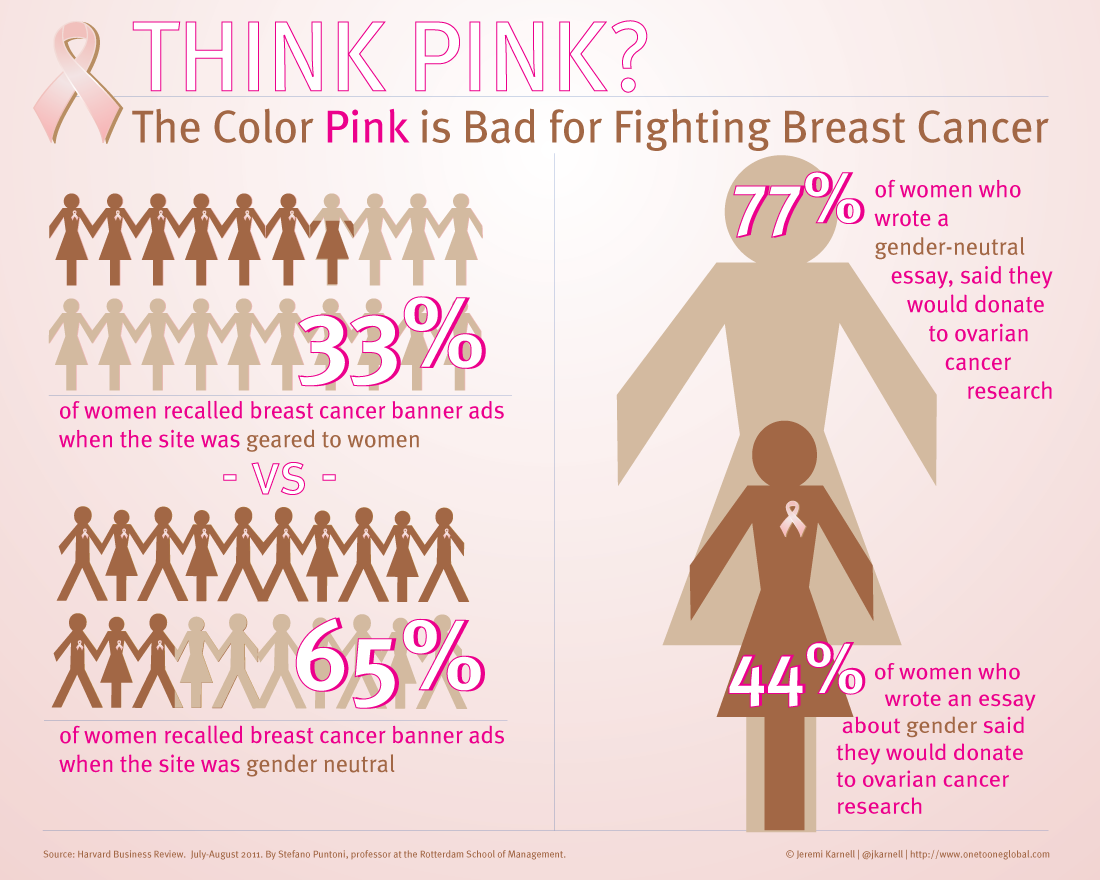
Dr. Puntoni is talking about the findings from 10 different experiments over the past three years that suggest gender cues (such as the color pink) may be counter-productive to campaigns against women’s diseases, such as breast cancer awareness and fundraising efforts. The main insight from the research found that when women saw branding that included gender cues (like the color pink), the branding and ads were less effective. Why? Possibly because the subconscious goes into a state of denial, causing women to:

  • Think they are less likely be at risk
  • Say they are less likely to donate in reaction to a breast or ovarian cancer advertisement

The infographic below created by One to One Global highlights more of the Dr. Puntoni’s research:

Gender Cue Research

Komen Responds

A spokeswomen for Susan G. Komen responded to the research in Ad Age saying that: “The research is food for thought but pink has worked well over the years,” she said. “I would say that in our experience for over 30 years now we’ve been pretty successful using pink. We’ve raised over $2 billion for research and community programs to help people with breast cancer. I don’t want to necessarily discount [the research]. It’s something to look at and consider, but our historic experience has been that we’re doing okay with the pink.”

The AdAge article continues:

Susan G. Komen, who died of breast cancer in 1980, also wore a lot of pink, the spokeswoman said, forming a strong association for her sister Nancy G. Brinker, who later founded Susan G. Komen for the Cure. “It’s not just a random color we selected,” she said. “It actually reflects the connection between the two sisters and the promise that was made.”

Though some have seen success with the color pink specifically, the research around gender cues is “something to consider” for breast cancer and beyond. Just like there’s cause fatigue, perhaps there’s been so much success—that younger generations of women don’t see the risk or the need to donate.

What do you think?

Citation:
Puntoni, S., Sweldens, S. & Tavassoli, N.T. (2011). Gender Identity Salience and Perceived Vulnerability to Breast Cancer. Journal of Marketing Research, 48(June), 413-424.
flickr credit: ILRI

Margaret Mead Predicts Social Science

“Never doubt that a small group of thoughtful, committed citizens can change the world.” Margaret Mead said this in the early 20th century. Who knew that in the early nineteen hundreds, she’d be quoting today’s science?

People and Crowds

A new study conducted at the Social Cognitive Networks Academic Research Center (SCNARC) at Rensselaer Polytechnic Institute on how beliefs spread through social networks found that minority rules: Only 10% of a population needs to be convinced of a new or different opinion to change the beliefs of an entire community.

According to the article, there are two main take-aways for those in the public health space:

  • Public health campaigns might do well to target a small percentage of a community.
  • Getting an entire population to adopt a new belief might require simply convincing 10 percent to believe it first.

In an interview, Prof. Boleslaw Szymanski, director of SCNARC, was quoted saying:

“We suggested,” Sreenivasan said, “that instead of trying to convince everyone, it might make the most sense to target selectively the people who are open-minded enough to hear out the evidence and make up their minds rationally.”

Reading through the details of this study is fascinating and so many questions come to mind for future exploration:

  • Is minority rule a good thing? This research helps us better understand the importance to develop messages, materials and services with a certain community in mind to help ignite a movement. However, taken to the extreme, one can’t help but wonder about this insight being applied with misguided intent.
  • Is 10% the tipping point? Once you reach 10% of the population–is that the tipping point for spreading ideas through social networks and alter behaviors on a larger scale?
  • Does this rule apply across the board? According to the article, the research is still in its early stages. It’s uncertain if this 10% rule will apply to all kinds of beliefs, especially political ones.
  • How does this connect with influencer theory? So much has been said about the role of influencers: who they are and how to connect with them–and if that even matters. Craig Lefebvre made a good point during last week’s CDC conference that the hyper-focus on influencers leads to a “distraction from understanding who are the ‘influenced’ and what can we learn from them.” I tend to agree.

What about you–What’s your reaction to this research?

flickr credit: ThisParticularGreg

Fame, Impact and the Rat Race We Run

“It is easier to reach fame than impact.” These wise words were shared by the great Hans Rosling, global health professor and economic development extraordinaire, in a recent interview. For someone who has had such an impact on a variety of fields and influences in ways that are too many to count and are applicable across so many different disciplines–we should heed these words.

What are you striving for? It’s so easy to get distracted, disillusioned or just discouraged from the full potential and possibility of what we as individuals, teams and communities could achieve. And achieve isn’t the right word–but more so: experience, live, build and share.

We get comfortable. We feel as if, because people know who we are or rely on us–that means we’re having a long-term impact. We start to feel stress, pressure and anxiety to get X deliverable done–and expend energy focusing so much on the little things–we lose sight of the greater impact that’s possible. Sometimes I just wonder what would happen if we just took more time to talk to our neighbors, to hold the door open, to listen to people’s hurts, to encourage people to chase their dreams with purposeful abandon–just how much we could truly accomplish.

It’s easy to get lost in these thoughts (and I apologize if you feel I’ve rambled)–but this is why Rosling’s quote resonates. It’s simple and direct. So the next time you find yourself rushing, impatient, tired, proud, accomplished, rich–ask yourself if you’re feeding your desire to reach fame–or your desire to have an impact.

So How Do We Align with Impact?

Here are some initial thoughts:

  • Be a team player–not a team slayer. Words of encouragement go so far–and all it takes is one harsh criticism, look or experience for someone to be completely cut down.
  • Self-Awareness. Realize that how you walk, act, speak, listen (or not listen!) all communicate to others how you value them, their work and yourself.
  • Encouragement. The more I realize how much people are isolated anymore, the great need I see for a culture of encouragement. My mother is the ultimate encourager–she calls me, writes me, emails me, posts on my Facebook wall–words of encouragement. Encouragement can change lives, build bridges of understanding, create common ground and develop a deep sense of trust.
  • Take time to reflect. You can do this however you prefer–running, driving home, in the shower, before you go to bed. Reflection provides time for us to assess our actions and learn from them.
  • People matter. This might seem obvious, but people–no matter their gender, age, race, creed, income, education-level, etc. matter. We are all members of the global citizenship–let’s not overlook anyone.

Please share your experiences in the comments–let’s learn together and kick fame’s butt–by reaching (living!) for impact.

flickr credit: Kate’s Photo Diary

The Understatement that is Digital Literacy

On Friday, the Department of Commerce’s  National Telecommunications and Information Administration (NTIA) in collaboration with a number of Federal agencies (including the U.S. Department of Health and Human Services)  launched of DigitalLiteracy.gov. The Web site serves to “provide libraries, community colleges, schools and workforce training centers a variety of resources and tools for teaching computer and Internet skills, which are increasingly necessary for success in today’s economy.”

This “online portal” serves a dire need and includes:

  • Workforce development materials
  • Curriculum materials
  • Train-the-trainer materials
  • Games and interactive tutorials
  • Reports and articles

Built with a user-friendly taxonomy and easy-to-use search features, the site also includes the opportunity for collaboration and feedback. DigitalLiteracy.gov augments NTIA’s Broadband Technology Opportunities Program, a Recovery Act grant program that invests in projects to expand broadband access and adoption in the United States.

Working Group Members of the Digital Literacy Initiative
What’s Cool

Often, sites launch and then people think about marketing them based on a mentality that “if you build it, they will come.” This might have worked for the Field of Dreams, but marketing and outreach needs to be a core component of launching any product from the get go. So get this:

NTIA is partnering with the American Library Association and the Institute of Museum and Library Services to promote the use of the portal by the nation’s 16,600 public libraries. Now THAT is interesting and THAT is where the real change will occur. This piece of information was the last bit of content shared in the three-page fact sheet about the launch. Yet, it’s where the real meat is (IMO).

Yes, having this resource is great and the fact that so many people are coming together around digital literacy is especially important to recognize. But here’s the thing: The launch of the site is a great milestone, but it’s only the beginning.

Digital Literacy and Public Health

Public health folks need to pay attention. More and more health information is going online and digital. How are the people who most need this information going to use it if 1) they can’t access it and 2) they don’t fully understand it? DigitalLiteracy.gov provides information to those working to help Americans develop digital literacy skills–but there’s also the feedback loop.

Librarians are public health professionals who often advocate to be a part of the solution, but who are sometimes overlooked–not anymore. 16,600 libraries means at least 16,600 stories. Let’s hope we get to hear about how these libraries are using DigitalLiteracy.gov and the impact its having on library patrons.

One of the best parts of the site is the “In the Community” section which highlights best practices from a variety of programs working to address digital inclusion and digital literacy. We need to hear–and listen to–these stories. We need the stories of success–just as much as we need to hear about the ones that failed. Why? Because it’s all about learning. We can learn from those teaching digital literacy and from those developing their digital literacy skills themselves to inform how we produce and deliver public health information.

Broadband access and digital literacy is vitally relevant to public health. Because of this, all public health folks should read the National Broadband Plan, understand it, and advocate for digital literacy and health literacy. Without either, we won’t get too far.

Hope is Rising

If we are afraid to respond–who will? To call these individuals unsung heroes–is an understatement. The people featured in the documentary Reparanda (trailer below) are warriors of humanity fighting for hope. The hope they bring can’t be seen, can’t be touched but it can be felt and in Guatemala, the hope is rising.

httpv://www.youtube.com/watch?v=3LGRAiWyu14

As many of you know, my grandma, my mom and I traveled to Guatemala last June to be fellow soliders in the fight for transformational change in what some think is a hopeless situation. The tragedy is real (10 minutes after we entered a homeless shelter–a man was shot and killed right outside the shelter’s door!). But the change is real too–Mother Tita as many often call her has built not just one, but two schools(!) in the largest slum in Latin America located in Guatemala City.

This documentary, produced by the group Athentikos, highlights the work of Mother Tita and some of the people we met on our trip in Guatemala. The people in the trailer–I’m honored to say I’ve met, I’ve shaken their hand, I’ve seen their tears, I’ve prayed with them and I respect, admire and love them.  Words aren’t enough–When people make impressions on your heart–on your being–you can’t fully express what that does to you.

Perhaps you’ve had a similar experience? Some people experience this and start their own company. Some people create a nonprofit. Some people work to tell the stories of those who share in the same experience. Others just do.

Believe in your story. Online, we talk about influence to the point of fatigue. We are all so much more than influencers–We can be changemakers. How will you respond?