Author Archives: Alex

Federal Web Council Reveals New Study: Putting Citizens First, Transforming Online Government

“There are about 24,000 U.S. Government Web sites now online.”

“Only a minority of government agencies have developed strong Web policies and management controls. Some have hundreds of “legacy” Web sites with outdated or irrelevant content.”

“We have too much content to categorize, search, and manage effectively, and there is no comprehensive system for removing or archiving old or underused content.”

“Agencies should be required and funded to regular content reviews, to ensure their online content is accurate. relevant, mission-related, and written in plain language. They should have a process for archiving content that is no longer in frequent use and no longer required on the Web site.”

According to my twitter search RSS feed, the term “Government 2.0” is increasing in frequency and popularity. More bloggers and more blog posts continue to emerge on what and how government should improve its online Web presence, leveraging social media. Thus, I was enthused to read last week’s report from the experts themselves: government, to accomplish just this.
Last week, the Federal Web Managers Council, comprised of Cabinet agency Web Directors released its study titled, “Putting Citizens First: Transforming Online Government.” Its purpose is to “recommend specific strategies for revolutionizing how the U.S. Government delivers online services to the American people.

One of the most exciting pieces of the report (in my opinion) is what I understand as the government’s endorsement for more social media:

“The Government should use social media, not just to create transparency, but also to help people accomplish core tasks…To do this, the government must ensure that federal employees who need access to social media tools have them, and that these new ways of delivering content are available to all, including people with disabilities.”

Within this document, the Federal Web Managers Council also reveal their shared vision for the government’s presence online. This vision is for the public to:

  • Easily find relevant, accurate, and up-to-date information
  • Understand information the first time they read it
  • Complete common tasks efficiently
  • Get the same answer whether they use the Web, phone, email, live chat, read a brochure, or visit in-person.
  • Provide feedback and ideas and hear what the government will do with them
  • Access critical information if they have a disability or aren’t proficient in English.

The list of recommendations is not limited to but includes:

  • Establish Web Communications as a core government business function
  • Help the public complete common government tasks efficiently
  • Clean up clutter so people can find what they need online
  • Engage the public in a dialogue to improve our customer service
  • Ensure under-served populations can access critical information online.

For more information or to read the report in its entirety, the full report is available here.

Your Turn: What do think of the recommendations, how would you prioritize and what else might you include?

Liked what you read? Feel free to share with others: Bookmark and Share and/or connect with me on Twitter – @socialbttrfly.


Crossing the line or a Creative Cross? MySpace Research with “Dr. Meg”

Have you heard of Dr. Meg? Maybe not, but if you’re a teen on MySpace you may have. Interesting research that was first published in the January issue of Archives of Pediatrics & Adolescent Medicine showed that adult supervision of MySape can raise adolescents’ awareness of how accessible their profiles are online.

To come to this conclusion, Dr. Megan Moreno, a pediatrician and adolescent medicine specialist at the University of Wisconsin-Madison, and fellow researchers, embarked on two separate studies to explore this issue further. Both research studies are to 1) encourage increased parental and adult supervision by family and friends, and 2) to potentially encourage similiar outreach approaches.

Dilemma: To Cross or not to Cross the Ethical Line

The research is very interesting, however, I feel an ethical discussion must be had. I am not saying Moreno’s approach was wrong or right, but I think we should slow down and discuss it further to learn and develop best practices, as well as ethical guidelines, especially since others may adopt this practice towards younger youth.

Headlines have buzzed about “Busybody Dr. Meg,” concluding that this outreach and behavior-change may offer hope to future, similiar methods being implemented by others. To me, I feel there can be high-levels of concerns with a universal application of this approach unless the strategy and concept is stretched. Including, but not limited to – the age those being contacted, how people are being contacted, the language and type of approach involved, the privacy and the stalking-like component, among other items. Additionally, does it matter who, as in which type of organizations embark on this strategy? For example, I can foresee potential problems if adopted by government health agencies and citizens’ concerns over freedom of expression. Curious on others’ thoughts on this! šŸ˜‰

Background About the Studies

Study 1. For the first, researchers located 190 MySpace public profiles in a single urban ZIP code, randomly selected from 10 U.S. Census areas with the lowest average income because researchers wanted to target adolescents who might have less access to doctors.

All the users involved revealed that they were 18 to 20 years old and their pages included three or more references to sex, drinking, drug use or smoking. Of the 190 profiles selected, half were sent “Dr. Meg” e-mails. After three months, 42% of those getting a “Dr. Meg” e-mail had either set their profiles to “private,” or they had removed both sexual or substance usage references. 29% of those not contacted made changes over the three-month period.

Study 2. In another study, Moreno and other researchers looked at 500 randomly selected MySpace profiles of 18-year-olds nationwide and found that more than half contained references to risky behavior such as sex, drinking and violence.

Your Turn: Crossing the line or a creative cross?

What do you think? I agree that there is a growing issue and concern for online safety and online identity of teens, youth, young adults and people in general, and this is an interesting new development to the field. How can you see this approach being adopted by your organization, or what would be your reaction if you were approached? Am I over-reacting?

photo credit: LoonSky

*********
Liked what you read? Feel free to share with others: Bookmark and Share

How YOU Can Attend the Presidential Inauguration of Barack Obama

With the holidays quickly behind us, many are looking forward to the next one: The Presidential Inauguration of Barack Obama on Jan. 20, 2009. Indeed, many companies [at least in the DC area] are giving an added holiday to their employees in recognition of the day!

Other organizations are offering ways for individuals to get more involved and to attend:

The CASE Foundation recently launched a “Change Begins With Me: initiative that coincides with a free trip for two to the inauguration. The campaign calls for people across the nation to visit the CASE Foundation’s Web site and make a personal pledge to “be the change” in 2009 by finishing the sentence “Change begins with me…” No idea is too small or big…whether it’s a personal commitment regarding one’s neighborhood, school, community or world. As an added bonus, this person will also participate in the Washington, DC Martin Luther King Day of Service. To get the creative juices flowing, the CASE Foundation has some other great initiatives that allow one to take action and also lists ways to “be the change” on their blog. Entries will be accepted until 3pm Jan. 12.

The Presidential Inauguration Committee is also offering your potential “ticket to history” to ten lucky winners between now and January 8. To be considered, you just have to answer the question, “What does this inauguration mean to you?” If selected, you and a guest could be flown to Washington D.C., put up in a hotel, and be part of this once-in-a-lifetime event.

Road Trip to Change. On a budget? No worries. Organizers, led by Horace Mackey, are gathering people in over 20 cities together in groups and car-pooling to the big day! If interested, you can still sign up, join the fun and make new friends along the way.


What have I missed? Are there other contests/opps out there not listed?

*********
Liked what you read? Feel free to share with others: Bookmark and Share

Words of the Year for 2008: What’s Yours?

One of the NY Times 2008 Buzzwords

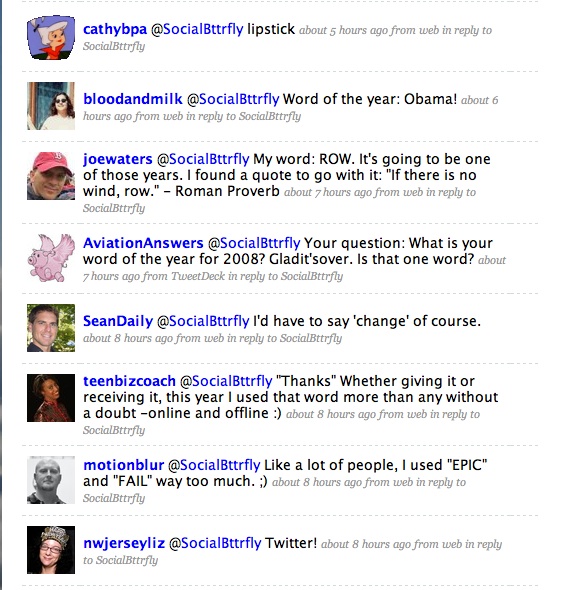
2008 was a big and busy year, can you imagine having to choose just ONE word to describe it? Just ONE?!? Some of our favorite sources share what their “Words of the Year” are below:

*************

New OxFord American Dictionary: hypermiling. According to the Web site, Hypermiling was coined in 2004 by Wayne Gerdes and means “to attempt to maximize gas mileage by making fuel-conserving adjustments to one’s car and one’s driving techniques.” In 2008, with the soaring gas prices, many of found ourselves “hypermiling” or just miling…by running/walking on our two legs to work!

Merriam-Webster: Bailout. Does this one even need describing? According to the Web site, “bail out” is defined in Merriam-Webster’s CollegiateĀ® Dictionary, Eleventh Edition as “a rescue from financial distress.” In 2008, the word received the highest intensity of lookups on Merriam-Webster Online over the shortest period of time. Other contender’s in Merriam-Webster’s top ten include: vet, socialism, maverick, rogue, misogyny, turmoil, trepidation, bipartisan, and precipice…All so positive sounding, don’t you think?

The New York Times. The Times, on the other hand, has chosen it’s set of “buzzwords” for 2008. These words include “Obamanation,” “Frugalista,” “Staycation,” “DigitalCliff,” “Fail,” and many others.

Webster’s New World Dictionary: Overshare. With popular votes taken and input from their editors, overshare was this year’s choice. According to the Web site, “overshare” is a verb that means to divulge excessive personal information, as in a blog or broadcast interview, prompting reactions ranging from alarmed discomfort to approval. In 2008, with information-mania and the economic problems as well, overshare can have stand for a plethora of meanings and correlations.

Global Language Monitor: Change. The other two in the top three were bailout and Obamamania.

SocialButterfly’s 2008 Word of the Year: Influence. For better or worse, as a buzzword, an academic concept or in terms of personal reflection, the word influence was spoken of, talked about, measured, desired, hated, calculated or loved. Thus, for me, the term “influence” describes 2008. (Web 2.0 was a close second, but that term has just gotten…grilled well and overdone.)

Twitter. In Twitter style, I asked SB follow-ers what their word for 2008 would be. One the respondents even mentioned that “Twitter” would be their word for the year! With the spike in news (and usage of Twitter) increasing daily, seems to make sense.

What do you think? Do you think these words say “2008?” Look forward to reading in the comments, what you would choose as your 2008 Word of the Year? Or, you can be like the American Dialect Society, and wait until January to reveal. They are taking nominations now. =)

Illustration by Jessica Hische
Liked what you read? Feel free to share with others: Bookmark and Share

Defining Health 2.0

According to a January 2008 study titled How America Searches, Health and Wellness:

  • In the past 12 months, 59% of adults reference the internet to find or access health and wellness information.
  • 67% of adult searchers use general search engines as an online tool or resource for health information and only 7% referred to online drug advertisements.
  • 36% of adult searchers use online health information to see what other consumers say about a medication or treatment

Because of statistics like those above, the concept of ‘Health 2.0’ has increased its usage and importance. Simply, Health 2.0 = the merging of social media into healthcare. However, others see the movement of Health 2.0 as something much wider and farther reaching. Even Google image searching shows a variety of more complex definitions. I’d be interested to see how you all define it for yourselves or for your practice.

Examples of Health 2.0

Websites

  • Carol.com , started in 2006, is the marketplace for care, allowing hospitals and providers to ‘bid’ for consumers’ care
  • Vitals.com, allows patients to review their current doctor’s or a potential doctor’s reviews and ratings
  • DoubleCheckMD, allows consumers to check for potential drug interactions quickly and easily
  • American Well , creates a healthcare marketplace where consumers and physicians come together online to acquire and provide convenient and immediate healthcare services

Wikis

  • Wikipedia
  • FluWiki
  • WiserWiki, a medical and healthcare information wiki edited exclusively by physicians
  • Clinfo Wiki, a wiki devoted to clinical informatics
  • Ask Dr. Wiki, allows those with a medical background to publish review articles, clinical notes, pearls and/or medical images to the wiki. The main focus has been on Cardiology and Electrophysiology, but they have expanded to other areas.

Blogs

  • DiabetesMine, a blog all about diabetes
  • HealthMatters (Healthline), a collection of weblogs by professionals, covering different aspects of health, wellness, treatments, and recent advances
  • WebMD, provides health and health-related information

Social Networks

Video-Sharing

  • ICYou, the source of healthcare videos and videos related to health information
  • Cleveland Clinic on Google Video
  • TauMed, a virtual health community where one can search and share information on a variety of health topics

Online Forums

Podcasts

Caution

Health 2.0 researchers warn that patients should be cautious about posting personal health-related information through unsecured social media as health insurance providers could gain access to this information, as well as potential employers.

Future

Social Media combined with health information, patients and user-generated content can be used for:

  • User-generated health ratings for hospitals and doctors
  • Bridge the gap between doctor and patient
  • Bring communities together in new, innovative ways
  • Establishing patients as opinion leaders
  • Managing health and managing community health in new ways

For specific case studies and more information, view this report titled: The Wisdom of Patients: Health Care Meets Online Social Media prepared for the California Healthcare Foundation by Jane Sarasohn-Kahn.

Questions to Ponder

  • Is Health 2.0 helpful or harmful?
  • Is the content trustrworthy? Does it matter? Will consumers take the information at face value?
  • Why are patients labeled as consumers? What does this mean/say about how health 2.0 is being approached?
  • What are the ethical concerns?
  • What are the privacy concerns?

Can’t wait to read your insights in the comments. =)

Helpful Listservs

mailbox Today, someone wanted a list of helpful social marketing websites/resources on the social marketing listserv. Not wanting to be redundant of my Links page….and out of my own curiousity, I’ve created a list of helpful social marketing listservs , and how to join.

First, let’s define a listserv. TechSoup, one of the oldest and largest nonprofit technology assistance agencies, who offers nonprofits a one-stop resource for technology needs, defines a listserv as:

“[an] electronic mailing lists that distributes written discussions to those who subscribe; each posted unit of a discussion shows up in the subscribers’ e-mail boxes. One of the most useful features of e-mail lists or listservs is the fact that you can send the same message to many people at once. Similarly, you can also receive many messages at once in a compiled and organized fashion.”

Social Marketing Listserv

The list is a place for those in academia, in research, and in practice to exchange information to advance the field, create discussion, present issues and debates, and encourage collaboration of resources. Alan Andreasen runs the list.

To join the Social Marketing listserv, subscribe to listproc@listproc.georgetown.edu through email and type subscribe soc-mktg <your name> in the message body (i.e., subscribe soc-mktg John Smith).

Social Marketing in Higher Education Listserv

The purpose for the Social Marketing in Higher Education Listserv is to allow engagement and participation in discussion of the application of evidence- and practice-based social marketing to bring about positive health and social change and enhanced learning on campuses. (taken from the website.)

To subscribe, you must go to this here and fill out the 5 second form.

Fostering Sustainable Behavior Listserv

The Fostering Sustainable Behavior Listserv currently has over 6000 subscribers from around the globe who are involved in delivering environmental programs.

To subscribe, send an email to fsb-on@cbsmlist.com You will receive a reply asking you to confirm your subscription. Once confirmed, you can post message by sending them to fsb@cbsmlist.com

American Communication Listserv

To join, compose an email to listproc@listproc.appstate.edu, and in the text area enter: sub ACA-L your name (Write your actual name there instead of “your name.”) Or, go to the online subscription page, and enter in your name and email address.

The Nonprofit-Social-Marketing Listserv

This smaller listserv I think is out of the UK. To subscribe to this list serv, you must fill out the 5 second online application found here.

ORG-MARKETING Listserv

This list focuses on the subject of marketing for non-profits and NGOs. A partial list of topics include PSAs, low (or no) budget marketing, promotion and advertising, surveys, service quality, marketing planning for non-profits, positioning, market models, relationship marketing, database marketing, and marketing ethics.

To subscribe to Org-Marketing, send the following command to the server listserv@amic.com in the BODY of the e-mail: SUBSCRIBE Org-Marketing

Nonprofit-Net Listserv

This list covers nonprofit and internet related topics. To subscribe, send the email message ‘SUB NONPROFIT-NET’ to: listproc@lists.nonprofit.net

Webcontent.gov Listserv (for Federal employees only) Web Content Managers Listserv

This list is open to web content managers from any level of U.S. Government: federal, state, and local. Since the purpose of this group is to exchange ideas among those of us who are in these roles, they do not admit contractors or other private individuals.

To subscribe, send an email to webmanager@hud.gov with ‘web content managers listserv’ in the subject line along with your email address, name, job title, and agency.

More

  • For a list of environmental listservs, this site provides a good comprehensive list.
  • For more nonprofit and related listservs, Idealist.org offers some great ones here.
  • For a long, comprehensive list of more list servs on a variety of communication related topics, the University of Iowa provides a good list here.
  • TheĀ American Marketing Association also provides a fuller list of its list-servs and chats.
  • This site also lists about 100 marketing and advertising listservs available.

***

Please leave the name of your favorite and helpful listserv in the comments. From my search, I have a feeling there are many more out there! Or, which ones, out of them all, do you find most helpful?


Free Rice: Mixing Online Learning and Entertainment with Giving

Have some extra time but also want to engage the brain? Try Free Rice.

Play a simple word game and based on your success, rice will be donated to hungry children.

How It Works

A word appears and asks you to define it. Every definition you correctly identify donates 20 grains of rice. You’re intriguing the mind, using social media tools AND giving. Talk about collaborative innovation.

There are 55 different vocabulary levels, with customized options for your own vocabulary growth…the site says that most people don’t get beyond level 48. Will you be the one to reach level 55?!?

The words are also constantly evaluated on their difficulty level depending on how many people get the word right or wrong and new words are always being added.

Why

Free Rice also lists many reasons why its encourages the development of vocabulary as part of its mission in its FAQ section of its website. They include:

  • Formulate your ideas better
  • Write better papers, emails and business letters
  • Speak more precisely and persuasively
  • Comprehend more of what you read
  • Read faster because you comprehend better
  • Get better grades in high school, college and graduate school
  • Score higher on tests like the SAT, GRE, LSAT and GMAT
  • Perform better at job interviews and conferences
  • Sell yourself, your services, and your products better
  • Be more effective and successful at your job

Who Finances The Donation?

According to the site, the site’s advertisers are the ones who actually pay for the rice to be donated. And, the site itself does not run a profit. Thus, you play, advertisers pay to be listed on the site, that money funds the rice donation.

Distribution

The United Nations World Food Program (WFP) distributes the rice. The WFP works with over 1,000 organizations in over 75 countries, making it the world’s largest food aid agency. When possible, WFP buys the food through the local growers and economy.

Results

From its start on October 7, 2007 to April 27, 2008, the total number of rice grains donated = 29,724,130,370! For a break down of results, click here.

More

To learn more about hunger, visit Poverty.com, an interactive site that teaches about hunger and poverty, and even tracks how many hunger deaths occur per hour through a moving, interactive map…

Other Helpful Sites include:

B2School Monday Minute: What is a 'non-profit'

I recently overheard a conversation that got me thinking. Here’s a clip from the conversation:

Person 1: With the rise of a third sector, defined as the non-profit sector, how will this affect both the private and public sectors? And, what are the relationships between the three and what will that mean for the future?

Person 2: Well, what is non-profit? Non-profit means merely a tax break. You have two kinds of non profits. Those that are genuinely good and advocate for their cause efficiently and effectively, but then you have those that don’t. So, when you say non-profit, you’re merely talking about a tax break.

Needless to say, this conversation got me wondering, and I’m still pondering. What is a non-profit? And, say the word ‘non-profit’ is a brand….how do current consumers perceive this brand?

I feel these questions are important because whether you are a political organization, grassroots, religions, a charity, professional organization, foundation, community oriented, advocacy organization, special interest group, etc… how the broad term non-profit is ‘branded’ and perceived could have large implications for your success.

Graduate student from Case Western Reserve University, Kate Luckert, provides a great outline on the definition of non-profits and various examples, including why they may/are important.

About. com‘s definition tends to support Person 2’s definition of a nonprofit:

A nonprofit organization is one that has committed legally not to distribute any net earnings (profits) to individuals with control over it such as members, officers, directors, or trustees. It may pay them for services rendered and goods provided.

The European Research Network states that there is no universally accepted definition to the term: non-profit sector. There is also no universally accepted social marketing definition. My view though is…. if the term non-profit lacks in credibility and reputation, the term social marketing should be used more often to describe certain effots.

Many organizations practice social marketing, but they don’t know it or realize it. Some people say that the term social marketing is too limiting, however, I see it more as an umbrella term backed with credible research.

Thoughts?

  • nonprofit.
  • social marketing.
  • private sector.
  • public sector.

How do they relate?

What's Your Anthem?

music

What’s your personal, social marketing, social change, change the world for the better, non-profit motivating, ignite the passion in people, representative of the times, light the fires anthem/song? or artist?

music2

Here is my playlist so far…though I’m terribly behind in the music scene. =)

  • John Lennon – Imagine
  • Bob Dylan – Blowin’ in the Wind
  • Sam Cooke – A Change is Gonna Come
  • What’s Goin’ On – (depending on your generation) Marvin Gaye or Justin Timberlake/Black Eyed Peas
  • Sly & The Family Stone – Everyday People
  • Respect – Aretha Franklin
  • Celine Dion – Call the Man
  • Brandon Heath – I’m Not Who I Was
  • R Kelly – I Believe I Can Fly
  • Finger Eleven – One Thing
  • Shania Twain – She’s Not Just a Pretty Face
  • India Arie’s version of – The Heart of the Matter
  • India Arie – Video
  • India Arie – I am not My Hair
  • Akon – Sorry, Blame it on Me
  • Alicia Keys – Superwoman
  • Michael Jackson – Man in the Mirror
  • Michael Jackson – Heal the World
  • John Mayer – Waiting on the World to Change
  • Tim McGraw – Live Like You Were Dying
  • Five for Fighting – 100 Years

I’m sure I left a ton out, so feel free to post your own in the comments. =)

***Update***

David Archuleta just sang the third verse of John Lennon’s Imagine on American Idol tonight.

9 Useful [& free] Web Analytic Time Killers

From searching for web analytic tools and social media that encourage evaluation tools lately, I have been able to generate a fun list of sites that you could easily kill time with….while also having fun and learning technical insights into web analytics. Enjoy, =)

1. SEO Website Grader (Thank you Dr. Stephen Dann for this amazing tool!)

This site allows you to receive a monthly report providing helpful and useful SEO information on any site of your choice, AND to compare it against competing sites. A great resource for any search engine optimization or interactive marketing plans. Warning: Hours of time will go by before you realize it! šŸ˜‰

2. Is your website Hott or Not….err, ok or ko?

Ok, we’re not in high school anymore, but don’t act like you’ve never checked out the infamous Hott or Not website or uploaded your friend’s picture to the site as a joke…

Well, now you can rate websites based on the design of their homepage with a 1-10 ranking and see the average rating other websites have received. To become a repeat visitor, register your website into the bank and see what other users rate it!

3. Blogpulse

Blogpulse is a Nielsen Buzzmetrics tool that allows one to create customized graphs based on keyword trends for chosen keywords. Other tools include featured keyword graphs based on popular keywords, conversation tracker which follows trackbacks and permalinks between blogs and blogger profiles that show the most recent posts, the sources used, numbers of times the bloggers is cited by fellow bloggers and a list of 10 related blogs. This is great for monitoring how the blogosphere views your brand, topic or organization and helps identify blog networks.

4. Ice Rocket

Ice Rocket is like a smaller version of Blogpulse and allows you to make keyword trend graphs, but only for the most recent three months, while Blogpulse lets you make a graph for the last 6 months.

5. Popular Viral Video Aggregate

Like PopURLS, only for videos, this site shows the most popular videos for YouTube, Metacafe, MySpace, Yahoo, ifilm, Break.com, Grounder and Google.

6. See Google’s top sites based on non-keyword metrics

This link takes out all the keyword data in Google and shows you what sites Google sees as the best ranked with the most traffic.

7. Alltop Topic: Social Media

Alltop is a blog aggregate that provides the most recent 5 posts from the top 40 blogs, sorted by topic. Topics include social media, nonprofit, moms, life, dads, career, celebrities, games, SEO, Macintosh, Windows, Journalism, world news, photography and more!

8. PopURLs

PopURLS is an aggregate that provides the most popular links across the web including digg, del.icio.us,Ā flickr, reddit, Truemors, YouTube, Google and Yahoo news, AOL Video, Mahalo, Twitter and more!

9. Hits Log

Hits Log is an SEO tool that allows you to discover your site’s Google Pank Rank and search engine rank. Though not as useful as Website grader, it may be easier for some to use.

    Feel free to add to the list.