Transparency Isn’t Just for the Government

It’s also for non-profits. This was the hottest topic during our first #read4change gathering–fueled by the recent revelations of Kiva and its transparency question. (Background: a NY Times article broke sharing that Kiva, a micro-lending Web site that markets “person-to-person” lending–actually works with third parties to help get loans in the hands of people who need them.) What I find most interesting–is that while this revelation has created an emotional response, most people still choose to support the cause.
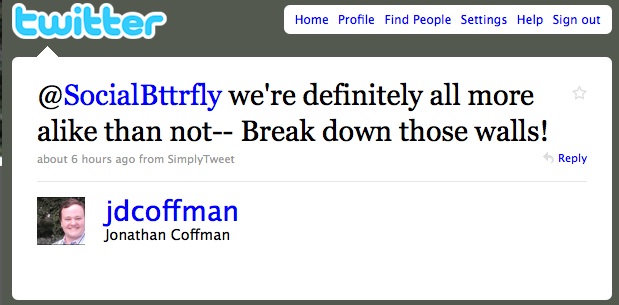
An additional effect is that it has sparked a conversation around the concept of transparency in the non-profit sector. Even before the Kiva story broke, Beth Kanter got some of us thinking about transparency when it comes to a non-profit’s Web metrics. In the comments, Holly Ross added that transparency is currently on the minds of her and the folks at NTEN. And where else have we heard about the priority in transparency before? –> Government.

Since my day-job leans more into the public health and government agency arena–I couldn’t help but see the parallels between government 2.0 and non-profit 2.0 (for the sake of better terminology). We may have different goals and end objectives, but the concepts both verticals must address (transparency, policy, management, buy-in, metrics, etc.) cross both lines. I think the Path of the Blue Eye folks were onto something when they posted the other day about looking for learning opportunities outside your comfort zone. As evidence, I commend Steve Radick, who did just that when he recently posted about the crossings between government 2.0 and sports 2.0.

The sharing of the line between government 2.0 and non-profit 2.0 was further solidified when I received news today of the AwesomeGov Fund organized by GovLoop and GovDelivery. This initiative is literally–combining and furthering the collision of government people with non-profit values–think philanthropy 2.0. Either way, it has me thinking that our worlds may just be more alike than different and that perhaps–the next event/conference/meetup needs to be a variety show for all us to get out of our comfort zone and look across the playing field.

PS: This past week, I also had the opportunity to talk with Andrew Conrad about Church 2.0–and again, there was much dialogue that ran quite similiar to conversations we’ve had around the conference table or that I’ve had with non-profit leaders. It’s almost creepy.

PSS: Please forgive all the “2.0” references–it’s just the most efficient way to get the point across.

Building a Web Site: Easy as 1, 2 OR 3?

Today, I heard that fundamentally there are three main purposes of a Web site: 1) informational, 2) transactional and 3) community-based. An Informational Web site is one that is primarily a resource. A transactional Web site has a desired action, which is usually associated with e-commerce. And lastly, a community-based Web site is one that is designed to encourage people to interact, network and share.

I’m not one to put things into boxes and draw hard boundaries, but at first I liked this concept. It’s simple. It’s easy. But, after pondering for a second, I got to thinking: is it relevant? We all know the Web is an evolving beast, which is why I think today’s best Web sites pull the best components from each of these three “types”  to creates a stronger vehicle.

Don’t get me wrong, this doesn’t mean that Web sites don’t need to focus. In the world of the Web, I’m seeing the concept of “focusing” becoming increasingly important. For example, these Web sites have focus:

  • Wikipedia–Informational
  • Amazon–Transactional
  • Facebook–Community

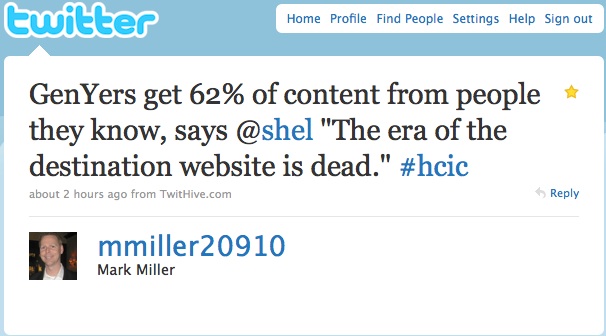
But Wikipedia is also a community of editors working together to create a service. Facebook has its own marketplace where transactions are worked out and don’t forget Facebook advertising or monetary exchange through Facebook applications such as Causes. Amazon–though primarily transactional–encourages us to give reviews, rate its products, create gift lists and in essence, build community around the purchases we make. Marinate on that thought for a second and then take this statement into consideration:

Considering current evolutions of the Web and comments such as Shel’s, I’m thinking the text books may need some updating. Web sites still need to focus, but at the same time, they need to add value to the end-consumer, provide products or services or action steps, while also building community. Just take a look around–the sites that we are all using everyday are Web sites that can serve multiple functions. So, get creative. Just because you have a ton of content you have to share, there are ways to not only “inform” people of the content, but also ways to generate actions, make the content interactive and build community. Thus, I answer “all of the above.”

What do you think? What’s your take? Is building a Web site easy as 1, 2, or 3?

flickr credit: Andreanna

Why Advocacy Is an Important Social Marketing Tool

Concerned about obesity? Either personally or within your community? You are not alone. One way to combat obesity is by promoting and advocating for more fruit and veggie consumption.

Your mother may have always told you to eat your fruit and veggies. If so–consider yourself fortunate. According to new data from the CDC in the first ever State Indicator Report on Fruits and Veggies, more us need to dish up.

The CDC report provides information for each state on how many fruits and veggies people are eating and importantly, it highlights three key areas within communities and schools that can be improved to increase access, availability and affordability of fruits and veggies. According to the report, it shows that no state is meeting the national goals that were outlined in Healthy People 2010 (as an fyi, you can now comment on the Healthy People 2020 objectives to help frame our nation’s health priorities).

Fruits and veggies are essential to healthy living, preventing obesity and protecting us from chronic diseases and certain cancer–yet simply put, the CDC report found that many of us can’t eat the recommend amounts because we can’t fruits and veggies may not be easily accessible, available or affordable. What I like about this report, is that is not only states the problem–but offers ways to overcome it. And many of them, tap into the social marketing tool of advocacy.

  1. Did you know that only 8 states have a state-level policy for healthier food retail improvements? Is your state one of these? If not, advocate for policy to address this concern.
  2. Did you know that only 1 in 5 middle and high schools offer fruits and non-fried veggies in vending machines, school stores or snack bars? And did you know that only 21 states have a state-level policy to increase fruit and vegetable access in schools? Check to see if this is your state, and if not, advocate that policy addresses this concern.
  3. Have you ever heard of a food policy council? According to the CDC, a food policy council is a “multi-stakeholder organization to improve food environments.” And guess what–only 20 states have a state-level food policy council and only 59 local food policy councils exist across the nation. I can’t vouch for their effectiveness, but it seems like a great way to start a conversation about the issue and presents another opportunity to advocate and organize.

For further inspiration to fuel ways to advocate for healthier behaviors in your community, check out CDC’s State Indicator Report on Fruits and Veggies as it provides fruit and vegetable consumption–as well as policy and environmental support–within each state. As an added resource, the CDC has also put together this report outlining recommended community strategies to address obesity.

At the CDC conference in August, we were reminded about the power and ability to leverage advocacy to meet social marketing objectives…looks like we have quite the opportunity here. Feel free to share what you and/or your community is doing to address this epidemic. We can continue spreading awareness about the obesity epidemic, or we can choose to do something about it.

flickr credit: mightmightmatz

Where Have All the Social Products Gone?

The debate between marketing and sales is not an old one. In fact, we’ve looked at this debate here at SB before. But one thing both sides can agree on: is that both have a relationship with products and services. Thus, if we are talking about social marketing, you don’t have to go far before you start wondering: Where are all the social products?

I’m not the first to ask this question, as I was inspired a bit back by Bill Smith of AED who challenged us social marketers to balance the scales more between the promotion side of marketing and the product side of marketing. And it was again highlighted in the Social Marketing Quarterly’s Summer issue.

Now, some people when they hear products–the hairs on the back of their neck raise. How can marketing products be in line with social marketing behaviors? This is because some people align a “product” with “revenue.” Then, it just gets sticky–often, these arguments are short sighted in my opinion. Before I get completely side tracked from my original purpose of this post, let’s keep moving forward.

I like the concept of “social products” also because it’s a moment to be creative. What products could exist that would help us live healthier, happier? Thus, instead of creating yet another 30-second PSA, take time in the conference room to consider the product side of marketing.

There’s more research available about leveraging products in a social marketing strategy, but I like how Nedra Weinreich sums it up on her company Web site:

“In order to have a viable product, people must first perceive that they have a genuine problem, and that the product offering is a good solution for that problem. The role of research here is to discover the consumers’ perceptions of the problem and the product, and to determine how important they feel it is to take action against the problem.”

Some Examples

  • The Red Card. Bill Smith shared this example with us at the 2008 World Social Marketing Card. Rather than just create a PSA to curb sexual pressure and abuse among young girls in Madagascar, AED created the red card–a product–that girls could use as an added to tool to say no.
  • FDA’s Peanut Recall Widget. In addition to creating press releases and sending out Tweets, the FDA and CDC worked together to create a tool in the form of a widget–a product–that people could use to find recalled food items they should avoid purchasing.
  • Road Crew. Services can also be part of the “product” piece of marketing. In Wisconsin, Road Crews offer rides to those who have drank too much to drive as a way to curb drunk driving.

Do you know where all the social products have gone? Feel free to share examples or future ideas.

Just in–Causewired’s Tom Watson Will Join Us and #read4change

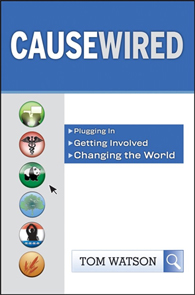
Image of Tom Watson's book CausewiredThe other week, I announced a new way for us book lovers to connect in a fun and meaningful way–through an online social change book club named #read4change.

After a week of collecting votes, and a battle between Allison Fine’s Momentum and Tom Watson’s Causewired, Causewired came out on top and will be the first book we discuss.

Bonus

What’s better than friends, social media and books? Imagine getting to go to your book club–and the author shows up. That’s right. Tom Watson has agreed to join us and be available for our comments, feedback and our questions!

To Participate

  1. Grab your copy of Causewired.
  2. Read and reflect.
  3. Join us November 10 at 8pm EST on Twitter
  4. Follow @read4change and track the conversation with the hashtag #read4change.

About the Book Club

Each month, lovers of books, people and making this world a better place will gather online to discuss a social change-related book–its story, its info and how it can be applied towards our work. Ideas for featured books are always welcome. Email me at socialbutterfly4change[at]gmail.com with suggestions. Until November 10, happy reading!

Who Pooped in Your Cereal?

Sometimes, you have bad days. When those bad days hit, those are the days you could use some inspiration. Yesterday, I woke up and was inspired.

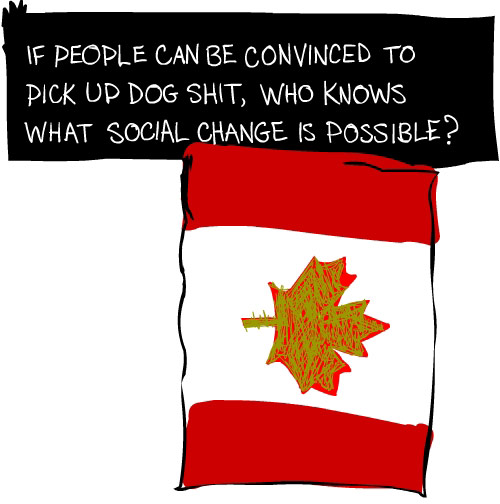
This image is taken from Franke James’ book “The Real Poop on Social Change.” In it, James delivers an important message regarding awareness vs. behavior. It’s an excellent read, and it’ll take you less than five minutes. (Warning: The text below is a bit provocative, but I think is presented just right–especially in the context of the whole story. One more reason to read it…)

Hope the image brought a smile to your face as it did to mine. Other points James’ makes that may not bring a smile to your face, but instead, infuse renewed energy to your actions:

  • “Look at global warming. Lots of awareness. But how many are doing something?”
  • “U.S. women have lots of awareness [about breast cancer]. But if they don’t have the money to see a doctor–what good is awareness?”

And then, I came across Sheila at LiveWell360, who I felt was so poignant in her questions that she got me thinking further about individual awareness vs. behavior battles:

  • “Why do we work and work and work so that when we are 65 we can *hopefully* retire and do nothing and/or “whatever we want”… at the sacrifice of our time with our family and living a joyful life now? That seems so backwards.
  • Why do we ask each other how we are doing, and the acceptable response is “not bad.” Tell me what you ARE, not what you are not.
  • Why is it weird to ask someone, “What inspires you?”
  • Why is it considered “wishful thinking” or even sometimes laughed upon to go after your dreams and believe that you can do more than status-quo?
  • Why are we willing to buy premium gas for our car, but not buy premium food for our body?”

What about you? Do any of Sheila’s thoughts speak to you? I mean, just because we pick up doggie-do-do, doesn’t mean you have to feel like doggie-do-do. As you wake up this morning, I hope this post leaves you inspired. It’s a new day–experience it.

[Thank you to LaDonna Coy for her tweet, as she is the one who originally brought Franke James’ illustration to my attention.]

How-To Go From Good to Great

Caveat: I am an outsider looking in, and like the title says–I think this initiative is a good thing. It just could have been great. Let me explain.

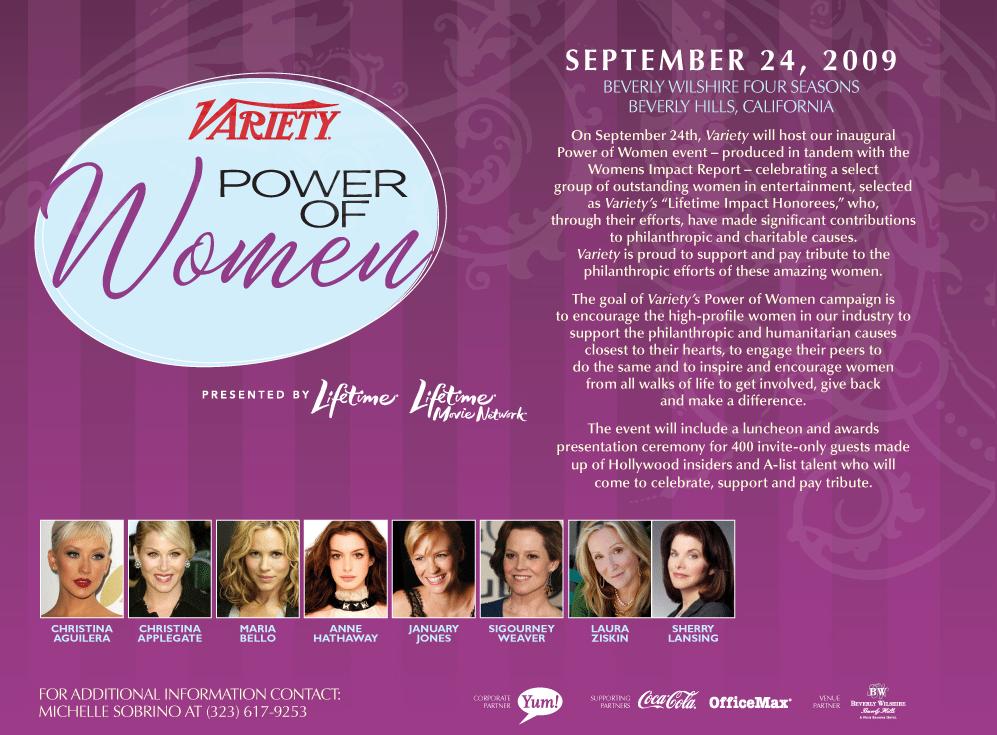
Project: Variety’s Power of Women Awards Recognition in Collaboration with the Lifetime Network

Good: Gathering together some of Hollywood’s greatest women, recognizing their contributions to some powerful nonprofits (Save Darfur and ServiceNation amongst them) and engaging the interest and attention of numerous influentials.

How it could have been GREAT: Involving the rest of us. Lifetime in and of itself has a huge audience base, and many of these watchers–I would presume–are also powerful women doing amazing things. What would have been great, would have been a contest of sorts that asked ordinary women to submit the story of everyday women who are working to better and change the world. The winner? Well, she gets to wine and dine with the A-listers at the described event above and gets to be recognized right alongside Anne Hathaway and company. How great would that have been?

Apply this to your own work. Many of you are doing awesome, notable, and persistent work. Good work. Just remember to pause and ask yourself–how can we make this GREAT? If Variety and Lifetime might have made the event bigger, just think of the blog posts, the camaraderie, the buzz, the views, the downloads–but most importantly, the community growth and involvement that could have resulted. It’s good, but it could have been great.

Love Social Change? Join us and #read4change.

We know there are multiple ways to connect. Offline, on Facebook, within an email, etc. Many of these are quick 140-headlines and/or aren’t necessarily in real-time. So, I’m proposing a new way, a less “it’s-for-work” or “I-want-to-network” way for our community to interact.

I have an idea.

But it slightly depends on you.

So one question: Like books?

The Big Idea: An Online Social Change Book Club

I just had one of those freakish “ah-ha” moments. Bare with me while I explain…

The idea started forming when my mom told me I should add a page to my blog that talks about the books I read and recommend.

Then, my mom emailed me saying her book club wanted to get a package of books for my fiance and I as a wedding present. Ever since, I’ve spotted more books I’d like to read.

And better yet, many of you SB readers have been recommending some fascinating titles.

So, Here’s how it works:

  1. We meet online (monthly or bi-monthly–you choose) on Twitter using the hashtag: #read4change.
  2. We all throw out suggestions for us to consider. I’ll keep a running tab. Each month, together, we’ll choose a book using Twitpoll.
  3. Because this is new, we will start, with our first #read4change chat on November 7 from 11am-12pm EST.
  4. After each round, we vote on the next book based on everyone’s recommendations. A week later, the book is chosen.
  5. Good news–you can recommend a book for the group to read at any time to have it added to the list.
  6. I’m also hoping to create eventbrite invites, just so we all know who’s reading along should we want to chat prior to the livechat. If you want added to the list, shoot me an email.
  7. Maybe, down the road, we could even get the authors to join us…
  8. Quarterly, we can get off our bums and do a community service project around reading.
  9. Around the holidays, help donate books….the possibilities are endless!

Let’s Start

Here’s the list of books for us to consider for the first pow-wow, based on some recent recommendations I’ve received myself:

  1. The Social Atom by Mark Buchana (recommended by Susannah Fox)
  2. Causewired by Tom Watson (recommended Tim Brauhn)
  3. Up and Out of Poverty by Nancy Lee and Philip Kotler (recommended by Alex Rampy)
  4. Momentum by Allison Fine (recommended by Beth Kanter)
  5. Groundswell by Charlene Li and Josh Bernoff (recommend by Geoff Livingston)
  6. The Blue Sweater by Jacqueline Novogratz (recommended by Andre Blackman)
  7. Here Comes Everybody by Clay Shirky (recommended by Nancy Shute)
  8. The Help, By Kathryn Stockett (recommended by Alex Rampy)
  9. Hope Dies Last by Studs Terkel (recommended by Mike Brooks)
  10. Rules for Revolutionaries by Guy Kawasaki (recommended by Amy Jussel)

Now what? Vote!

Vote on which book we’ll discuss first and I’ll announce it in a about a week what YOU chose for us all to read and chat about. In the meantime, feel free to also email me book suggestions: socialbutterfly4change@gmail.com. I’ll work on getting that page up that my mom told me about. Thanks mom. (I know she’s reading.)


flickr credit: Chocolate Geek
Book Images: Courtesy of Amazon

Behavior and Why It Deserves A Seat at the Goverment 2.0 Table

Table with four chairsAs I participated in the Government 2.0 events this past week, I couldn’t help but think about one word–behavior. Over and over again, I observed that often we weren’t talking about a tool, a Web site, some new blog, or a newer IT database. We were talking about influencing and changing behavior.

Almost every topic and issue discussed had behavior in common. Whether working to increase understanding across ethnicity, wanting people to be aware and address the peanut recall situation, take better care of the environment, to adopt new work processes, or to empower local citizens to help fix up their community–behavior plays a key role. Whether it’s the behavior of the American public or the behavior of those within an organization, work is being done not to be cool, not to be different, but to influence and change behavior.

The idea of Government 2.0 and government as a platform is not about tools and technology. It’s about cultivating an environment and culture that enables citizens to influence and direct its government and each other.

Now the big question: Why? Why does government as a platform matter? Why are so many smart, talented, and skilled people devoting time, energy and resources to “Government 2.0?” The Answer: Government 2.0 is a metaphor. It’s a field jazzed about influencing behavior for the better (whether they realize it or not–many of them are social marketeers). It’s a group of people who say no to the status quo, and instead says, “We can do more. We can do better.”

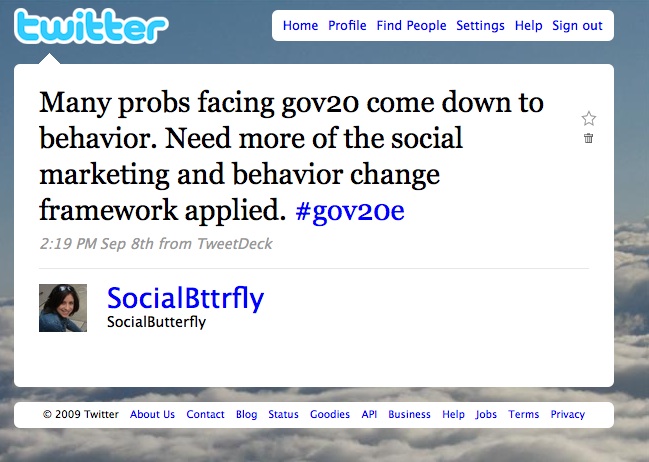
Herein comes the next big question: How? This is a longer answer, but I know a good place to turn to-studying and knowing about behavior. The great thing–this is nothing new. Sure, technology is new, cultures evolve, but we as humans have been and will continue to be fascinated with behavior. So if behavior plays such a huge role in the programs we authorize, products we produce and services we fulfill–here is my recommendation–more social marketing:

What do you think? Many of us participants finish this week motivated to take our lessons learned and move the needle on some of the biggest issues facing our country. What are your recommendations to implement and help realize “Government 2.0?”

flickr credit: Leo Reynolds

Defining SocialButterfly–Social Change, Social Marketing and Social Media

A beautiful yellow and black spotted butterfly with its wings outstretched, lightly resting on rocks.At SB, I’ve noticed a spike in new visitors this summer who might be wondering, “What is SocialButterfly all about?” Well, I’ve been evaluating that myself, and encouraged by a few colleagues of mine, I believe it’s time for an update. As we go forward, you’ll see me working to align my work, content and chatter around this working vision:  Make SocialButterfly a resource for information and dialogue on social change, social marketing and social media.

In my first post on SB, I explained that:

Defined–a social butterfly is someone who is amazing at socializing, making connections and creating conversation…appearing to ‘fly’ about the room. In the context of this Web site, it is a play on words.

Social‘ is taking from the term social marketing, in which marketing efforts are applied to create and influence behavior changes that are beneficial to society. In other words, depending on one’s view, it is learning to examine social issues and look for ways to ignite social change for the better.

Butterfly‘ is taken from the butterfly insect, which goes through a metamorphosis, and changes into a beautiful creation. Thus, this site works to promote and increase understanding surrounding the practice of social marketing by inspiring any and all to create change for the better. Then, in a ripple effect, maybe we could all become SocialButterflies in creating social change for the betterment of society.

As the header alludes, social change, social marketing and social media is a metamorphosis and we all play a role in spreading the good. It’s an evolution of an ongoing revolution. We can all be SocialButterflies. Let me elaborate:

Social Change–In the online space, and as our world becomes a smaller place, boundaries continue to become blurred. More public-private partnerships are evolving. Government agencies are reaching out to non-profits. Private sector is getting energized by government. And, this is good. Social change for social good takes a village. I was recently inspired by the discovery of Booz Allen’s “MegaComunities” concept. It mirrors a similar message that I detailed in my graduate research–emphasizing the collaboration across fields, industries and sectors. Social change umbrellas work of non-profits, journalism, activism, advocacy, health, environmentalism, social justice, human rights, public policy, lobbying, and more–for the improvement in the quality of life.

Social Marketing–Again, social marketing, on SB, does not mean social media. It means influencing behavior change for social good. Founded by marketing guru Philip Kotler and Nancy Lee, it’s the “science” behind behavior change for social good–aka social change. See the connection? Social change is the WHAT or the GOAL, social marketing is the theoretical STRATEGY or FRAMEWORK.

Social Media–Social media encompasses a variety of TACTICS and/or TOOLS. Social media marketing is best when it’s an integrated approach that complements current outreach and communication efforts, when it works to solve a problem, and is about what it enables, empowers and builds–more so than tools or information. SB looks at social media for a few reasons 1) It’s evolving itself as new tools and best practices continue to emerge on almost a daily basis; 2) Because of its fast growth and continual change, it demands savvy practitioners; 3) Because of reason #2, an active commitment to learn and engage is required, not just for me, but for all of us colleagues; and 4) It has the potential to completely change the game for social change and behavior–and in many ways, it already has–making it critical to know, understand and grasp.

But I can’t accomplish this alone. It’s going to take an active-living-breathing-charged-committed-encouraged-motivated-and-dedicated swarm of socialbutterflies to move the needle. What are your thoughts? How do you think we’re doing?

flickr credit: ~flutterby~’s