Author Archives: Alex

What’s Happening this March?

Spring is in the air…  Well, almost. Here’s a look at some of the top social change events happening this month. Where do you go for your inspiration?
March Events

Observances

National Nutrition Month
March 2011, [U.S. Health Observance]
Hashtag: #NNM

National Sleep Awareness Week
March 7-13, 2011 [U.S. Health Observance]
Hashtag: #sleephealth2011

World Water Day
March 22, 2011 [UN Observance]
Hashtag: #WorldWaterDay

Earth Hour
March 27, Worldwide
Hashtag: #earthhour

Events and Conferences

TED2011
Feb. 28-March 4, 2011, Long Beach, CA
Hashtag: #TED

The Social Enterprise Conference–Presented by the Students of Harvard
March 5-6, 2011, Boston, Massachusetts (Harvard Campus)
Hashtag: #seocon

South by Southwest (Interactive)
March 11-15, 2011, Austin, TX
Hashtag: #SXSW

Innogive: Mobile Giving Applied
March 16, 2011, Washington D.C.

2011 Government Web and Social Media Conference
March 17-18, 2011, Austin, TX
Hashtag: #govwebcon

Nonprofit Technology Conference (NTEN)
March 17-19, 2011, Washington D.C.
Hashtag: #11ntc

IMAGINE Solutions
March 21-22, 2011 Naples, FL

Skoll World Forum
March 30-April 1, Oxford, U.K.
Hashtag: #skollwf

*******

Feel free to send me an email at abornkessel@fly4change.com if there is an event happening that I should consider adding.  I look for events that discuss social innovation, social marketing, mobile and social technologies, public health, advocacy, social change, non-profits, journalism, social entrepreneurship, leadership, special observances,  and more.

flickr credit: eaglegrl76

Crossing the Double Divide, Two Million Dollar Questions

Earlier this month, Susannah Fox discussed a health Information divide based on a recent report. This divide was also confirmed in a recent literature review on the effectiveness of social media in public health–cited as a double divide:

“A common concern raised in the published literature (38, 66, 67, 68, 69, 70) relates to the populations with limited online access, poor literacy skills, and disabilities that impair access to social media platforms: “…health scientists exploring the issue of the digital divide have found evidence of a double divide. Specifically, those without internet access (a large portion of whom may be without adequate health care access) are prevented from gaining health information available on the Internet” (38).

Though this double divide exists, it does not mean that we should disregard the Internet and social media as a tool in our health communications and social marketing work. There are bright spots of the Internet and social media’s impact in public health and in impacting the health of vulnerable populations. As, the literature review goes on to share that some researchers suggest that social media platforms can actually “augment poor health literacy of basic literacy skills” and “that digital penetration into marginalized groups actually improves access to some specific demographics.”  And this is where the importance of the National Broadband Plan comes into play.

Why? Because of the National Broadband plan not only outlines how to increase access to the Internet across the United States. But, it also includes key recommendations for increasing digital literacy. One of the recommendations that caught my attention most was the call to create a Digital Literacy Corps with the objective of mobilizing thousands of Americans across the United States to improve digital literacy. Compound that with last year’s release of the National Action Plan to Improve Health Literacy and the objectives set out in Healthy People 2020, and we’re on our way to crossing this double divide.

But what do we do until then?

The literature review offers the following recommendations on using social media to improve effectiveness for public health:

  1. Establish clear objectives.
  2. Know your target audiences.
  3. Design campaigns for longevity and/or have exit strategies and clear archiving processes.
  4. Determine resource needs.
  5. Determine agency content-clearance processes and/or prepare pre-approved messaging scripts.
  6. Listen to online health discourse.
  7. Encourage or sponsor research.
  8. Encourage coordination.

These are great recommendations, and number 7 is especially important. But value is gained from having a critical eye. So when data like this from Pew’s Health Topics report is shared, how can we be sure to reach the people who need our attention:

…fewer than half of adults in the following groups in the U.S. look online for health information:

  • African Americans
  • Latinos
  • Adults living with a disability
  • Adults age 65 and older
  • Adults with a high school education or less

As I write and work to use social technologies for social good, I know their potential and understand the benefits they can offer. So I don’t necessarily need “convincing.” Instead, I’m on the lookout for case studies–from the local level and up.

A Case in Point

For example, in St. Louis, the St. Louis County Library and the physicians of Saint Louis University have teamed up on a series of free community health literacy programs, referred to as “60-Minute Health Check-Ups.” The check-ups are” designed to provide information and resources to help attendees learn more about health-related issues. Each program features health information presented by a SLUCare professional, followed by health literacy tips from a St. Louis County Library reference librarian and free health screenings.”

This might not seem wildly innovative–but it’s a strong example of the place “P” in social marketing. And, when you add these stats from the 2010 U.S. IMPACT Public Library study into the mix (borrowed from a comment made by Luke Rosenburger on Susannah’s Health Information Divide post)–you can see the opportunity increased digital literacy could provide for better health:

Research has shown that libraries are a very important nexus for this kind of connection. The “US IMPACT” study, released April 2010 by the University of Washington Information School and underwritten by the federal Institute of Museum and Library Services and the Bill & Melinda Gates Foundation, reveals that nearly one in three Americans age 14 or older — 32% or roughly 77 million people — used a library computer or wireless network to access the Internet in the previous year. Among people living in households whose income was less than 200% of federal poverty guidelines ($44,000 a year for a family of four), 44% used library computers and Internet access.

Thirty-seven percent of library computer users, an estimated 28 million people, focused on health and wellness issues, including learning about medical conditions, finding health care providers, and assessing health insurance options. In one particular group — seniors (65 and older) living in poverty — a full 54% used library computers for health or wellness needs.

The study also suggests that library computer use leads to positive action on health and wellness: roughly half of the people who used a public library computer to find doctors or health care providers reported that they made follow-up appointments. Among those who reported researching diet and nutrition issues online at the library, 83% decided to change their diet; among visitors who searched for exercise and fitness information, 84% decided to change their exercise habits. The benefits also reach beyond just the individuals who come into the library: nearly two-thirds of library computer users (63%) logged on to help others; 56% reported helping friends or family with health matters specifically.

So are libraries the answer? From the information provided and from knowing some smart and savvy librarians, I’d say yes! But, I feel like they are just part of the answer.

The Million Dollar Questions

One:  What are people doing to cross this double divide and what results are they seeing? Show us the case studies and share the lessons learned!

Two:  In what ways can we reach people on the side of the divide without health information and without digital literacy skills–and bridge the gap in terms of health disparities and health information, services and products? (And before you answer “MySpace” or “mobile” –show me the evidence. As, I feel more and more strongly, to cross the divide, we need a markets-based approach to health that addresses changes regarding the social determinants of health. No?)

BONUS: CDC’s January 2011 Health Disparities and Inequalities Report (CHDIR) — The information in this report is astounding and eye-opening.

flickr credit: kcryder

Still Here–Just In More Places

You may have noticed that I haven’t been posting here quite as often. Part of the reason for this is that I’ve been writing for a few different places over the past few months. I highlight some of the posts below:

  • Have Questions, Not Answers for 2011
    [On Care2’s frogloop Blog] In the nonprofit arena, the word “marketing” can have a bad rap. But you can help change that–and with good reason.  Marketing, in particular, social marketing can make all the difference in your organization’s work come 2011.                                               Read More.
  • In Review, the mHealth Attendee Gaining in Notoriety
    [On Pulse + Signal] This week’s mHealth Summit in Washington D.C rolled out the red carpet for some of the world’s top innovators including Ted Turner, Bill Gates, U.S. CTO Aneesh Chopra and over 2,000 participants from 30 countries. It was a learning hub and feeding ground for those in government, NGOs, research, technology, policy and business. But there’s one attendee I spotted throughout the conference that gained in notoriety and demand—behavior change.
    Read More.

Hopefully, I’ll be back here posting more regularly again soon. However, I’m now starting to understand why, when I tell people that I blog, they ask me: How do you find the time? Well, as you can see, that’s been a bit of a struggle lately. Never fear though–something it always in the works. Until next time, Alex.

flickr credit: Leonard John Matthews

Designing for Community Change

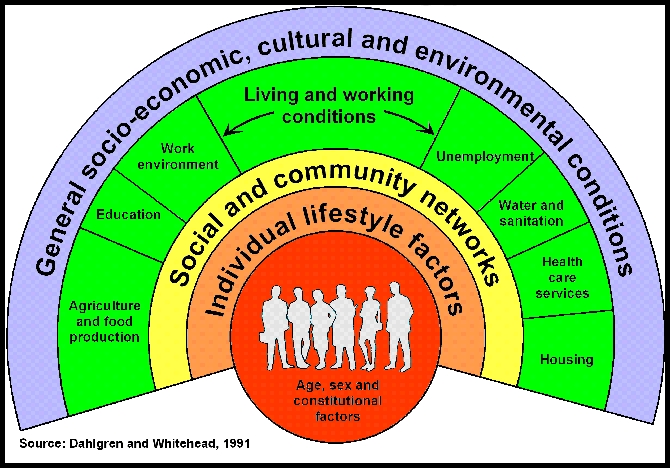
At the beginning of the month, Craig Lefebvre challenged us to 10 “What Ifs” for social marketing in the coming year. At the heart of Craig’s what ifs is a change in perspective in terms of approach. This shift is also reflected in the United States’ recently released Healthy People 2020 blueprint which is committed to improving the quality of our Nation’s health by producing a framework for public health prevention priorities and actions. Compared to Healthy People 2010, Healthy People 2020 includes:

  • Social determinants of health as a new topic area in the Healthy People 2020 framework, and
  • Determinants of Health are also one of the four new Foundation Health Measures which will be used as guides to monitor progress toward promoting health, preventing disease and disability, eliminating disparities, and improving quality of life in the United States.

One of the greatest ways that this shift is being applied in social marketing is by evolving the social marketing approach to influence systems, networks and environments. How? Through design–Let’s take a look at a couple examples.

Bertie County, North Carolina:  Teaching Design for Change

httpv://www.youtube.com/watch?v=aiIxdFBA0Sw

Designer Emily Pilloton is truly inspiring in her approach, her commitment and personal dedication to finding innovative solutions and sustainable approaches to positive social change. Pilloton founded Project H Design, a non-profit design firm where they apply the design process to catalyze communities and public education from within. In the presentation above, Pilloton shares with us the story of Bertie County. The county is the poorest in the state and faces a number of public health challenges that other rural areas may relate to including being a “rural ghetto,” dealing with “brain drain,” and having little access to creative capital.

However, the picture in Bertie County is becoming more vibrant thanks to Pilloton and others working to change the system–the environment. Pilloton walks us through the six steps her firm has applied to make change come to Bertie County:

  1. Design through action.
  2. Design with, not for.
  3. Design systems, not stuff.
  4. Document, share and measure.
  5. Start locally and scale globally.
  6. Build.

In short, Poilloton and the Project H team “design solutions that empower communities and build collective creative capital.” They might not say “we do social marketing” up front–but to me, that’s exactly what they’re doing and we can learn much from them. They are doing the work and taking the type of approach that the shift described above calls for and requires. And shown in Bertie County, this may mean that we need to get our hands dirty, ignite creativity, make genuine connections with those we want to serve, and have a personal conviction to see change happen.

Howard Roads, Virginia:  Designing for Physical Activity

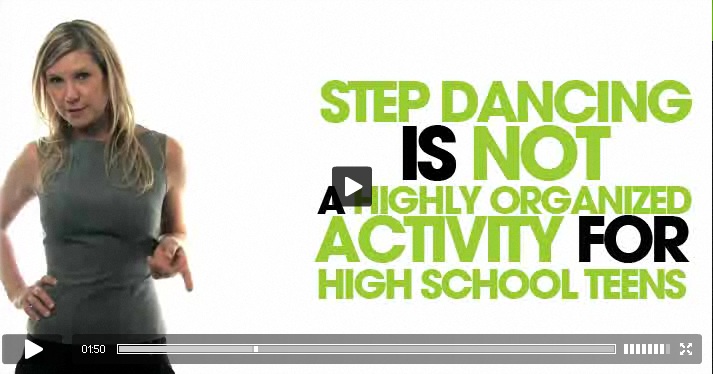
This example comes from Rescue Social Change Group (RSCG). RSCG is a research, marketing and strategy firm where they focus on the relationship between identity and behavior to change behavior through culture. In this specific case, RSCG worked with Howards Roads, Virginia to promote physical activity amongst youth. The reason this case stands out is because it didn’t take the ‘easy button’ approach of pushing “get active” or “exercise more” messages to tweens and teens. Instead, they went a step further and actually designed an environment to promote physical activity for youth. They accomplished this by creating a step dancing league called Step Royale where teams compete throughout the year to earn the title of the best step team in Hampton Roads.

From What Ifs to What Next

Given these two examples, here are three “What Ifs” to add to the list:

  • What if public health wasn’t just about the message but also about the design, the system, the network and the environment?
  • What if public health wasn’t just the responsibility of public health folks but resonated and took root in our communities?
  • What if we didn’t ask what if–but instead, asked what’s next?

I’m almost thinking of a Roosevelt-New-Deal-sense of shared responsibility and commitment. The global citizen can start with us and our neighbors–We can design change in our communities.

Disclaimer: Healthy People 2020 is an initiative by the Office of Disease Prevention and Health Promotion within the U.S. Department of Health and Human Services–of which, is a client that I work with at IQ Solutions.

What Would You Say? Thoughts on Global Citizenship

What would you say to world leaders if given the chance? This is the question the UN’s Citizen Ambassadors campaign asks us. The campaign is two years running and involves a video contest that “encourages world citizens to voice their opinions to Heads of State and Government and weigh in on the decisions made by the member states of the United Nations.”

According to the campaign Web site, the initiative is one in a series launched by UN Secretary-General Ban Ki-Moon. The purpose? To utilize “the power of the Internet and social networking to engage a new generation of world citizens in the importance of international diplomacy.”  This is an inspiring charge–but in reality, could be quite difficult in achieving. So, let’s break this down.

The Power of the Internet and Social Networking

Over 825 million people use the Internet in Asia as of July 2010. In terms of population, Facebook would be the third largest country if it were a country given its 500 million active users. It’s also translated in over 70 languages. Six in ten Americans go online wirelessly using a laptop or cell phone. 86% of adults ages 18-29 use social networking.

Mobile giving raising over $30 million for Haiti relief efforts. Technology saving lives and enabling communication. Community-funded journalism fueled by the passion of citizen journalists and digital storytelling. Random Hacks of Kindness, Crisis Camps, Ushahidi, accessible health data and a slew of additional examples have some dubbing 2010 as “the year citizen platforms grew.” Why? Because of the power of the Internet and social networking in facilitating, connecting, empowering and enabling both individuals and communities to better serve a global mission.

Need I say more?

A New Generation of World Citizens

By now, you’ve probably heard about the “Millenials,” those born between 1981 and 2000 as defined by the Pew Research Center. Summed up, Pew identifies Millenials as “Confident. Connected. and Open to Change.” The UN is correct–there is a new generation of world citizens who want more, but I don’t think it’s limited to just Millenials. I think they are referred to as global citizens. Lovisa Williams in her post “Global Citizenship Building Momentum” defines global citizens as:

A Global Citizen is everyone whether they know it or not.  They don’t have to know the term or even the concepts associated with the term.  The bottom line is if you live on earth you are now part of an ecosystem that is larger than your village, your tribe, you town, state, province, or nation…Part of recognizing you are a Global Citizen is recognizing you have the world on your shoulders.  You have the responsibility to help advocate for those who don’t recognize they are Global Citizens and are also responsible for helping to provide solutions to these issues.

The concept of global citizenship faces its own challenges.  For example, Maslow’s Hierarchy of Needs may come to mind. If someone doesn’t have their basic needs met such as having food and shelter–is it too much to expect global citizenry? Some may say yes. But the potential of a network of people coming together over shared commonalities wanting to promote humanity–well, if we could achieve that, then just imagine the possibilities.

International Diplomacy

In August 2010, Sec. of State Hillary Clinton announced the State Department’s Global Health Initiative, working to improve global health as a way to achieve diplomacy:

I’d like to share with you the next chapter in America’s work in health worldwide. It’s called the Global Health Initiative, GHI for short, and it represents a new approach, informed by new thinking and aimed at a new goal: To save the greatest possible number of lives, both by increasing our existing health programs and by building upon them to help countries develop their own capacity to improve the health of their own people….

Global health is a prime example of how investing our resources strategically can have an immediate and lasting impact on people, communities, and countries.

There is too little coordination…

There is too little integration….

There is too little innovation…

Addressing global health is now a part of the U.S.’ International diplomacy efforts. An important step–is going to be figuring out how to enable and empower the global citizen to play a part in achieving better global health (diplomacy). Our world is growing–but it’s also shrinking. We are becoming more connected and more aware of the problems we face and the commonalities we share–how we funnel this awareness into action could make the difference.

When These Powers Combine

Combine innovation mixed with the rising call of global citizenship with the changes happening at the policy level–I dare to be optimistic in saying that change is going to come. The next step? How do we first define global citizenship, then operationalize and expand its mantra? There are glimpses of it–See the U.N. Foundation’s Girl Up! campaign or the State Department’s Civil Society 2.0 initative–but the concept can go wider and deeper.

So, what would I say to world leaders if given the chance? First, I’d ask them when was the last time they served the humblest members of their communities and what they learned from the experience. My hope would be that shared challenges would be identified and that the  conversation would turn from “What Would You Say?” to “What Would You Do?” And in that, a focus and discussion on global citizenship would take place.

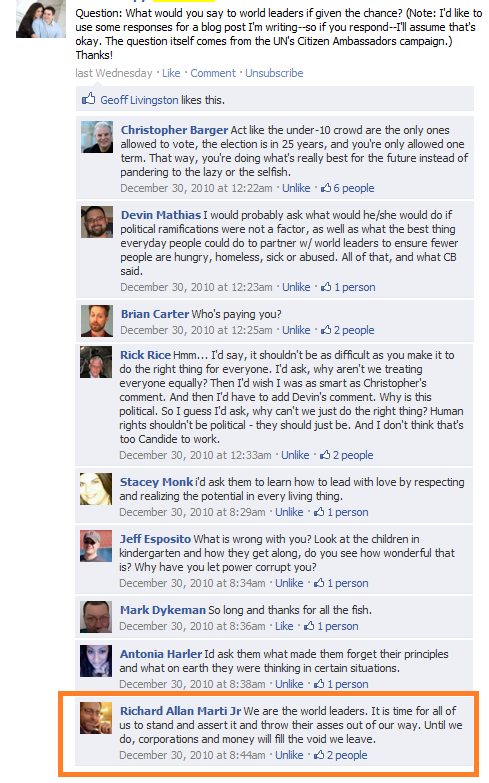
I recently asked some fellow colleagues what they would say to world leaders if given the opportunity. And without any prompting from me–the discussion concluded with an assertion that gets to the heart of global citizenship–We are the world leaders:

So, What would you say to world leaders if given the chance? And if we are the world leaders, what does that mean?

Read to Think

Sometimes, direct instruction is helpful. Like when learning how to cook or change a flat tire. But when it comes to learning about social change, I learn best from those that challenge me to think. This includes blogs.

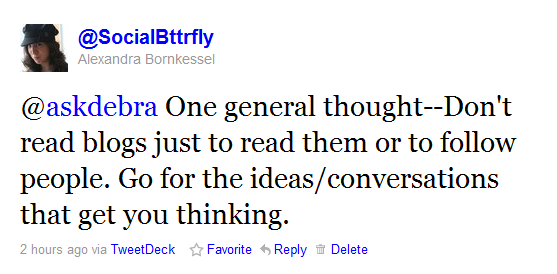
Last night, Debra Askanase of Community Organizer 2.0 tweeted that she was working on a blog post highlighting blogs to read in 2011. In her tweet, she asked for people to share their own recommendations. I shared the following:

In response, Debra asked me: What are two blogs that get you thinking? Two of the blogs I followed-up with are:

  • Assetmap: New to the market, Assetmap is the platform that former Change.org’s Social Entrepreneurship blogger Nathaniel Whittemore is working to get started. The blog covers the topic on “how social capital is transforming business, culture and social change.” Not surprising, its posts give me lots of think about, chew on and explore.
  • Health Populi: Authored by Jane Sarasohn-Kahn, often takes on complicated topics, events and news and breaks it down by highlighting evidence and data. With  “Health Populi’s Hot Points,” key take aways are provided that connect the dots of application through added analysis. It also gets me thinking of how the “what” of a news story impacts the “how” of everyday life and work.

Now it’s your turn–In the comments, name two blogs that get you thinking. This way, we can give our RSS readers a refresh for 2011.

A Must-Read Case Study

If you’ve ever worked in fundraising, on developing partnerships, community building, or in campaign development, you want to read this case study. Which case study you ask? It’s the case study of how “Minnesota’s ‘Networked Nonprofits’ Raised Over 10M in One Day, with Only One Full-Time Employee!That case study.

For those who prefer, a highlight video is below. But, you want to head over to Beth Kanter’s blog and read the full case study about GiveMN.org and the strategy they used to achieve such a feat.

httpv://www.youtube.com/watch?v=_cvpj2B-KnI&feature=player_embedded

Written by Jeff Achen, GiveMN.org’s own interactive media strategist, I promise you will walk away both inspired and enlightened. Here’s a sneak peak:

Here at GiveMN, we’ve harnessed the power of our networks to raise record amounts of money online for nonprofits in Minnesota and engage record numbers of people in an annual, one-day giving event—Give to the Max Day.

On Nov. 16, 2010, we shattered our goal of 40,000 donors in 24 hours by engaging 42,596 unique donors who donated to their favorite nonprofits using the GiveMN.org platform. All told, Minnesota nonprofits collectively raised $10,041,021 in one incredible day. [continue reading]

My big take-away from reading the case study is the amazing, incredible possibility of powerful partnerships and collaboration. Secondly, I am completely awed and greatly admire the approach this effort represents and inspires. GiveMN.org not only achieved its goals–but also united a state around the causes and the people working to improve the lives of its citizens. Minnesotans may  have different challenges, interests and experiences, but no matter all of that, Minnesota is a shared commonality that GiveMN.org used to help communicate that we are all in this together–a great message that obviously resonated with donors. Bravo GiveMN.org!

Thank you Beth and Jeff for sharing!

Social Marketing Works

For all those working to raise awareness, guess what? Awareness just got punked. See this excellent video appropriately titled “Awareness Schmawareness:” from the wonderful Nedra Weinreich to see what I mean:

httpv://www.youtube.com/watch?v=hRhXKTAG0kc

If you feel the awareness building fever catching in your organization or team, have no fear. Review these questions to get back on the right track. The TurningPoint Collaborative also has the following resources (for free!) available:

Last but not least, you can always ask questions here at SocialButterfly. Take a step today towards effectiveness–know that the social marketing approach works. Why else would it now be an official part of how our nation plans on improving our country’s health (see objective 13)?

What Are Your Non-Negotiables?

It’s the morning after Election Day, and I have a question for you: Have you ever hired anyone? Well, if you’ve voted, then you’ve at least influenced who gets hired. And, with all the he-said, she-said and who is right or wrong when–it can be difficult to navigate. So, I ask you: What are your non-negotiables when hiring someone?

I’m not implying that these are the only things you look for when hiring or even that they correlate to how you or I vote. But, they do provide a focus and help us cultivate an internal culture, mindset and attitude towards our work.

My Four Non-Negotiables:

Initiative

People with initiative are rare–and when you come across them, you can develop not only a mentorship relationship, but also a reverse-mentorship relationship. In other words, like iron sharpens iron, working together makes you both better at what you do and what you know. A person with initiative does not always have all the answers–but they know where to get them. They are resourceful, pro-active and self-thinkers. For example, I once was in an interview where the person asked: If I was hired, what could I do before now and then to prepare for the position? Is there anything you’d like me to study or any skills I should refine? This is initiative. Check.

Commitment

From my experience, those with initiative often possess commitment. Commitment comes in many shapes and forms–maybe it’s in the form of certain ethics and values, maybe it’s a deep passion or belief in what one is doing. Maybe it comes from a personal experience that resonates with the individual or a desire to contribute to the team or be a part of something greater than oneself. Often, commitment is the seed for both initiative and accountability. As, people with commitment tend to be life-long learners. People who are willing to “Do, Learn, Improve and Repeat.”

Accountability

They say that few people can admit when they are wrong. What may be more rare, are people who are willing to admit that they don’t know something (but then have the initiative to discover it). To me though, accountability is more than this type of black and white definition. There are shades of accountability, that when you can find hints of it in someone, it is easily recognizable. This is because accountability can also be referred to as servant leadership. I first learned of servant leadership from my dad. In sum, servant leadership is when the leader serves others–rather than others serving the leader. I believe leadership can come at any level in an organization. And one who is a servant leader is the cream of the crop.

Writing Ability

In marketing, we write…a lot. Whether it’s email, marketing plans, research reports, presentations, blog posts, tweets, etc., writing and overall communication is at the core. Writing can be a detailed yet creative process. It gives you insight into how someone thinks and arranges thoughts and ideas and how someone approaches a task. Maybe it’s my own love for writing that gives me this bias, but you can tell a lot from someone’s writing–it can be a canvas for change.

Your Challenge

So–What are your non-negotiables? Consider putting together your team or organization’s non-negotiables. Make it a team brainstorm over lunch. Even if just as an exercise, I think you’ll find it telling about the culture you work in and the direction you’re headed. And that holds great importance in achieving your team and organization’s mission and affecting positive social change. If you do this, please share how the experience goes with the rest of us by posting a comment.

flickr credit: Jose Betancur

Things to Do, People to Meet: November 2010 Event Listing

From online webinars to Twitter chats to traditional conferences, people are on the move. Starting this month, I plan on posting that month’s event listing at the beginning of each month. I also do my best to keep an updated, ongoing list of events. So–Where will you be this month?

November Events

Month-Long Observances

American Diabetes Month
Lung Cancer Awareness Month

Individual Events and Observances

2010 Election Day–Vote!
Nov. 2, 2010, United States

World Entrepreneurship Forum
Nov. 3, 2010, Lyon, France

Civil Society 2.0
Nov. 4-5, 2010, Washington D.C.

Connecting Social Innovation 2010 (Hashtag  = #cosi10)
Nov. 4-9, 2010, See Website for Details.

TEDxMidAtlantic
Nov. 5, 2010, Washington D.C.

APHA Annual Meeting–Social Justice: Public Health Imperative (Hashtag  = #apha10)
*Worldways Social Marketing is hosting an #apha10 tweet-up on Nov. 7.
Nov. 6-10, 2010, Denver, CO

mHealth Summit (Hashtag = #mhs10)
Nov. 8-10, 2010, Washington D.C.

National Drug Facts Week (Hashtag  = #drugfacts2010)
Nov. 8-14, 2010, Everywhere

HealthCampDC
Nov. 12, 2010, Washington D.C.

TEDxYSE (Young Social Entrepreneurs)
Nov. 13, 2010, Washington D.C.

World Diabetes Day
Nov. 15, 2010, Everywhere

On the Move: The Power of Mobile Communication
Nov. 15, 2010, Washington D.C.

Web 2.0 Summit
Nov. 15-17, 2010, San Francisco, CA

D.C. Entrepreneurship Week
Nov. 15-19, 2010, Washington D.C.

Broadening Influence: Examining Public Health Driven Social Media
Nov. 16, 2010, Washington D.C.

Great American Smokeout
Nov. 18, 2010, Everywhere

Health 2.0 STAT Meet-up
Nov. 18, 2010, Washington, D.C.

Big Tent
Nov. 18-20, 2010, Houston, TX

National Survivors of Suicide Day
Nov. 20, 2010, Everywhere

International Day for the Elimination of Violence Against Women
Nov. 25, 2010, Everywhere

Medicine 2.0
Nov. 29-30, 2010, The Netherlands

Open Innovation Africa Summit (Submit your own ideas for innovation in Africa and potentially win a spot at the conference!)
Nov. 29-December 1, 2010, Nairobi, Kenya

*******

Feel free to let me know of events I should consider adding by emailing me at abornkessel@fly4change.com. In particular, I look for events that combine a number of the following topics: social media, social marketing, mobile, tech, health 2.0, social innovation, government 2.o, social change, non-profits, journalism, social entrepreneurship, leadership, special observances,  and more.