Author Archives: Alex

Philanthropy: Po-ta-toe, pa-ta-toe?

Browsing my facebook groups following my last post on FliP, I found and joined the FLiP facebook group. I noticed one of the discussions posted on the topic: ‘Traditional vs. Social Change Philanthropy.’ For the sake of anonymity, the Poster of the topic wrote as follows:

“On the FLiP homepage there is a great article about how, in many respects, traditional philanthropy is actually reinforcing the status quo. In my comment to that article I quoted Martin Luther King Jr, “Philanthropy is commendable, but it must not cause the philanthropists to overlook the circumstances of economic injustice that make philanthropy necessary.”

What are your thoughts on that? Are too many of us in the nonprofit sector offering programmes that are far too reactive, vs actually examining and addressing the socio-economic issues that require our ‘programmes’?”

This discussion topic is followed by another that asks about philanthropy education programs. And, to my surprise and after some research, there are many, and growing: IUPUI’s Center on Philanthropy, NY University School of Philanthropy, Columbia’s MA in Fundraising, Hebrew University of Israel’s M.A. in Community Leadership and Philanthropy Studies, Bay Path College in Massachusett’s M.S. in Non-Profit Management and Philanthropy, St. Mary’s graduate program in Philanthropy and Development, and MORE!  The programs listed include degrees surrounding fundraising, non-profit management, leadership, governance, development, philanthropy and othe-related terms….yet social marketing termed programs still lack.

Upon this brief internet browsing, I reflected on what the definition of what ‘philanthropy‘ means. Are the terms philanthropy and social marketing interchangeable? What is this term social-change philanthropy? We’ve been talking a lot about the identity crisis in communications, and it appears that there is some overlap. Social marketing does take in the marketing process, but it is also – as the Facebook Poster said – can be applied to looking at socio-economic issues.

Feel free to share as this thought is still developing….how do the two relate to one another and what does this mean for the field of communications or in the non-profit sector?
Is Everything Going 2.0?

Is everything going 2.0?

Health, Science, Museum, Birding, Philanthropy, Reputation, Enterprise, Food and more! Feel free to add to the list.

**********************

  • Museum 2.0 is a blog itself by Nina Simon that talks about how Web 2.0 can be applied in museum design. Nina paints her vision for the revitlization for museums and future possibilities here, and in her video.
  • Health 2.0: SocialButterfly’s own post sparked by recently released research studies, regarding the developments in the growing Health 2.0 field, offering numerous examples and resources.
  • Science 2.0: SocialButterfly’s own post on Science 2.0, including a mini-case study on the OpenWetWare project, voicing both concerns and future possibilities.
  • Birding 2.0: Michelle Riggen-Ransom as Social Media for Social Change wrote a great piece on Birding 2.0, about how Science 2.0 and technological developments are advancing great hobbies such as bird watching in the bird watching community.
  • Reputation 2.0: Jeff McCord looks at the importance of one’s online reputation when entering the trenches of the job search in his post titled, Reputation 2.0.

***********************

Other topics I Googled with a ‘2.0’ added that found results include Love 2.0, Crafts 2.0, Education 2.0, Music 2.0, Church 2.0 …What others can you find?

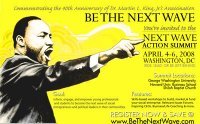
Catch the Wave with MLK, Jr.

What wave you may ask? The wave of effective positive change in yourself and in your community. At the Next Wave Take Action Summit 2008, the leaders of the future gathered and shared King’s inspiration with their visions for the next big wave of change.

Participants in this interactive 3-day program to learn how to create, develop and spread this ‘wave’ for social change. Speakers shared insights, knowledge and resources about copyright, trademark, gaining nonprofit status, business development, financial integrity, marketing, social marketing and fund raising.  The main message: Before you can motivate/inspire/encourage/support others….you have to know who you are, where you’re are going, your strengths, weaknesses, etc.

As organizer Tambra Stevenson might say, “You’ve got to lead your own ship before you can have effective leadership with others.”

The social entrepreneurs who attended this past weekend’s summit are steering their own ship and others, addressing such social causes as:

– Eco-enterprise
– Youth literacy
– Financial literacy
– Health awareness
– Political engagement
– Poverty and welfare
– Health and Wellness
– and more!

Yours truly also spoke about the exciting field of social marketing and social marketing’s role in the growing field of social enterprise. Other summit speakers represented a kaleidoscope of organizations including: ASHOKA Foundation, IQ Solutions, OhMyGov!, GreenDMV, William James Foundation, First Environment, Chance Academy, D.C. Mayor’s Office on Community Affairs, Upgrade America, IBM, U.S. Patent and Trademark Office, U.S. Copyright Office, Nonprofit Roundtable, D.C. Office of Partnerships and Grants Development, Main Streets Anacostia, Creative Cause, DNC Women’s Leadership Forum.

In the future, the Next Wave Take Action committee plans on hosting an event to commemorate Robert Kennedy’s assassination. See you there!

My First Meme, Letters to My Younger Self: A Lesson From Susie Buffet

Today, Kivi Leroux Miller at NonProfit Communications participated in a continuing blog posting style called a meme, titled: Meme: Excerpt from a Book on My Desk.

Until today, I did not know what a meme was or is. I’m pretty excited though, now that I know what it is, as I’m always looking for new ways to evolve the style of blog posts. (Another recent favorite is Bamboo Project’s 31 Day Comment Challenge Series. Today is Day 6 of the Challenge.)

*****************

A meme is like an internet chain letter, with depth. One blogger posts a topic or call to action, then tags 5-10 other people to follow suite and add to the ‘meme.’ This being my first tag in a meme, I am participating. Plus, I was pretty excited about the book nearest me…

Here is what I am supposed to do:

1. Pick up the nearest book.
2. Open to page 123.
3. Find the fifth sentence.
4. Post the next three sentences.
5. Tag five people, and acknowledge who tagged you.

It’s titled: What I Know Now, Letters to My Younger Self, written by a collaboration of accomplished and amazing women. Contributers include Madeleine Albright, Maya Angelou, Ann Curry, Olmypia Dukakis, and many more! This book is great, because women need role models and mentors. This book offers just a glimpse into some of the more important LIFE lessons we learn along our journey.

When I’m finished reading, I plan on writing my own letter to my older self, and store it away to read at a later date. And another letter to my younger self, that I hope to one day pass on to a future daughter. This idea is what I’d like to forward in my version of the meme.

Not wanting to be a complete rule breaker though…this is what I found:

Page 123 was part of the letter Jane Bryant Quinn, author and columnist, writes to herself about parenting and what’s she learned from her kids. But, I preferred to share one of my favorite excerpts from the book instead, written by Susie Buffet, daughter of Warren Buffet, written back to her 17 year old self, about her admiration for her mother.

“Empathy has led her [Susie’s mother] to become extraordinarily accepting of others, but it’s also what makes her comfortable with acting unconventionally…Empathy doesn’t have to lead you to the routes she [mom] will follow, which may be a temptation, given your resemblance to her. The important thing is that it becomes part of your compass, too.”

If you wrote a letter to yourself, how old would you be and what would be your message?

I tag:

Britt Bravo

Cool People Care

SocialCitizen

Ian Wilker

New Voices of Philanthropy

Web 2.0 Wednesday – Super Tuesday Super Cool: When Google Met Twitter

So, I’ll leave the political analysis to those more qualified, but I will point out a super cool social media event that also took place on Super Tuesday: Google Met Twitter.

Google teamed up with Twitter and Twittervision to show on Google maps, people’s comments through Twitter about the elections and Super Tuesday… and, it was live! Every few seconds the map would change and take you halfway across the world to a person’s comment in Malta, then to Australia, then to Southern California. This continued throughout the day. Then, as the night continued, reported live results too.

Talk about relevance!

This is what social media is all about…and can be about when used and optimized to full potential. Many social marketing clients may get nervous when venturing into new territory, and then again, nowadays, anyone can make a MySpace or a Facebook. But, taking the risks, venturing outside the box, adding to the tools in your belt, and you can come up with fun, interactive, attention-getting technology and marketing.

Wanted to share the tidbit.

Click here to check it out (not sure how long Google and Twitter plan on keeping the application live however).

Future Social Marketers Unite

As the debate on the creation of a National Social Marketing Association continues, future social marketing and SM-related students/practitioners should check out FLiP (Future Leaders in Philanthropy). It is another online community that offers many great resources and connections for those exploring philanthropic related fields. According to the its homepage, FLiP’s mission statement includes:

We are the future leaders in philanthropy. By working together, we will further our careers, serve our organizations’ mission, and change the world. FLiP is dedicated to creating a community and a network where other future leaders can meet, learn, exchange ideas, and contribute to each other’s success.

They offer interviews with young professionals in a variety of social change/philanthropy related careers. They offers resources for further education, career guides, views from fellow interns, opportunities to network, online presence on Facebook, MySpace and AOL and much more.

This community is great for making connections with those who have related interests and goals. In the meantime, there is a Massachusetts Social Marketing Association. However, a national social marketing association is still in progress. Nedra Weinreich, on her blog Spare Change, offers a better history about the creation of a professional social marketing society. Weinreich also offers her views on the status of such an organization. The big debate seems to rest on whether or not the SM Association should be underneath the AMA (American Marketing Association) or be its own separate identity.

As this blog has hinted at, I believe this relates to the ‘identity crisis’ that all of strategic communications is facing, whether commercial or not, in seeking universally accepted definitions. How do you draw the lines between what is and what is not advertising, marketing, dare I say journalism, corporate social responsibility, word of mouth marketing, social marketing, viral marketing, sponsorship, etc. I have my own ideas, of course. But, I’m more curious about learning what others think about this topic.

  • Should social marketing have its own professional organization?
  • How would you decide who could and could not join?
  • Should it me under the AMA? If so, then should word-of-mouth-marketing also be under the AMA instead of having its own organization?
  • Etc. There are much more questions than answers about this topic. Feel free to leave your own questions as comments.

Who is SocialButterfly? An Interview for BlogHer as the Interview-ee

Beth Kanter, of the Beth’s Blog, who I featured last month as the second member of SocialButterfly’s Blogger Neighborhood, interviewed me for BlogHer. My first official ‘professional’ interview as the interview-ee!

1. Tell me a little about you.

I am a social marketing believer, blogger, researcher, practitioner and enthusiast. Social marketing for good – not to be confused with social media marketing. Currently, my day job is a graduate student at the University of Missouri’s School of Journalism where I will graduate this month. In June, I will start full-time at the social marketing firm I’ve been completing a fellowship at in Washington D.C., working on the client team representing the National Institute on Drug Abuse. As of this moment, I am defending my thesis, graduating and taking a moment to breath, =).

Academics and work aside, my passion is working with and on behalf of nonprofits. My family, myself and a small group of dedicated and committed individuals started a non-profit in Arkansas that benefits multiple sclerosis and works in partnership with the MS Society. In one year, with about eight people, no budget and two main events, we’ve raised over $275k.

2. Tell me about your thesis.

Just the word ‘thesis’ seems to make eyes glaze over, so I’ll try to keep this interesting. What influences you in the actions you take? the opinions or attitudes you hold? What shapes how you feel? Is it CNN broadcasting live, yahoo news feeds, a blog, your next door neighbor, or a guest lecturer? I’m supposing that it’s all the above and more. My research looks at the media landscape and the concept of influence and how this affects the public agenda….and within this mess and shades of gray, how and where the practice of social marketing fits in. I suggest social marketing offers us an opportunity to work collaboratively, erase divisions and provides a platform for those with similar motivations – doing good – to unite across industry fields, and thus, be more effective and successful.
I’m looking forward to hearing feedback and insights when I present the paper at the World Social Marketing Conference in Brighton, England this upcoming September 2008.
3. You’re a digital native (I am guessing ..:-) Millennial or whatever .. so, from your perspective in seeing various campaigns launched by nonprofits that use social media strategies, what are they doing right? What do they need to improve to appeal to folks like you?

Understandably, there are many questions about branching into social media and concerns about it being unregulated. But, I suggest, to just jump in. If not your organization, then you as the marketing/communications/outreach person. You, yourself, need to be familiar with new communication channels. I appreciate the digital native label….but I am constantly finding new applications and new strategies that online technology offers. So new or accustomed, there’s always more to learn.

When you’re open to learning, you’re open to opportunity.

4. Why do you think it is important for nonprofits to embrace social media?

For the same reasons why it is important for you to get to know your neighbors. Or, to teach your child how to change a tire. It just makes sense to know what’s out there and how it can be used.
5. What practical advice would you offer a nonprofit just dipping their toes in the social media waters?

Best practical tip, create a relatively simple, but not hackable password and keep it the same for all the accounts you are going to create. This stays true for the ID/name you create for your accounts. You’re identity still needs to be consistent, and practically, it helps you keep track and manage your online relationships.

Next, do a social media scan of your non-profit and/or cause using Technorati or a Google blog search. There are also social media apps that help you track keywords in the blogosphere. How can you know how to help further a cause, meet needs, etc., if you do not know what people are saying or how people currently perceive your organization/message?

6. Your 5 favorite social media or nonprofit blogs are:

There’s so many good ones out there, that it’s hard to choose. Narrowing it down to best blogs by women helps though…some I love include:
  1. Spare Change by Nedra Weinreich (social marketing)
  2. Have Fun * Do Good by Britt Bravo (nonprofit)
  3. Trendspotting by Dr. Taly Weiss (social media/marketing trends/research)
  4. NonProfit Communications/Carnival for Nonprofit Consultants by Kivi Leroux Miller (nonprofit)
  5. Lorelle on WordPress by Lorelle VanFossen (social media/wordpress help) She gets back to you very quickly with questions/comments too!
…and this one isn’t necessarily nonprofit or social media, but it’s a great break from the routine, work and provides good insight and entertainment: My Cool Job, by Carrie Lowery, where she interviews someone with a cool job multiple times a week and posts the interviews.

Thanks for the interview Beth!

Superbowl PSA Advertisement: Parents, The Anti-Drug

Was anyone else surprised to see this PSA advertisement in the middle of the $2.5 million dollar 30 second ad slots?

[youtube=http://www.youtube.com/watch?v=zY5Css5U82E&rel=1]

At work, rumor has it that the time was really donated for the PSA. How cool is this? Perhaps with other big events and future Superbowls we will start seeing this more and more. My question is though….how did they get this gem of an ad placement? Out of all the non-profits and PSA messages, how did Parents: The Anti-Drug sneak in there? Next year, let’s give them a ton of PSAs to choose from, maybe this will get them to do more of it!

Also, with all the Superbowl advertising water cooler talk, here’s another great tidbit and interactive resource provided by the New York Times: The Super Ad Bowl: Two Decades of Players.

It allows you to view a break down of which types of ads ran each year, what type of genre they used, who advertised, and an one-line synopsis of the advertisement.

Update: The First PSA in-game advertisement was supposedly a 15 second slot by CBS Cares, the NFL and United Way in 2007’s superbowl. Read more here.

Already, for 2008, we saw an increase. the 30-second Parents: The Anti-Drug ad, and Tom Brady’s United Way PSA advertisement as well. Keep the PSA times coming!

A Look At Science 2.0, including OpenWetWare Case Study

Last week, I published a post on Health 2.0, based on a couple research studies that were recently released.

Also last week, another report was published by the Scientific American Magazine that looked at the concept of Science 2.0, titled “Is Open-Access Science the future?

About

Before this article was published, the author put the draft version of the article in a wiki, and encouraged readers’ comments and edits…to help formulate the articles final version.

In this article, the author looks at the increasing use of social media within marketing, journalism, and politics – and how it can spread to the field of science, as more researchers increase their use of web 2.0 tools within their research. Some critics think that this new process to scientific discovery curbs the traditional institutional lines and poses danger. Advocates see Science 2.0 as a way to increase openness and collaboration across studies – furthering progress

Science 2.0

Science 2.0 refers to the growing movement of integrating social media into the scientific process and its promotion. Science 2.0 is a component of the broader Open Science movement according to the author of the article, M. Mitchell Waldrop. This Open Science Movement includes other topics such as open-access scientific publishing and open-data practices.

Case Study

The article points to a success project named OpenWetWare at MIT, which:

OpenWetWare is an effort to promote the sharing of information, know-how, and wisdom among researchers and groups who are working in biology & biological engineering. OWW provides a place for labs, individuals, and groups to organize their own information and collaborate with others easily and efficiently.”

OpenWetWare now hosts more than 15 labs, 6100 web pages and is edited by 3000 registered users. To learn more, gain access, or get involved, you can contact the project at admin@openwetware.org or join here.

Concerns

Due to the content of this budding use of technology, in that it is labeled ‘science’ brings many concerns to critics minds. These include:

  • Privacy Concerns
  • Authorship and Copyright
  • Looking ‘unprofessional’
  • Undermining the field of ‘science’
  • Trust-worthiness of information and hackers

Future

Despite concerns, advocates see Science 2.0 as still in its launching point. Future ideas for implementing Science 2.0 include:

  • Collaborate for scientific articles and ideas
  • online lab journals
  • Developing internet-friendly lab equipment
  • Virtual scientific conferences
  • Virtual Labs
  • Updated Lab ‘feeds’
  • Data-Sharing
  • Truth-Based Social Marketing
  • For more information regarding these ideas and more visit here.

More

  • Duncan Hull wrote up an insightful blog post about science 2.0 by interviewing scientist and researcher Dave DeRoure. DeRoure mapped out what he thinks is a widening gap between scientists and the web infrastruture. You can read the post here.
  • For those who like reading how trends relate, the Columbia Journalism Review wrote up a great article about web 2.0 and its evolution to Journalism 2.0 and Science 2.0, and how the two concepts relate. The author demonstrates how concerns towards the two fields are similar and the implications this has for science journalism 2.0.

What are your thoughts on Science 2.0?? A ‘yay’ or a ‘nay’ …share with us your thoughts

Blogger Outreach Series 1: Regulation, in reference to government blogging

hotoblog

On my Twitter feed, I recently asked the question:

What are people’s experience with their clients and organizations about incorporating blogs and/or blogger outreach to their interactive marketing plans?

I ask this because as social media knowledge expands, more organizations are looking at the concept of blogging, including government agencies. Thus, this next series of posts will revolve around questions organizations must ask themselves when wrestling with the ‘blogging dilemma.’ Or, to change the outlook and attitude, the blogging opportunity.

**********************************

Question 1: To blog, or not to blog, that is the question.

The first response I usually receive when discussing blogging is a question relating to regulation. Thus, to start-off this series, this post will focus on regulation. Not all organizations desire to blog. In fact, many fear blogging because of a popular notion that it is an unregulated mode of communications…a public relations disaster waiting to unfold. These fears inspire numerous questions.

1. What if someone leaves a bad comment?
2. What if the blogosphere doesn’t approve or doesn’t view us as transparent?
3. How will we manage this logistical mess?
4. How do we even evaluate if we make any progress?
5. What can a blog even achieve?
6. What is a blog?
7. What will a blog cost us?
8. How do we control a blog?

and the list continues. These questions cover a lot of topics. In my experience, this concept of regulation most often appears with government clients. Here is a common statement:

We can’t do blogging. It’s unregulated and you have no idea what people will say or how they’ll say it. We are a government agency, and we can’t take that sort of risk.”

This fear is understandable. For those not infiltrated in the blog arena, it appears messy – and at times, honestly, it is. However, the blogosphere doesn’t have to be completely viewed as ‘unregulated.’

Here are two examples on how organizations have approached blogging:

1. Regulate Blog Access. One organization I’m working with loves the idea of blogs, so much…(possibly a bit too much in my opinion…but hey, it’s also going to be a trial and error basis)…that their site will have 5-8 blogs. Logistically, this will be interesting. But in theory, the idea is to regulate who has blog access. The site will be set-up as an online community, so only members will see all the topical blogs. Whereas, the public will only see the one main blog. This way we can regulate what non-members have access to.

2. Trial and Error. One consulting client I worked with loved the idea of a blog, but wasn’t sold on having the blog content being created and written by the organization. They wanted to use a blog as an outreach to their non-profit’s community as another tool of engagement. So, they started the blog, regulate it, but let their community members write the content by having the blog’s perspective be: Share Your Story. So, those wrestling with the non-profit’s illness shared their stories, could build online community and support one another.

  • Event blogging
  • Live Blogging
  • Topical Blogging

Now, if you are working with a federal or state agency, the notion of blogging ruffles some feathers. Here is a critical case to make: blogging has been done. and can be done. Here eare some helpful sites to note:

1. Public Officials’ Blogs. Just do a quick environmental scan of the presidential candidates’ websites! This site even offers a full listing of current blogs held by public officials across the United States.

2. Increasing Government Agencies’ Blogs. Now the list may be small, especially when considering just how many agencies exist, but it’s a starting point.

3. Government Blog Resource. A great outline of what blogs are, issues to consider, blog statistics, viewpoints, etc…a great resource!

4. Research Study.The Blogging Revolution: Government in the Age of Web 2.0,” a report by the IBM Center for the Business of Government which lists congressional, state, and local blogs.

(pic from www.masternewmedia.org)