Deprecated: Function WP_Dependencies->add_data() was called with an argument that is deprecated since version 6.9.0! IE conditional comments are ignored by all supported browsers. in /home2/flyfouch/public_html/wp-includes/functions.php on line 6131
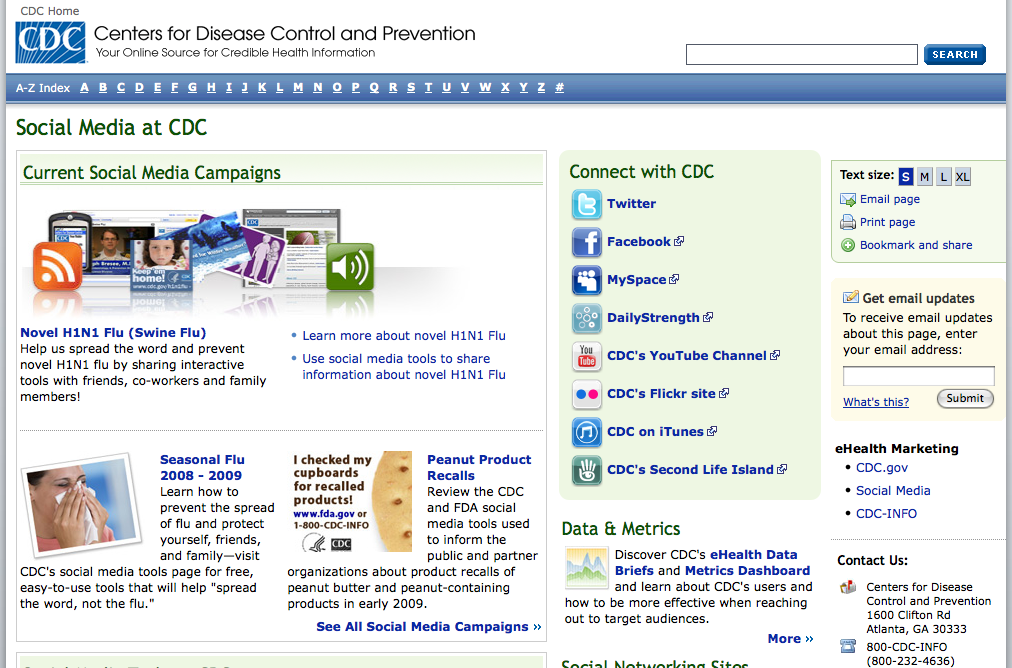
Today, I received a tip that Monday night, CDC.gov launched it’s re-designed Web site–placing a larger emphasis on tools. I think it’s looking pretty good myself–especially the “connect” icons as I’m a large fan of communicating visually. Plus, icons are fun, right? What about you? What are your thoughts?
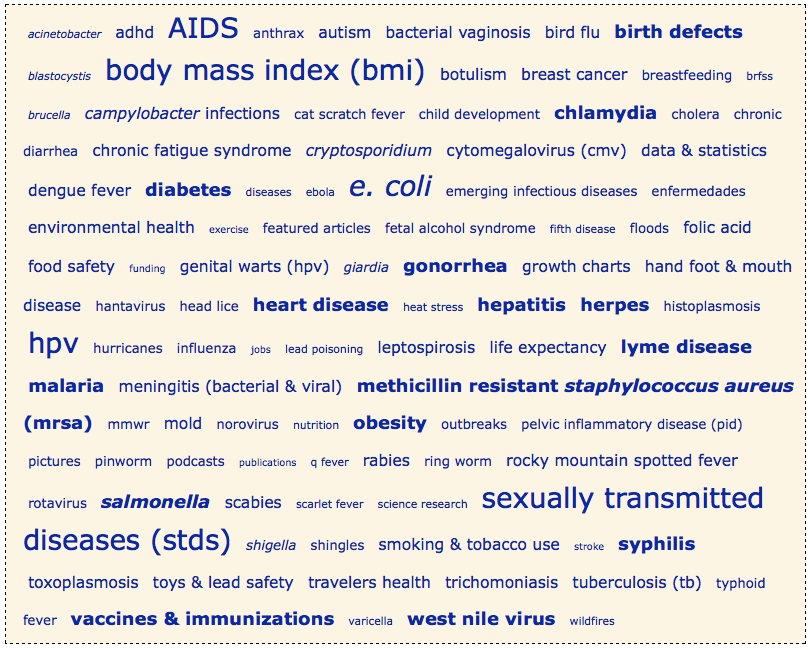
I think one of my all-time favorite features is the CDC.gov Tag Cloud. According to the Web site, “[the] Tag Cloud is an alphabetized list of the most popular search topics on the CDC.gov Web site. The text size of the term shows its relative popularity: bigger terms are more popular than smaller ones.” Even better, each term is click-able for information about that specific topic. Here’s a quick snap shot:
It’s simple. It’s user-generated (via consumer search queries). It offers a quick snapshot to what consumers are concerned about in regards to public health. And, thus, it’s powerful. And, it communicates all this and more, visually. For a visual learner like myself, I give it two thumbs up. I’m envisioning that one day, we might be able to update these types of queries in real-time, though from my own experience, I also know it’s going to be a challenge.
*This post was originally published on the blog of iQ Solutions, a health communications and health IT company. Disclosure, iQ Solutions is also the place of SB’s current employment.
Buzz has been building for a while now as delegates, organizers and presenters make their final preparations for next week’s National Conference on Health Communication, Marketing and Media. Hosted by the CDC’s National Center for Health Marketing and the Office in Enterprise Communications, the conference is packed with discussion about health marketing, health disparities, new frontiers in technology, and collaboration.
iQ Solutions’ own VP of Health Communications, Jennifer Isenberg Blacker, will also be presenting on behalf of the National Institute on Drug Abuse about the use of new technologies to engage youth. Senior VP of Communications and Social Marketing, Kim Callinan, and myself will also be there to cheer her on and gain insights from other presenters, as well as share in community with other health evangelists.
As the iQ team preps for our journey down to Atlanta, I’ve identified five ways to prepare for this year’s CDC Conference:
1. Network.Nedra Weinreich has set up a community on NING, a social network that lets you create your own social community. Already boasting 60+ members, this public platform enables us to network before, during, and after the conference, and is how I learned that the CDC program book was available for download.
2. Follow the conversation. Whether you are signed up for Twitter or not, you can still follow the conversations that are happening there. Using the tool Twitter Search, type in the hashtag “#NCHCMM09” to see what people are saying about the conference. I will also be live-tweeting certain presentations and added insights through IQ Solutions’ new Twitter handle, @iQSolutions.
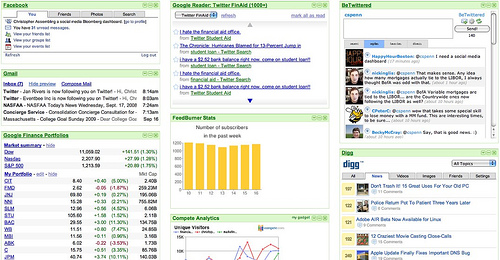
3. Create your own conference dashboard. If you want to be a real superstar like Chris Brogan or Christopher Penn, you can even create your own conference dashboard using iGoogle, Netvibes, or PageFlakes. The dashboard, Brogan explains, is a one-stop online location “to see the elements you might want to know about at a conference…and you can get a fast scan of a lot of data that might prove useful during the event.” Example information may include adding some Twitter search strings to your dashboard, integrating a local map, local clock, local weather information, and much more. See an example below.
4. Meet-Up and Tweet-Up. They say at conferences that some of the best insights and conversations are those you have with colleagues in the hallways or over a great meal. Don’t miss out on these nuggets of opportunity for sharing. Already, CDC’s Justin Williams has organized a Tweet-up for Wednesday, August 12th from 7:30-10:30pm at STATS. This is one more opportunity to gather and meet with colleagues. Already attending are Craig Lefebvre, Andre Blackman, Susannah Fox and myself. Join us.
5. Study. It’s always good to know what you’re getting yourself into. Thus, I recommend checking out the conference’s Web site, seeing who’s who, as well as downloading and reading through the program book. Studying may be overkill, but as I mentioned earlier, this conference is packed with powerful presentations-so much so, that if you’re like me, you’re going to have to prioritize what you can attend. It’s not possible to see every single presenter, even though you’ll want to! (This is another good reason Tip #2 and Tip #3 come in handy-you can catch what you may be missing during concurrent presentations.)
Your Turn: What other tips might you offer to prep for this year’s conference?
I don’t know about you, but this is a question that I make myself answer everyday. Of course, that means that you need to know your main thing. Preparing for marriage over the past year, I’ve found that my main thing has changed. And for me, that’s a good thing because it represents the type of person I want to be, it keeps me more focused, and in in the end, makes me better at everything else.
During one of those moments–you know, the times where you feel like everything is coming at you from all directions and you’re just not sure how you’re going to make it all work–I reached out to my friend Qui, who simply said: “Keep the main thing, the main thing.” Seven simple words that got my head to the ground working, only this time, I was healthier, happier and more productive.
Thus, I want to recognize some colleagues that I know have worked hard this past year to keep the main, the main thing.
Main Thing Keepers
Andre Blackman: When I first met Andre, he was living in DC as a newlywed working to balance life, marriage, work and his pursuits in public health. I’ll never forget the look on his face when I told him I was engaged, and he said: Just you wait, things will change. (How right you were friend, and I’m a better woman for it!) Fast forward to today, he’s living closer to family, moving the public health field forward and leading the charge in his role at RTI. Nice job Andre!
Geoff Livingston: I greatly respect Geoff’s approach to work and life. For one, I like how he integrates his love for social change pursuits into his work–nice balancing. Further, if you read his blog or follow him on Twitter, you often hear him give props to his wife. In fact, this past year, Geoff sold his company and joined the CRT/Tanaka crew. In his blog post announcing the big move, Geoff acknowledged his appreciation and renewed relationship with his wife! Even better–His first descriptor in his Twitter bio for the longest time was “husband.” To me, for someone who is so accomplished in our field, to wake up everyday and say he is a husband first, that deserves mad respect.
Rosetta Thurman: Admittedly, I don’t know Rosetta as well as the other two. But just read her latest post on her own personal revelations when it comes to life, love and the lure of the “career.’ Rosetta, I feel you. I use to deny kids and used to think I was destined to be single–and in fact, I was quite comfortable with that. Now, I’m in love and getting married in a couple months. Thus, I encourage you girl.
Bonus: Seth Godin. I don’t know him personally, but I feel it’s very easy for us in the social media field to get thrown off-course. In this video, Seth shares these sentiments and challenges us with the question: “Where are the real relationships?…Networking is so important when it’s real, and it’s always a useless distraction when it’s fake.”
Your turn. Who do you know that is keeping the main thing, the main thing? And better yet, how are they doing it?
Lights. Camera. Help. is hosting the 1st non-profit film festival July 31-August 2 at the University of Texas at Austin. Founded by David Neff (@DaveIam) and Aaron Bramley (@AaronMSB), the film festival is intended to bring attention to the “films-for-a-cause” genre by showcasing the best PSAs, shorts and feature-length films that nonprofits use to spread the word about their cause.
Out of 140 submissions, the list has been narrowed to 20, and with this line-up, you can understand why I wish I could be in two places at one time. (Bonus: The event is more affordable than most with tickets from $7-$15!)
The “judge’s winner” will receive all the proceeds and donations raised from the event. Kudos to Aaron and David for following their goals and highlighting these moving films. I wish you, all attendees and the non-profit organizations themselves, the very best. Can’t wait to hear how it goes!
Say that title 7-times fast…Recently, I published a post based on my observations about recent “Twitter Follow-and-Fundraise” initiatives and offered “7 Tips” to successfully recruit and retain followers. My purpose in this article was to bring social change communicators together about this increasing communications tactic to share lessons learned and gain valuable insights to apply to future initiatives.
This post grabbed the attention of friend and respected colleague Geoff Livingston, including his colleagues at ChildFund International who, at the time, were in the midst of such a campaign. Graciously, through conversations via email and Twitter, Geoff and I agreed that it’d be great to have ChildFund International share its experience and thoughts as they develop @ChildFund on Twitter, and establish their rejuvenated brand online. Therefore, I invite you to hear from David Hylton (pictured below), the voice behind @ChildFund’s Twitter, in the following interview. Geoff contributed some insights as well.
Alex: What are past Twitter-Follow initiatives that changemakers might look-up to gain insights about how to conduct their own strategy?
Geoff: The one we looked at for @ChildFund was the UNEP tree for a follow campaign. We thought that it was a great strategy to incentivize followers. With that campaign, we (UNEP) had set an ambitious end goal of 10,000 followers, which in retrospect, we think was not realistic given the re-branding of UNEP, our lack of a community manager, and that we were national.
Further, we wanted to give folks something to 1) strive for and 2) to report back to them on so they can see the program in action. So, with UNEP, it was to get us 10k followers. For @ChildFund, we wanted to raise our visibility because as part of our strategy, we had a new name, and we wanted people to know about us and that if they followed us, we would show them specifically what we’re doing with the gifts donated by a donor, especially for Twitter followers. It’s a commitment.
Alex: Using @ChildFund’s latest Twitter strategy as an example, what were your initial objectives and how did the use of Twitter help you meet them?
David: Our primary goal is to 1) launch the ChildFund brand on the Internet and 2) drive awareness of our activity among new stakeholders. We think we’re successfully doing that. Keep in mind that in addition to the opt-in follower,s tens of thousands of people are seeing the ChildFund International brand online.
3) In addition, the changeblogger space has noted that we are online. This was also a critical aspect of our effort. We see other nonprofit bloggers as vital community members that we want to develop relationships with, and we hope we can help some of them in their efforts, too. So from that standpoint, it’s been a successful effort.
4) Lastly, but not the least, we want to develop an international community of people online that care about the well-being (I know it’s not much different, but as part of our new brand, we must be positive) of children. This is the beginning, and really, people are giving us an opportunity to start a conversation with them, but have not yet necessarily committed to that community. We hope to be worthwhile additions to their Twitter experience and to evolve that experience into something more meaningful and rewarding.
Alex: How did @ChildFund go about promoting its Twitter-follow initiative?
David: We hired CRT/Tananka to develop the strategy, and then used Geoff Livingston to be an initial voice for us. Given a very limited budget, we thought getting someone who was established with an existing community, and some experience dealing with bloggers was the best way to go. And Geoff did a lot with a very limited amount of time and resources available to him.
Alex: We know it’s only been a few days, but what are some initial results of the @ChildFund campaign on Twitter? Overall?
David: We’ll probably have helped out six or seven African communities and their children by week’s end. By the end of the campaign we expect it will be in the neighborhood of ten communities. That in itself is great. We want to be up front that the items will be mailed at the end of the campaign. And once the items are received, we’re going to post about how the items impact the recipients lives. We want you to see how the money is used and how just a little goes a long way. More importantly, is the new community members we are developing, all the awareness of the new mission and brand name and ChildFund’s work with children. Plus, people will get to see our work in action AND participate even further as other elements of our social media effort continues, including the hire of our community manager. This was exactly the right start to something we see as an ongoing activity.
Alex: In my initial post, I listed “7 Tips” for changemakers to consider if they want to create their own Twitter-follow strategy for their organization. I recognize different organizations have different needs, roadblocks, etc., but what additional tips might you recommend others consider?
David: The seventh follow-up tip is critical. We’re not just trying to get a number count for Twitter followers, we’re trying to build something – a relationship. In that regard, we have a long-term plan in mind.
The other thing we’d add is to put a real voice behind the Twitter account. Who wants to follow someone and the only communication they receive is asks for donations and links? Even organizations have people working for them. Make sure a real person is working there and that they can interact with their followers freely.
And for those who are following and supporting us as sponsors or donors and decide they want to engage further with others, we’ve created a section on the ChildFund Web site that provides that opportunity.
Alex: Twitter is Twitter. How can changemakers increase awareness of their efforts outside of Twitter?
David: One of the things you’ll notice is that we’ll start referring to our blog, or our Facebook page, or videos to report back to the community. Real stakeholders who care about us will want more information and have deeper dialogue. That’s where the real social media effort begins, and we look forward to having those conversations with our core stakeholders. And from there, they can get even further involved if they choose to.
The key is if “they choose to.” By providing opportunities to opt in and permission to engage further via links to other media, a true relationship is forged. And that’s how you get beyond 140 characters.
Alex: Thank you David and ChildFund for your willingness to share with us fellow changemakers. I wish you the best in your endeavours and will be sure to stay posted as I can see just from a quick scan of the new Web site (ps-I highly recommend checking it out based on design alone) that you have many more great initiatives, stories and real change programs in the works. Props to Geoff as well for coordinating and recommending such a great idea!
Mass publishing. Did you know this is accomplishable through blogs? This type of experimentation (or application) of guest posting took place earlier this year when Max Gladwell published 10 Ways to Change the World through Social Media, and it was simultaneously published on over 80+ blogs. Today is part two. *Know of other examples of “mass” publishing (i.e. Blog Action Day, Bloggers Unite, or others)? Feel free to share in the comments.*
Social media is about connecting people and providing the tools necessary to have a conversation. That global conversation is an extremely powerful platform for spreading information and awareness about social causes and issues. That’s one of the reasons charities can benefit so greatly from being active on social media channels. But you can also do a lot to help your favorite charity or causes you are passionate about through social media.
Below is a list of 10 ways you can use social media to show your support for issues that are important to you. If you can think of any other ways to help charities via social web tools, please add them in the comments. If you’d like to retweet this post or take the conversation to Twitter or FriendFeed, please use the hashtag #10Ways.
1. Write a Blog Post
Blogging is one of the easiest ways you can help a charity or cause you feel passionate about. Almost everyone has an outlet for blogging these days — whether that means a site running WordPress, an account at LiveJournal, or a blog on MySpace or Facebook. By writing about issues you’re passionate about, you’re helping to spread awareness among your social circle. Because your friends or readers already trust you, what you say is influential.
You should also consider taking part in Blog Action Day, a once a year event in which thousands of blogs pledge to write at least one post about a specific social cause (last year it was fighting poverty). Blog Action Day will be on October 15 this year.
2. Share Stories with Friends
Another way to spread awareness among your social graph is to share links to blog posts and news articles via sites like Twitter, Facebook, Delicious, Digg, and even through email. Your network of friends is likely interested in what you have to say, so you have influence wherever you’ve gathered a social network.
You’ll be doing charities you support a great service when you share links to their campaigns, or to articles about causes you care about.
3. Follow Charities on Social Networks
In addition to sharing links to articles about issues you come across, you should also follow charities you support on the social networks where they are active. By increasing the size of their social graph, you’re increasing the size of their reach. When your charities tweet or post information about a campaign or a cause, statistics or a link to a good article, consider retweeting that post on Twitter, liking it on Facebook, or blogging about it.
Following charities on social media sites is a great way to keep in the loop and get updates, and it’s a great way to help the charity increase its reach by spreading information to your friends and followers.
You can follow the Summer of Social Good Charities:
Another way you can show your support for the charities you care about is to rally around them on awareness hubs like Change.org, Care2, or the Facebook Causes application. These are social networks or applications specifically built with non-profits in mind. They offer special tools and opportunities for charities to spread awareness of issues, take action, and raise money.
It’s important to follow and support organizations on these sites because they’re another point of access for you to gather information about a charity or cause, and because by supporting your charity you’ll be increasing their overall reach. The more people they have following them and receiving their updates, the greater the chance that information they put out will spread virally.
5. Find Volunteer Opportunities
Using social media online can help connect you with volunteer opportunities offline, and according to web analytics firm Compete, traffic to volunteering sites is actually up sharply in 2009. Two of the biggest sites for locating volunteer opportunities are VolunteerMatch, which has almost 60,000 opportunities listed, and Idealist.org, which also lists paying jobs in the non-profit sector, in addition to maintaining databases of both volunteer jobs and willing volunteers.
For those who are interested in helping out when volunteers are urgently needed in crisis situations, check out HelpInDisaster.org, a site which helps register and educate those who want to help during disasters so that local resources are not tied up directing the calls of eager volunteers. Teenagers, meanwhile, should check out DoSomething.org, a site targeted at young adults seeking volunteer opportunities in their communities.
6. Embed a Widget on Your Site
Many charities offer embeddable widgets or badges that you can use on your social networking profiles or blogs to show your support. These badges generally serve one of two purposes (or both). They raise awareness of an issue and offer up a link or links to additional information. And very often they are used to raise money.
Mashable’s Summer of Social Good campaign, for example, has a widget that does both. The embeddable widget, which was custom built using Sprout (the creators of ChipIn), can both collect funds and offer information about the four charities the campaign supports.
7. Organize a Tweetup
You can use online social media tools to organize offline events, which are a great way to gather together like-minded people to raise awareness, raise money, or just discuss an issue that’s important to you. Getting people together offline to learn about an important issue can really kick start the conversation and make supporting the cause seem more real.
As mentioned, blog posts are great, but a picture really says a thousand words. The web has become a lot more visual in recent years and there are now a large number of social tools to help you express yourself using video. When you record a video plea or call to action about your issue or charity, you can make your message sound more authentic and real. You can use sites like 12seconds.tv, Vimeo, and YouTube to easily record and spread your video message.
Last week, the Summer of Social Good campaign encouraged people to use video to show support for charity. The #12forGood campaign challenged people to submit a 12 second video of themselves doing something for the Summer of Social Good. That could be anything, from singing a song to reciting a poem to just dancing around like a maniac — the idea was to use the power of video to spread awareness about the campaign and the charities it supports.
If you’re more into watching videos than recording them, Givzy.com enables you to raise funds for charities like Unicef and St. Jude’s Children’s Hospital by sharing viral videos by e-mail.
9. Sign or Start a Petition
There aren’t many more powerful ways to support a cause than to sign your name to a petition. Petitions spread awareness and, when successfully carried out, can demonstrate massive support for an issue. By making petitions viral, the social web has arguably made them even more powerful tools for social change. There are a large number of petition creation and hosting web sites out there. One of the biggest is The Petition Site, which is operated by the social awareness network Care2, or PetitionOnline.com, which has collected more than 79 million signatures over the years.
Petitions are extremely powerful, because they can strike a chord, spread virally, and serve as a visual demonstration of the support that an issue has gathered. Social media fans will want to check out a fairly new option for creating and spreading petitions: Twitition, an application that allows people to create, spread, and sign petitions via Twitter.
10. Organize an Online Event
Social media is a great way to organize offline, but you can also use online tools to organize effective online events. That can mean free form fund raising drives, like the Twitter-and-blog-powered campaign to raise money for a crisis center in Illinois last month that took in over $130,000 in just two weeks. Or it could mean an organized “tweet-a-thon” like the ones run by the 12for12k group, which aims to raise $12,000 each month for a different charity.
In March, 12for12k ran a 12-hour tweet-a-thon, in which any donation of at least $12 over a 12 hour period gained the person donating an entry into a drawing for prizes like an iPod Touch or a Nintendo Wii Fit. Last month, 12for12k took a different approach to an online event by holding a more ambitious 24-hour live video-a-thon, which included video interviews, music and sketch comedy performances, call-ins, and drawings for a large number of prizes given out to anyone who donated $12 or more.
Bonus: Think Outside the Box
Social media provides almost limitless opportunity for being creative. You can think outside the box to come up with all sorts of innovative ways to raise money or awareness for a charity or cause. When Drew Olanoff was diagnosed with cancer, for example, he created Blame Drew’s Cancer, a campaign that encourages people to blow off steam by blaming his cancer for bad things in their lives using the Twitter hashtag #BlameDrewsCancer. Over 16,000 things have been blamed on Drew’s cancer, and he intends to find sponsors to turn those tweets into donations to LIVESTRONG once he beats the disease.
Or check out Nathan Winters, who is biking across the United States and documenting the entire trip using social media tools, in order to raise money and awareness for The Nature Conservancy.
The number of innovative things you can do using social media to support a charity or spread information about an issue is nearly endless. Can you think of any others? Please share them in the comments.
About the “10 Ways” Series
The “10 Ways” Series was originated by Max Gladwell. This is the second simultaneous blog post in the series. The first ran on more than 80 blogs, including Mashable. Among other things, it is a social media experiment and the exploration of a new content distribution model. You can follow Max Gladwell on Twitter.
Those of us who follow Beth Kanter’s blog about non-profits and technology may have noticed a great experiment (whether she meant it to be or not) on guest posting. As Beth and her family made the move to California, Beth invited non-profit, social change and do-good members of the blogosphere to guest post on her blog with their best posts from the past.
People like Amy Sample Ward, Britt Bravo, Geoff Livingston, Nancy Schwartz, Stacey Monk and others. And yesterday, my own post from last October on the “Cool Factor About Mobile” was also cross-posted on Beth’s blog. To me, this experiment has blossomed with success. It’s added color to our blogosphere, raised voices and increased the camaraderie of the folks in this space.
So, thank you Beth Kanter, not only for the opportunity to share in your space, but also for trying out this guest posting experiment. Look forward to your shared insights and revelations this series has generated (*Tip: If you haven’t checked out Beth’s blog yet, I highly encourage it.)
What do you think? What are your thoughts about guest posting? Stay tuned for tomorrow’s “Guest Posting Part Duex” as another guest post experiment is revealed.
Follow @NameYourNonProfit and you could feed 5 villages, save 1000 Trees and create wind energy. Sounds great right? It seems that online, in the social change arena, this seems to be the new infomercial. I’m all for it–if it brings success. And even further–is it affecting real change? Therefore, let’s break it down.
From my own observations of these initiatives, here’s what I have to offer to your organization if you’re working on a “follow-and-fundraise” plan:
Wait. Join Twitter first and gain a solid, respectable following according to your organization’s side and market share of the issue at hand. This way, when you make your “call to follow,” it won’t be an empty room you are inviting people to.
Set realistic and attainable benchmarks. This will motivate potential Twitter followers to support your cause and spread the word to their own networks. 500,000 new followers, when you are only at 300, might seem a bit daunting and dis-enfranchise people early in the game.
Mirror realistic rewards. Similarly, if you want to gain 500,000 followers to merely plant one tree is a bit disheartening. Yes, planting one tree any time is a good thing. However, that’s a lot of work and a lot of people to recruit for one tree. Make the effort worth it.
Extend the initiative. So you are working to generate a following and spread the word about a particular event/issue. Don’t stop at that. Extend your overall strategy to incorporate or integrate Twitter into the overall strategy. Or, extend Twitter to off-line events by hosting live-events. Either way, make the message and the action live beyond the technology.
Keep momentum. Okay, I’m following you today. But who says I’ll keep following you tomorrow? Or even a month from now? Provide fresh, timely and relevant content that will not only speak to me, but draw me into your mission.
Make it fun. Give me a reason to encourage my friends to follow you as well. In fact, provide me with the words to say. Detail it out–It could be a Twitter meme even. For a made up example, imagine @lovewater wants to recruit followers to build X amount of wells. Here’s an idea: Share the call to action. Tell three people you love them and water, and you want them to join the pool party @lovewater. (I was going to say hot tub–but hey, this isn’t the Bachelorette!)
Follow-up. If I follow you, give a shout out. Or, keep me updated with how your progress is coming. Have you achieved your goals? What were the results? How can I help or get involved more? Think of the person hitting the “follow” button as the bite. What are you going to do to reel in the fish?
Don’t get me wrong. I’m happy to participate in these campaigns. After all, it’s at low cost to me, the end-consumer. My main point is that I just want these initiatives to be better and the experience to be greater–and overall, I’m wondering why, if it is a low cost, does it seem to not always work?
What other tips would you suggest, and what are your own observations for these calls to action?
If your organization has implored this strategy, what were the results, lessons learned or key take aways that we can all learn from?
I’m no expert on the Iran situation. But, I do know when a video has that extra powerful “umph.” Talk about responding to current events (Michael Jackson), harnessing in on emotion, and making a statement through visual storytelling.
Have you seen this video of the events in Iran set to the music of Michael Jackson’s “They Don’t Care About Us” yet? What are your thoughts?
(One more tip: Jocelyn Harmon, in her latest post, also talks about how the Sierra Club recently leveraged ‘timeliness’ in one of its new initiatives as well.)
We all like solutions, right? We’ve heard them talked about, seen some of them unfulfilled or seen them not live up to their potential. But all the trials and errors mean that much more when a solution works. I invite you to read Barack Obama’s remarks about the Social Innovation Fund from earlier today.
The Social Innovation Fund is a proposed solution to identify the most promising, results-oriented non-profit programs and expand their reach throughout the country. The Fund has four main objectives, including:
Catalyzing partnerships between the government and nonprofits, businesses and philanthropists to make progres on the President’s policy agenda
Indentifying and supporting the rigorous evaluation and scaling of innovative, promising ideas that are transforming communities like, for example, Harlem Children’s Zone, Youth Villages, Nurse-Family Partnership, and Citizen Schools.
Support greater civic participation through new media tools
Promote national service.
In sum, Pres. Obama is looking for solutions, and he’s looking across the walls and barriers of private, public, non-profit, individual and organizational groups:
“So all of this represents a new kind of partnership between government and the non-profit sector. [love that!] But I can tell you right now, that partnership isn’t complete, and it won’t be successful, without help from the private sector. [even better!] And that’s why I’m glad that there are some deep pockets in the audience here — foundations, corporations, and individuals. You need to be part of this effort, as well. And that’s my challenge to the private sector today. Our non-profits can provide the solutions.” [and so can our social marketeers!]
******
Thought 1: What are the evaluative benchmarks for “success” going to be? As, those who are familiar with the debate around libertarian paternalism, this will depend largely on how and WHO defines “success.”
Thought 2: My second thought and gut-wrenching ask was: Have the people involved in this heard of the solutions that social marketing can offer? In the remarks, Obama references individuals working for great changes, telling of their success. What if these success stories came from social marketeers? What if social marketing was applied to some of the very issues the Social Innovation Fund might examine? My mind is boggling with the possibilites–and solutions!
To Start: In response to Thought #2, I would like to highlight that social marketing already is, and can be a solution. Yesterday, I finally received my copy of Philip Kotler and Nancy Lee’s book, “Up and Out of Poverty.” This book examines the issue of poverty and all past and current solutions being sought to solve this issue. Then, the authors offer up social marketing as a solution. I can’t give much more than that because I am just about to crack it open myself. But, I have been waiting for this book. Imagine, a series of social marketing books that looks at real issues, BIG issues, and applies social marketing as a solution. Perhaps, there in lies the rub, some food for thought for the Social Innovation Fund committee. Perhaps, if we had an organization or an entity (hint, hint, join the 260+ others who’ve signed the pledge), then we could get some folks to chat.
I’d like to borrow some words from Pres. Obama himself to thank you for all the work you do in helping us clutivate and discover strong solutions:
“I want to thank all of you here today for everything you’re doing to find new solutions to some of our oldest, toughest problems. I know what you do is not easy.”






 Social media provides almost limitless opportunity for being creative. You can think outside the box to come up with all sorts of innovative ways to raise money or awareness for a charity or cause. When Drew Olanoff was diagnosed with cancer, for example, he created
 Follow @NameYourNonProfit and you could feed 5 villages, save 1000 Trees and create wind energy. Sounds great right? It seems that online, in the social change arena, this seems to be the new infomercial. I’m all for it–if it brings success. And even further–is it affecting real change? Therefore, let’s break it down.